
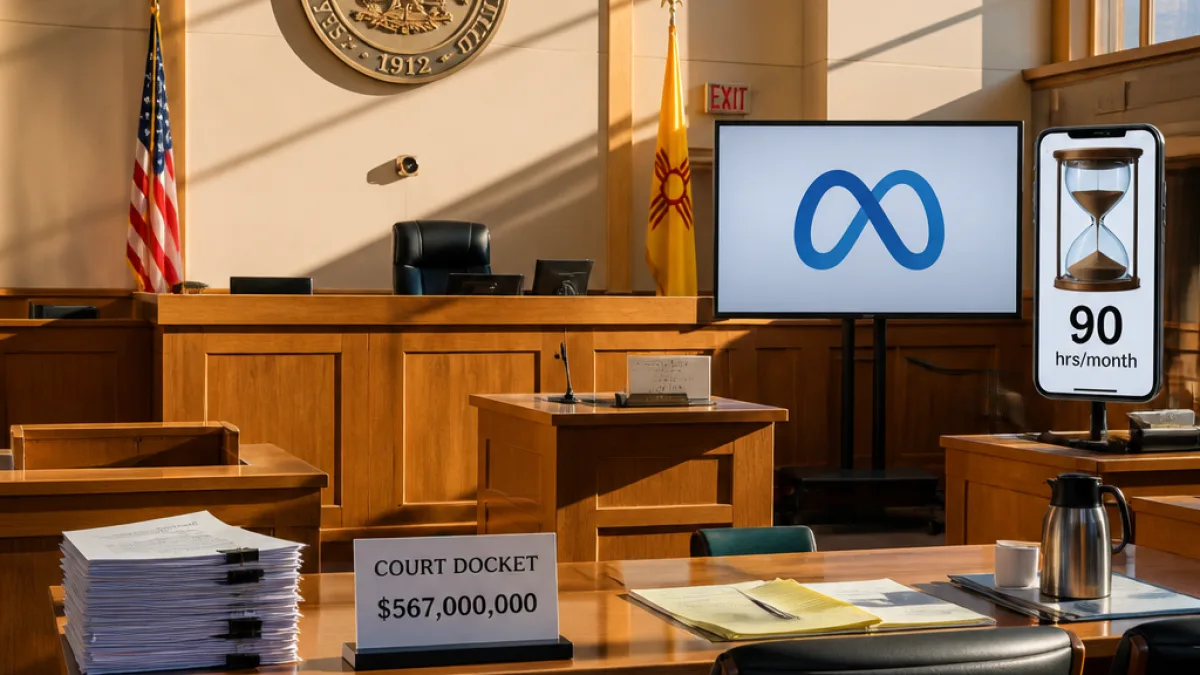
A New Mexico judge on Thursday ordered sweeping new protections for children who use Meta’s Facebook and Instagram platforms and fined the company $567 million, describing the mental-health harms he found as akin to industrial pollution.
Court prescribes limits, warnings and AI restrictions
Judge Bryan Biedscheid issued the ruling in the second phase of a lawsuit the state brought against Meta, saying the psychological damage to child users is visible and requires a judicially imposed remedy. The order requires several new safety measures that would apply to users under 18 living in New Mexico, including a monthly time limit, restrictions on certain artificial intelligence features and mandatory warnings on the platforms.
- Time limits: A cap of 90 hours per month for users under 18.
- AI chatbot restrictions: Limits on how certain AI tools can interact with minors.
- Mandatory warnings: Notices to users and parents about risks and harms.
The judge’s remedies were framed as steps to "clean up" what he described as the byproducts of Meta’s design choices, likening social apps to factories whose output has created public-health consequences. How readily the ordered features can be implemented — and how effective they will be in preventing mental-health harms — remains uncertain, legal observers said.
Financial penalties build on earlier jury award
The new $567 million fine is in addition to $375 million in civil penalties that a jury ordered in March after finding Meta had knowingly harmed children’s mental health and concealed information about child sexual exploitation on its platforms. Taken together, the two rulings amount to $942 million in state-imposed financial penalties.
| Penalty | Amount |
|---|---|
| March jury civil penalties | $375,000,000 |
| Judge Biedscheid’s fine | $567,000,000 |
| Total | $942,000,000 |
Scope, timing and enforceability questioned
The judge’s orders would apply only to children who live in New Mexico, and the ruling did not impose an immediate deadline for Meta to adopt the measures. Meta has said it will appeal.
Implementation hinges on strong age-verification methods, a technical and legal challenge that the judge acknowledged. How the company would verify ages without intruding on privacy or relying on easily falsified data remains an open question, as does the enforceability of a state-level mandate on a global company.
Meta responds, vows to fight ruling
Meta issued a statement saying the company strives to keep people safe and has been transparent about the difficulties of identifying and removing harmful actors and content. The company disputed the characterization of its record and signaled it will pursue an appeal.
“We remain confident in our record of protecting teens online and will continue to defend ourselves against claims that misrepresent the facts,” the company said.
Legal and political ripple effects
Advocates who brought the case say the ruling could serve as a blueprint for other states and courts seeking to hold social-media companies accountable for harms to minors. New Mexico Attorney General Raúl Torrez, who led the prosecution, has publicly pushed for stronger protections for children online.
But legal analysts caution that the ruling faces likely appeals and that a patchwork of state orders could create conflicts with federal law, interstate commerce principles and platform architectures. Courts elsewhere will watch carefully to see whether New Mexico’s approach survives appellate review and whether other states replicate the remedies.
What this means for parents and users in New Mexico
For now, the orders apply only to minors in New Mexico and are not yet in force while the company pursues legal remedies. Parents in the state looking to reduce risks may consider existing parental controls, monitoring tools and in-app privacy and screen-time settings while courts determine whether the judge’s requirements will take effect.
The case reflects growing pressure on technology companies from state governments, juries and regulators to address the potential harms of their platforms to young users. How courts, policymakers and companies navigate age verification, technical feasibility and constitutional limits will shape the next phase of regulation of online platforms.
Diego Salazar is a state correspondent for WE NEWS covering legal affairs and technology policy in New Mexico.

















