
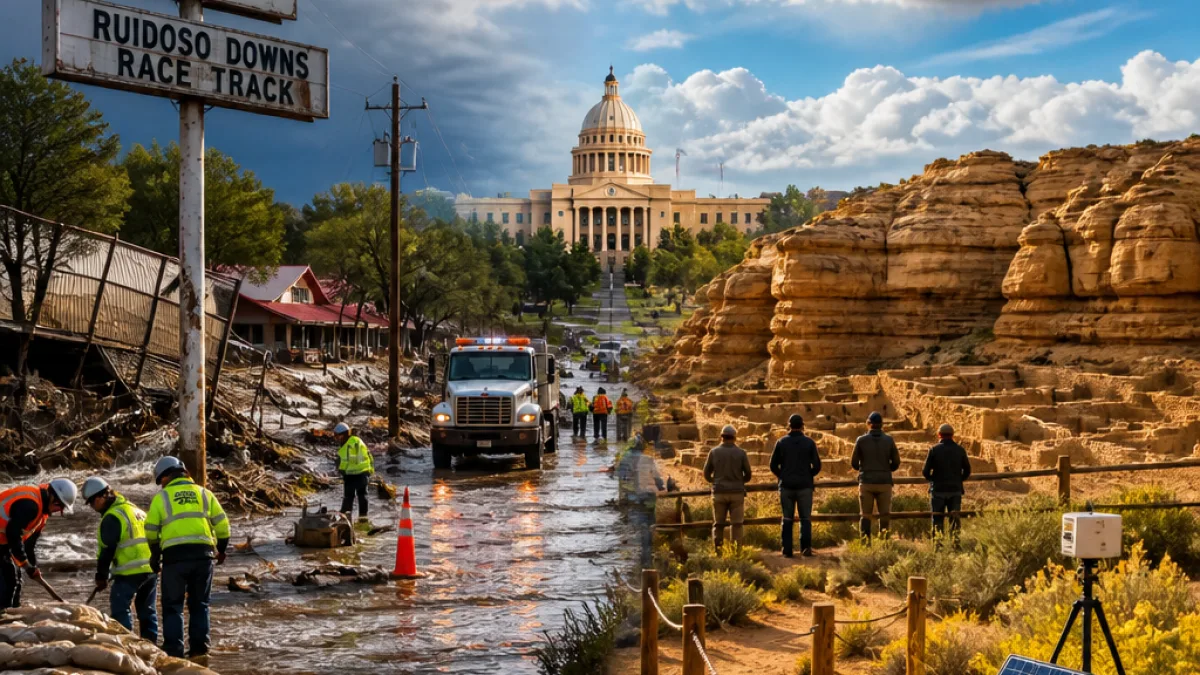
ALBUQUERQUE — As New Mexico moves toward the Nov. 3 gubernatorial election, former Interior Secretary Deb Haaland and former Rio Rancho Mayor Gregg Hull are sharpening their competing messages, addressing urgent local concerns such as the recent fires and floods that devastated communities like Ruidoso and the stewardship of culturally significant sites such as Chaco Canyon.
Focus on local recovery
Both candidates framed their responses around recovery for communities hit by extreme weather and wildfire, but they emphasized different approaches. Hull, drawing on his experience as a city mayor, highlighted the economic fallout from infrastructure damage, pointing to the flash flooding in Ruidoso and its impact on the town’s racetrack — an economic anchor for the community.
“As a mayor of a city, I understand the direct and immediate impact that these emergencies have on our communities,” Hull said. He argued that restoring economic drivers is essential to helping small towns rebuild.
“When you think about the flash flooding in Ruidoso, it's destroyed their economy because it's destroyed the race track there. And that is a critical, critical economic driver for that community.”
Haaland stressed the human toll and long-term resilience. She said she wants to ensure families and businesses receive the support needed to recover and thrive. Her comments focused on helping local commerce rebound from disasters and on preventing future harm through stronger planning and resources.
Disagreements over Chaco and tribal authority
The candidates also discussed protection of Chaco Canyon, an archaeological and cultural landscape central to regional Indigenous communities. Haaland emphasized federal restrictions she supported while serving as U.S. Interior secretary, noting a protective buffer around the area intended to shield it from extraction and development.
“When I was Secretary, of course we withdrew a 10-mile radius around Chaco to protect it from extractive industry,” Haaland said. “Our President has no bounds and I am going to continue to fight for New Mexico's treasures.”
Hull affirmed the need to safeguard ceremonial sites but emphasized tribal sovereignty, noting that Chaco lies within the Navajo Nation and that sovereign nations should guide decisions affecting their sacred places.
“We do need to protect those ceremonial sites. Those are sacred to the Tribal communities across the state,” Hull said. “Chaco Canyon rests solely on the Navajo Nation. And so these are sovereign nations that we're dealing with.”
Where the candidates overlap and diverge
On disaster response, both candidates emphasized support for affected communities. Their divergence centers on the balance between federal intervention and local or tribal control when it comes to land protection and resource management.
- Disaster recovery: Hull stresses rebuilding economic assets and local leadership; Haaland emphasizes comprehensive aid to families and businesses and prevention.
- Chaco Canyon and tribal sites: Haaland points to federal protections she helped enact; Hull stresses decision-making by sovereign tribal nations.
- Approach to governance: Hull frames his message through municipal experience; Haaland foregrounds federal experience and national-level policy implementation.
The exchange reflects a broader theme of the campaign: how to reconcile state priorities with federal authority and tribal sovereignty on matters that tightly intersect with local economies, cultural preservation and natural-resource policy.
| Issue | Deb Haaland | Gregg Hull |
|---|---|---|
| Ruidoso floods & local recovery | Prioritize aid and long-term resilience for businesses and families | Emphasize restoring economic drivers and immediate municipal-level responses |
| Chaco Canyon protection | Supports federal safeguards, cited a 10-mile withdrawal to limit extractive industry | Supports protection but defers to tribal sovereignty and tribal decision-making |
Campaign context and what’s next
With less than three months remaining before New Mexicans cast ballots, both campaigns are stepping up public outreach across the state. The contrast between Haaland’s federal record and Hull’s local-government experience will continue to shape debates on disaster policy, economic recovery and how to manage culturally significant lands.
Voters in affected communities will be watching how each candidate plans to translate promises into action if elected. Officials and community leaders in places like Ruidoso have pressing questions about funding timelines, rebuilding priorities and measures to reduce future flood risk. Meanwhile, tribal leaders and preservation advocates are assessing how each campaign’s approach could influence long-term stewardship of sacred and archaeological sites.
As the campaign progresses, candidates are likely to face more detailed questioning on implementation specifics — including funding sources, coordination with federal and tribal governments, and timelines for recovery projects — matters that will ultimately shape voter choices this fall.
Reporting for this story included interviews and campaign statements made public during the candidates’ recent appearances. Election Day in New Mexico is Nov. 3.

















