
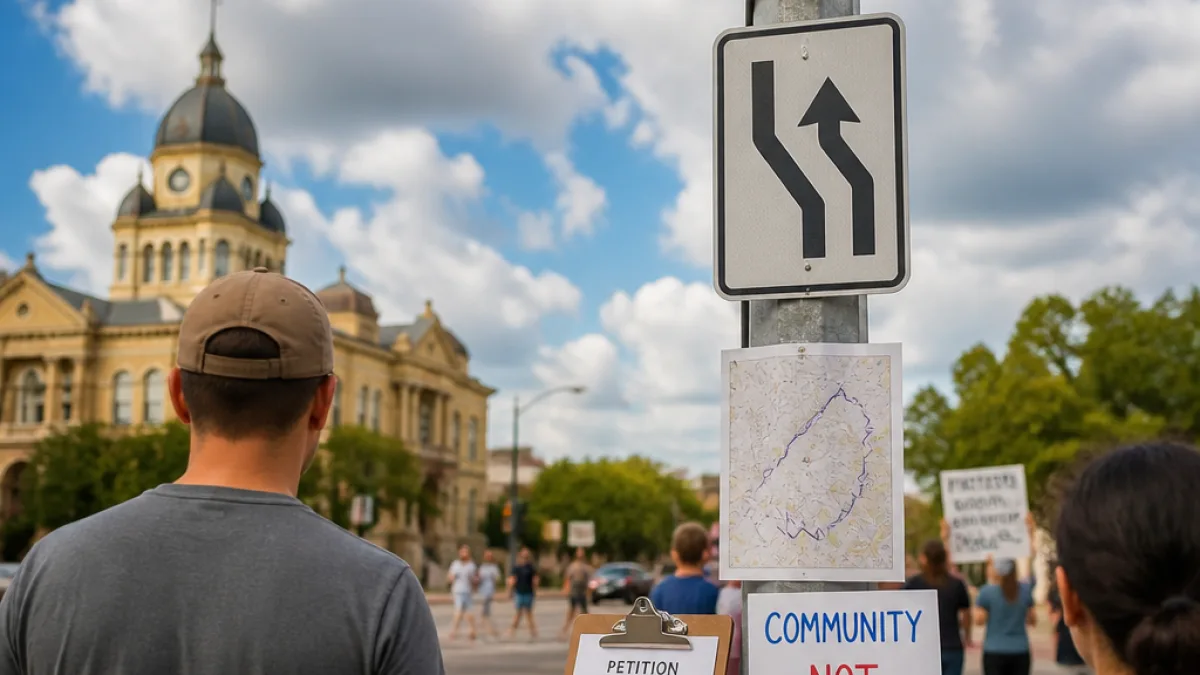
Denton police maintain that automated license-plate readers from Flock Safety are a vital tool in fighting property crime, but a growing group of residents says the cameras amount to mass surveillance and are demanding the city end its contract with the company.
What is in place in Denton
City staff say Denton Police Department controls 10 fixed Flock automated license-plate reader (ALPR) cameras that are positioned on public rights of way in areas bounded by Interstate 35E, Loop 288 and Mayhill and Spencer roads. Those locations were selected because staff said property crimes such as vehicle burglaries and thefts are higher in that area.
| Item | Known figure |
|---|---|
| Flock cameras under Denton PD control | 10 |
| Estimated total Flock cameras in Denton (local activism group) | 61 |
| Signatures on Change.org petition (as of Monday) | Nearly 500 |
Residents organize and question access
Earlier this year, Denton resident Jon Miller began placing signs near Flock cameras that warned people “Flock Camera. Tracking you. Recording you. Reporting you.” The signs included a QR code linking to a Change.org petition that asks city leaders to remove Flock cameras to protect residents’ privacy and civil liberties. The petition had nearly 500 signatures as of Monday.
In public comment to the City Council, residents voiced concerns about how easily the government or private citizens could access data collected by the camera network. A local activist website called DeFlock Denton estimates there are 61 Flock cameras citywide, a figure that includes cameras on private property or systems not operated by Denton police.
“The difference between a private smartphone and mass surveillance is how easy it is for the government to access the data and use it against you, or for citizens to access it without warrants or permission,” a resident told the Denton City Council.
How Flock systems can be used
City staff said other Flock cameras in Denton are privately owned or not under police control. The company offers law enforcement the ability to request direct access to feeds from privately owned cameras at neighborhoods, schools and businesses. Denton police have used information from Flock’s database in criminal investigations: in 2024 they accessed data that included images from privately owned systems to locate stolen vehicles and to find fugitives wanted for aggravated kidnapping.
- Police view: ALPRs are an important investigative tool to recover stolen vehicles and locate suspects.
- Residents' view: The cameras enable mass surveillance, potentially sidestepping warrant requirements and constitutional protections.
- Access concerns: Some feeds are privately owned but can be requested by law enforcement, raising questions about transparency and oversight.
Local debate and possible next steps
The debate in Denton mirrors similar disputes in cities across Texas where residents and civil liberties advocates have challenged the expansion of ALPR networks. At least a handful of community members have addressed the City Council to press their concerns, and the petition drive reflects a growing grassroots effort to press for policy change.
City officials will face decisions about oversight, public access to records, and the balance between privacy and public safety. The issues likely to shape local policy discussions include:
- Whether the city will review or amend its contract with Flock Safety and clarify which cameras are under police control versus privately owned.
- How and when law enforcement may access data from private camera owners, and whether those procedures require warrants or additional safeguards.
- What transparency measures the city will adopt to inform residents about camera locations, data retention, and access logs.
For now, the presence of the cameras and the visible protest campaign have put surveillance policy squarely on the local agenda. City leaders and residents say they expect ongoing public discussion and possible formal review in coming months as the city weighs privacy concerns against the police department’s public-safety rationale.















