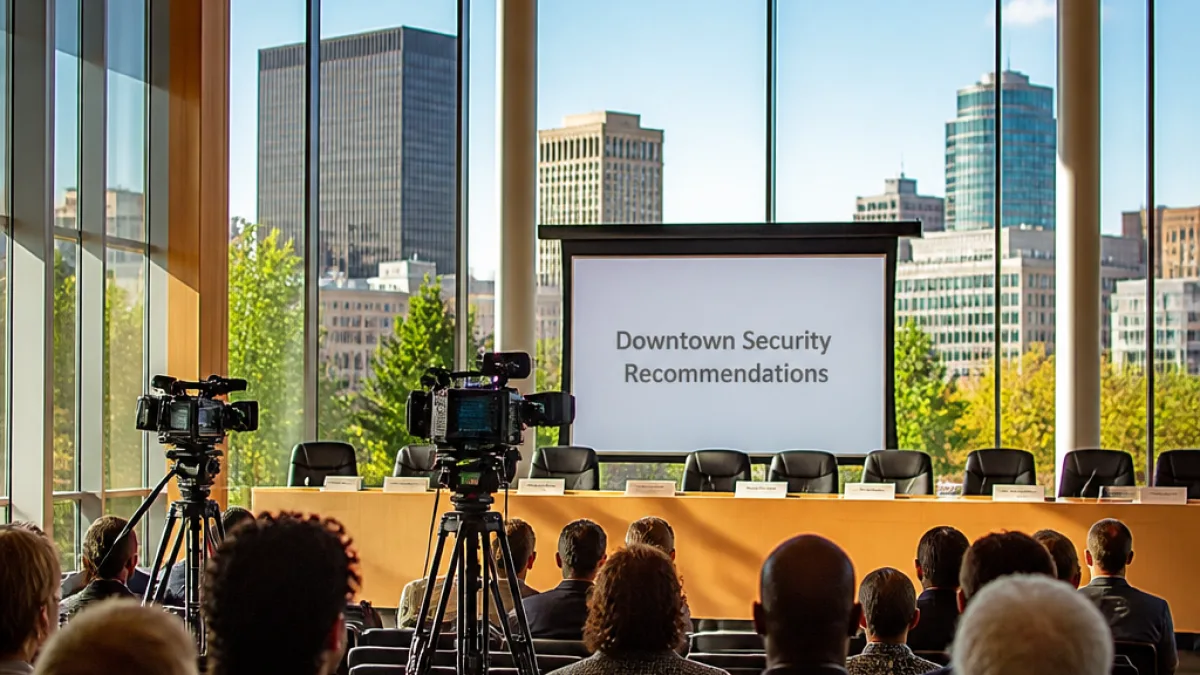
DAYTON — Montgomery County and Dayton city commissioners met Monday at Sinclair College to review recommendations from Congressman Mike Turner’s downtown security working group, marking the first joint commission session between the two governments in a decade.
Meeting brought multiple voices and a central debate
The meeting included presentations from representatives of the working group, which Turner said was formed last year and includes elected officials, business leaders and education experts. Wright State University President Sue Edwards moderated the discussion.
Work group members framed their recommendations around findings from several focused subgroups, including justice and policing, social services, government communication and business, officials said. Republican state representatives Phil Plummer, Andrea White and Tom Young outlined proposals the group developed earlier this year.
Plummer stressed the economic implications of perceptions of safety downtown, saying leaders risk losing investment if people are afraid to visit the central business district. His remarks — echoed by others in the working group — helped crystallize the proposals presented at the session.
“If people are afraid to come downtown because of safety, we're going to lose investments,” Rep. Phil Plummer said.
Recommendations highlighted at the meeting
Presenters highlighted a series of recommendations aimed at bolstering downtown security and coordination. Among the items discussed were:
- Increasing police presence in the downtown corridor.
- Establishing a real-time monitoring system for downtown cameras.
- Creating a special downtown court docket to handle cases arising from the downtown area.
- Strengthening communications between government entities, businesses and social service providers.
During the session, attendees and commissioners emphasized that these recommendations stemmed from multiple subgroups’ work rather than a single individual's agenda. Congressman Turner, a Dayton Republican, described the meeting as a dialogue rather than the presentation of a finalized plan.
Concerns from residents and city leaders about focus
The downtown emphasis drew criticism from some community members who said concentrating resources on the central business district risks leaving neighborhoods without equivalent attention. Tenants’ rights advocate Destiny Brown told the meeting that equity questions persist when investments and safety efforts appear centered on downtown.
“I think there's a perception that people or community members are opposed to downtown investment, and I think … equity is where there is frustration,” Destiny Brown said.
City Commissioner Darryl Fairchild and other local officials underscored that public safety is a citywide issue. Fairchild warned that narrowly focusing on downtown could be “short-sighted,” reflecting concerns voiced by residents who reported a string of crimes in neighborhoods even as some downtown crime metrics have improved.
What the recommendations mean for Dayton
The proposals now move into the local policymaking arena where commissioners and county leaders will have to weigh costs, legal implications and operational logistics. Creating a downtown-specific court docket, for example, would require coordination between municipal, county and possibly state judicial systems; expanding camera monitoring raises questions about funding, oversight and privacy; and increasing police presence downtown would need allocation decisions not only about officers but also about patrol patterns across neighborhoods.
Officials at the meeting did not present a detailed funding plan or a timeline for implementing the working group’s recommendations. The joint session did, however, signal willingness from both commissions to discuss shared approaches to public safety in Dayton.
| Working group subgroup | Primary focus |
|---|---|
| Justice and policing | Law enforcement coordination and court processes |
| Social services | Support networks for vulnerable populations |
| Government communication | Interagency and public information strategies |
| Business | Economic impacts and private-sector partnerships |
Residents who testified at the meeting cited recent violent incidents across the Dayton area — including youth-involved vehicle thefts with firearms and a separate park shooting — as evidence that safety concerns extend beyond downtown. City and county leaders will face community pressure to distribute resources in ways that address both downtown perceptions and neighborhood realities.
The joint meeting was the first between Montgomery County and Dayton city commissioners in 10 years, a fact officials noted as emblematic of the renewed effort to coordinate responses. State Rep. Desiree Tims and state Sen. Willis Blackshear Jr., who represent Dayton and served on the working group, were part of the panel but did not speak during Monday's presentations.
Next steps were not finalized at the session. Commissioners will likely return to the proposals with follow-up discussions about funding, timelines and measures to ensure that any downtown-focused interventions do not leave neighborhoods behind.