
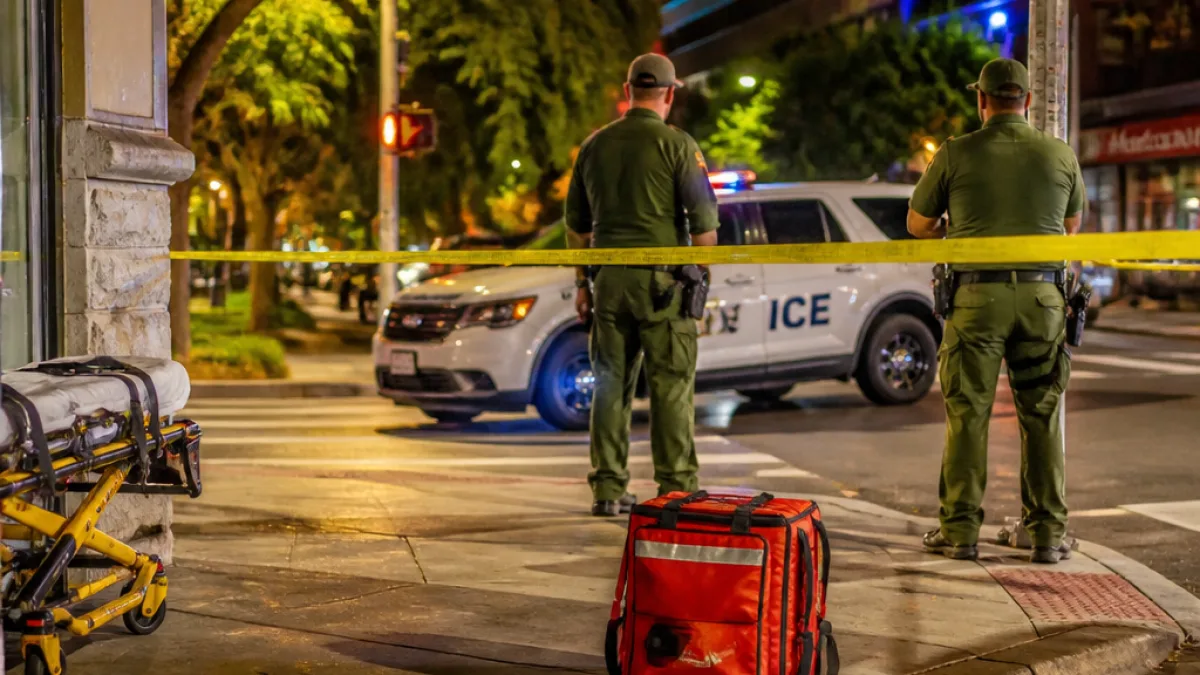
A federal Immigration and Customs Enforcement officer who shot a 28-year-old DoorDash driver in Austin over the weekend was issued a body-worn camera but was not wearing it at the time of the shooting, two Department of Homeland Security officials told NBC News. The incident has prompted questions about federal officer oversight and the medical care provided to the man while in immigration custody.
What officials say happened
Wilber Rafael Garcés Pérez was shot early Sunday afternoon while making deliveries in Austin. The wound left a bullet lodged in his back, according to his attorney. Garcés Pérez was taken to a hospital following the shooting and, about four hours later, transferred into immigration custody at the South Texas ICE Processing Center in Pearsall, Texas, his attorney said.
One ICE officer in the vehicle with the shooter was wearing a body camera; officials said that camera captured partial footage of the incident but did not record the moment the shooting occurred. DHS officials told NBC News it was not clear why the officer who fired his weapon was not wearing the camera he had been issued.
Medical concerns and detention
Garcés Pérez’s attorney, Kate Lincoln-Goldfinch, has publicly described continuing medical problems after the shooting. On social media, she said that by Monday the man began experiencing an inability to move his arm and was taken back to a hospital for several hours before being returned to the detention center. She also asserted that after the detainee spoke at a news conference by phone, staff at the facility removed his tablet, revoked his communication privileges and moved him out of the infirmary into an isolated room with a flat bed that she said could not be adjusted like a medical bed.
“Wilber reports that he was handcuffed, shackled at the ankles, placed in a waist chain,” Lincoln-Goldfinch wrote.
The Department of Homeland Security did not respond to requests for comment about the attorney’s account, nor to questions about the absence of the shooter’s body camera. Local authorities and federal officials have provided limited public detail about the exact sequence and circumstances that led to the shooting.
Political attention and federal policy context
Texas Gov. Greg Abbott, who was traveling out of state on Tuesday, told reporters he was still being briefed on the incident and called the available details "sketchy." His comments came as reporting surfaced that an ICE officer had not been wearing his camera when the shooting took place.
Homeland Security Secretary Markwayne Mullin recently said that all ICE officers would be equipped with body cameras by the end of September, a policy goal intended to increase transparency. The lack of recorded footage from the officer involved in the Austin shooting is likely to intensify scrutiny of that rollout and of agency practices in the field.
Unanswered questions for local residents
- Why was the officer who fired his weapon not wearing the issued body camera?
- What did the partial footage captured by the other officer record, and why does it not show the shooting?
- What medical evaluations and treatment has Garcés Pérez received while in custody, and what oversight is in place for detainee care?
| Event | Reported timing |
|---|---|
| Shooting of Wilber Rafael Garcés Pérez | Early Sunday afternoon |
| Initial hospital visit | Sunday, immediately after shooting |
| Transfer to ICE custody (Pearsall) | About four hours after the shooting |
| Return to hospital for arm mobility issues | Monday afternoon |
Advocates, legal representatives and elected officials have called for transparent release of evidence and prompt answers about detainee care. For Austin residents, the case raises concerns about the operations of federal law enforcement within the city, the effectiveness of body-camera policies and the treatment of people in immigration custody who require medical attention.
WE NEWS will continue reporting on developments as federal and local authorities provide further information, and as attorneys for the man involved pursue details about his treatment and the circumstances of the shooting.















