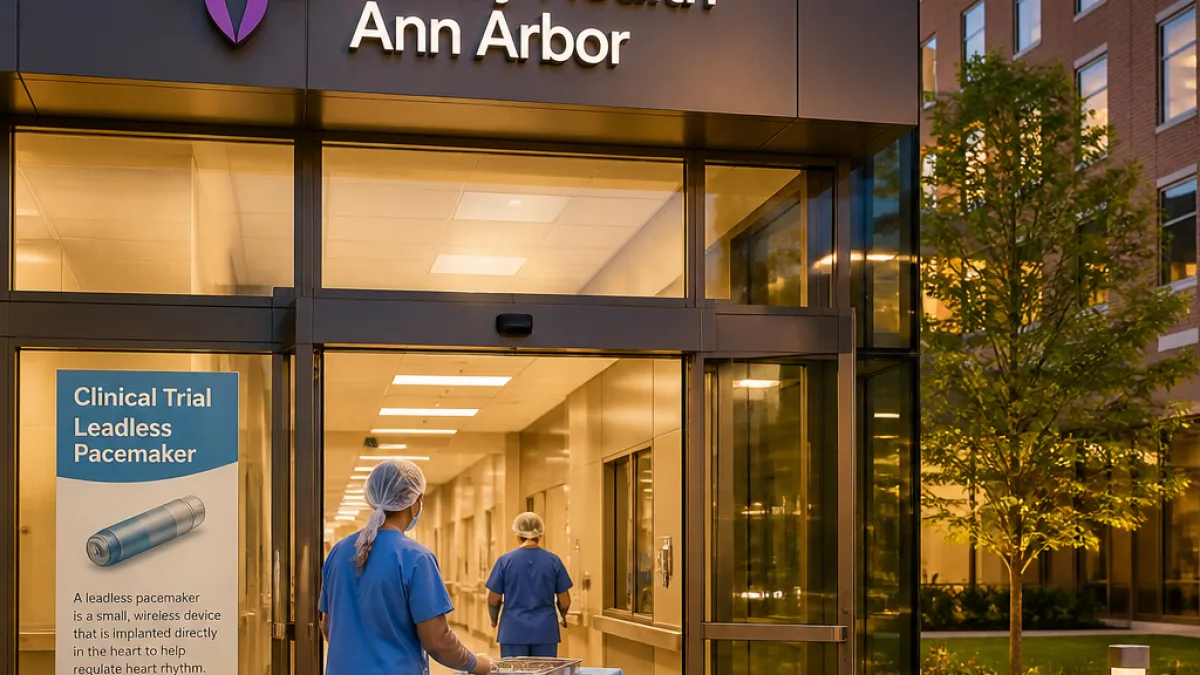
TRINITY HEALTH ANN ARBOR — Trinity Health Ann Arbor announced it performed the Midwest’s first implantation of a next‑generation leadless pacemaker on Aug. 6, participating in a multinational clinical study that aims to evaluate whether the device can safely deliver coordinated pacing without the leads and chest‑wall pocket required by conventional pacemakers.
What the procedure involved
The device used in the procedure, an investigational BIOTRONIK LivIQ leadless pacemaker, is being studied under an FDA Investigational Device Exemption to assess its safety, pacing performance and effects on patient quality of life. Trinity Health said the hospital is the first site in Michigan to take part in the study.
Leadless pacemakers are implanted directly into the heart and remove the need for transvenous leads and a surgically created device pocket beneath the skin. Hospital officials and participating electrophysiologists say that approach can reduce long‑term complications tied to leads, lower infection risk and improve patient comfort.
“Advances in electrophysiology are happening at a remarkable pace, and we’re proud to be at the forefront of it all, offering innovative therapies that can improve both quality of life and longevity for our patients,”
said Dr. Jihn D. Han, electrophysiologist and medical director of Trinity Health Ann Arbor’s Electrophysiology Lab. Dr. Mohammad‑Ali Jazayeri, medical director of the Cardiac Device Clinic at Trinity Health Ann Arbor, described leadless pacing as a less invasive evolution of pacemaker therapy.
Scope of the trial and local role
The clinical study will enroll a total of 325 participants across centers in the United States, Europe and Asia. Trinity Health’s facility on McAuley Drive in Superior Township is one of the U.S. sites taking part in the evaluation.
- Device: BIOTRONIK LivIQ leadless pacemaker (investigational)
- Study goal: Evaluate safety, pacing performance and impact on quality of life
- Planned enrollment: 325 people across multiple international centers
- Local milestone: First implant in the Midwest; first Michigan study site
The hospital release emphasized that the study explores whether the investigational technology can enable the heart’s upper and lower chambers to work together more naturally through enhanced sensing capabilities while maintaining the benefits of leadless systems.
Why it matters to Ann Arbor patients
For residents of Ann Arbor and Washtenaw County, participation by a local hospital in the trial means earlier access to advanced therapies that otherwise might be available only at distant academic centers. If the device proves safe and effective in the study, it could broaden options for patients who require pacing but want to avoid the potential complications associated with traditional pacemaker leads and subcutaneous pockets.
Physicians involved stressed both patient safety and the research implications. The study’s multinational design is intended to provide data across diverse patient populations, while local enrollment allows clinicians at Trinity Health Ann Arbor to contribute to — and learn from — emerging advances in cardiac electrophysiology.
| Item | Detail |
|---|---|
| Study device | BIOTRONIK LivIQ leadless pacemaker (investigational) |
| Study status | FDA Investigational Device Exemption clinical study |
| Total enrollment target | 325 participants (U.S., Europe, Asia) |
| Local site | Trinity Health Ann Arbor, Superior Township (McAuley Drive) |
Hospital leaders framed the implantation as both a patient care achievement and a research milestone. As with all investigational devices, outcomes from the trial will guide regulatory review and future availability. Trinity Health did not release patient‑specific details about the Aug. 6 implant.
Cardiac pacing technology has evolved significantly in recent years, and leadless systems are a notable part of that shift. Trinity Health Ann Arbor’s involvement places Ann Arbor in the network of centers testing the next wave of devices intended to improve the lives of people with heart rhythm disorders.