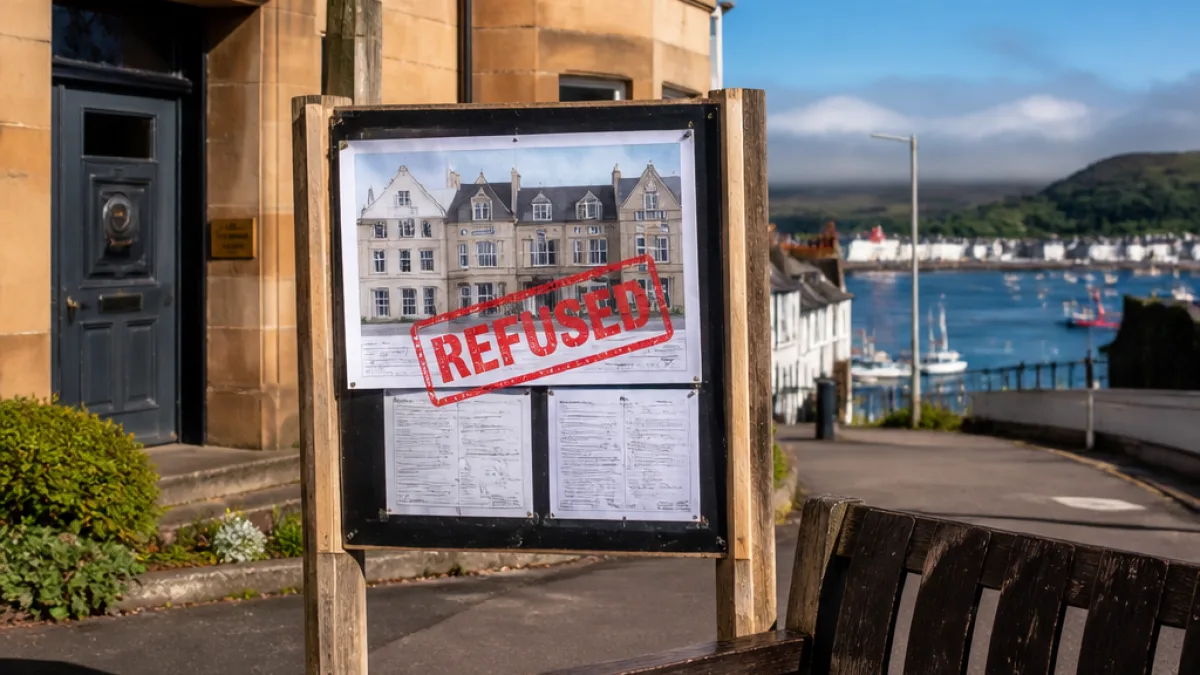
Argyll and Bute Council has refused planning permission for a proposal to create staff accommodation at Corran House on Victoria Crescent in Oban. The application was submitted by CHMD Ltd and was accompanied by an artist’s impression of the proposed accommodation units, credited to Bracewell/Argyll and Bute Council.
Decision and immediate context
The council’s refusal halts plans to convert or develop the Corran House site for use as personnel housing for a local hostel. The formal rejection means the applicant will either need to revise and resubmit the proposal, seek to appeal the decision through the statutory routes, or abandon the project.
"Argyll and Bute Council has turned down the application for planning permission by CHMD Ltd for Corran House in the town’s Victoria Crescent."
The publicly available information about the case is limited to the fact of the decision, the identity of the applicant and the location. An artist’s impression showing the proposed accommodation units was supplied as part of the submission and is attributed to the applicant and the council.
What this means for Oban
Oban, as a principal service town for the west Highlands and a tourist destination, has an ongoing need for staff accommodation linked to its hospitality and visitor economy. Planning decisions affecting conversions or new-build housing for workers can therefore have wider local consequences.
- Housing supply: refusal reduces the immediate prospect of additional staff housing at a central Oban site.
- Tourism workforce: hostels and other visitor accommodations often rely on nearby staff housing to fill seasonal roles.
- Planning precedent and design: the council’s decision will be read by other applicants and architects working in the town centre.
While the council’s precise reasons for refusal have not been published alongside the headline of the decision, such outcomes commonly relate to considerations including use-class change, impact on local amenity, design or access concerns. Any revised application would need to address the council’s planning standards and policy framework.
Next steps and options for the applicant
Following refusal, applicants typically have several options: submit an amended application addressing reasons for refusal; lodge an appeal to the Scottish Government’s planning appeals body; or explore alternative sites or forms of accommodation. The limited public detail means it is not yet clear which route CHMD Ltd will pursue.
Local interest in the outcome is likely because central Oban sites are finite and any proposal to repurpose buildings on Victoria Crescent will attract scrutiny from residents, businesses and visitors concerned about the balance between housing, tourist accommodation and town-centre character.
| Item | Detail |
|---|---|
| Site | Corran House, Victoria Crescent, Oban |
| Applicant | CHMD Ltd |
| Decision | Refused by Argyll and Bute Council |
| Supporting material | Artist’s impression (credited to Bracewell/Argyll and Bute Council) |
Argyll and Bute Council’s planning records and the applicant’s planning agent are the primary sources for full documentation, including the council’s formal reasons for refusal. Those documents will set out the material considerations that informed the decision and identify any deficiencies the applicant would need to remedy in a resubmission.
For residents and businesses in Oban, the ruling is a reminder of the competing pressures on town-centre sites and the importance of the planning system in shaping how the town meets its housing and economic needs. Any future amended proposal for Corran House will be subject to the usual consultation and decision-making processes that give the local community the opportunity to review and comment.