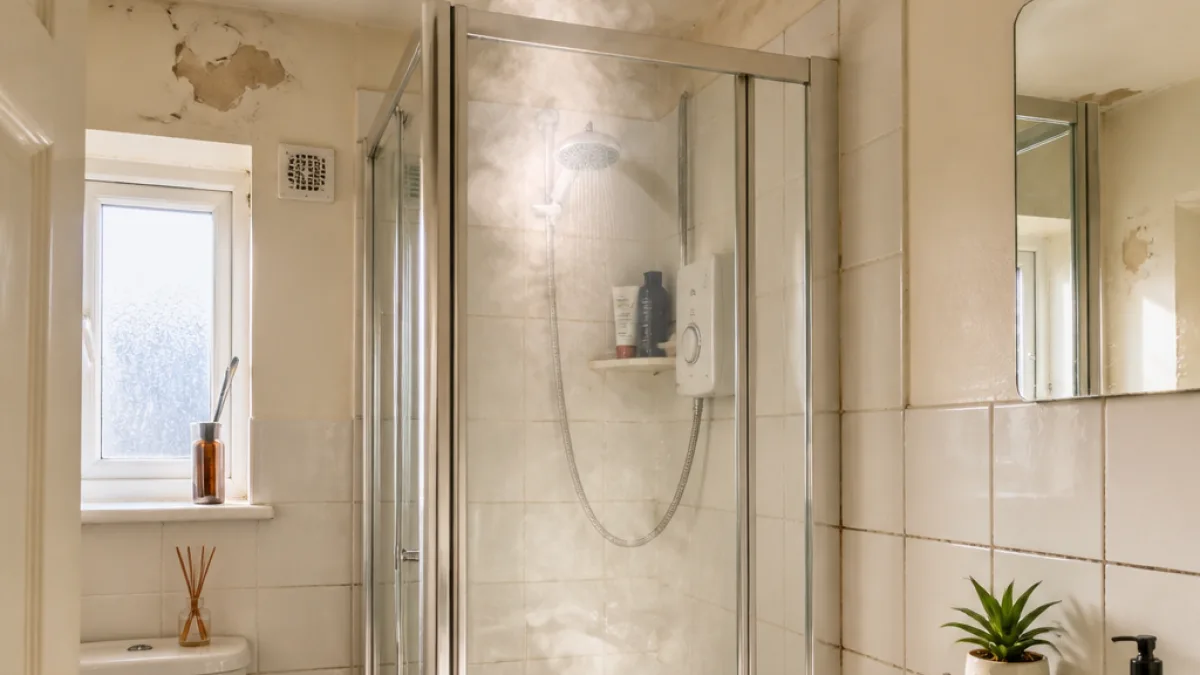
Many households in and around Mold treat the bathroom fan as an afterthought, but local landlords and homeowners should take heed: poor use of extract ventilation is a common cause of damp, mould and peeling paint. Two HVAC specialists interviewed in a recent feature outlined practical steps that could save residents time, expense and worry — particularly in older Welsh properties prone to trapped moisture.
Start the fan before the steam
Both experts agree that the extractor should be switched on before the shower or bath begins so it can intercept steam as it is produced rather than trying to remove it after surfaces and air are already saturated. That advice is especially pertinent for smaller or internal bathrooms that lack windows — common in many terraced houses and flats in the area.
“The bathroom fan should be left running throughout the entire time moisture is being generated,” said Brian White, HVAC expert and commercial president of Accurate Heating, Cooling & Plumbing.
White emphasised the importance of creating an active airflow that captures steam at source. Waiting until after the shower has finished, he warned, means the fan has to work harder and is often less effective.
How long is long enough?
There is no single precise formula, but guidance from the experts gives a practical rule of thumb that homeowners can apply. Running the fan while bathing and for a period afterwards allows residual dampness on tiles, grout and towels to clear before it soaks into plasterboard, paint and timber.
| Situation | Recommended run time |
|---|---|
| Short shower (low steam) | 15 minutes after finishing |
| Long or very hot shower / bath | 20–30 minutes after finishing |
| Poorly ventilated or windowless bathroom | 30 minutes or consider continuous low-speed ventilation |
Lisa Purvins, owner of Pro-Tech Heating & Cooling, pointed out the cumulative harm of moisture left to sit. Over time, it can lead not only to visible mould but to structural problems where damp penetrates into wall cavities and timber framing.
Common mistakes and simple fixes
- Turning the fan on only after the bath or shower has finished, which reduces effectiveness.
- Using a fan that is too small for the room or not vented to the outside, which can simply redistribute moisture.
- Failing to maintain the unit — a dusty or blocked fan performs poorly and can be noisier, putting people off using it.
Practical measures homeowners can take include ensuring extractors vent externally rather than into loft spaces, cleaning fan grilles and ductwork where accessible, and choosing an extractor with a timer or humidity sensor (thermostatic or humidistat-controlled units can switch off automatically when conditions have normalised).
Why this matters for Mold
In Mold and neighbouring towns, many properties were built before modern ventilation standards and may still rely on windows alone. Where small bathrooms lack an external wall, or where loft and roof spaces are used for storage, moist air can migrate into building fabric. That process can be slow and unseen until signs such as staining, flaking paint or the telltale musty smell appear.
For tenants and landlords, the consequences are not only aesthetic. Persistent mould can affect health, aggravating asthma and allergies, and, if left unchecked, lead to more costly repairs — something neither owners nor social housing providers want to face.
Simple habits — starting the extractor before you shower, running it for about 15–30 minutes afterwards, and keeping units clean and properly ducted — are low-cost ways to reduce that risk. For persistent problems, residents should seek advice from a qualified tradesperson or their landlord, particularly where structural damp or recurring mould is present.
Local councils and housing associations often publish guidance and can point to approved contractors. Taking a few straightforward steps now can prevent the much greater inconvenience and expense of dealing with entrenched mould later.