
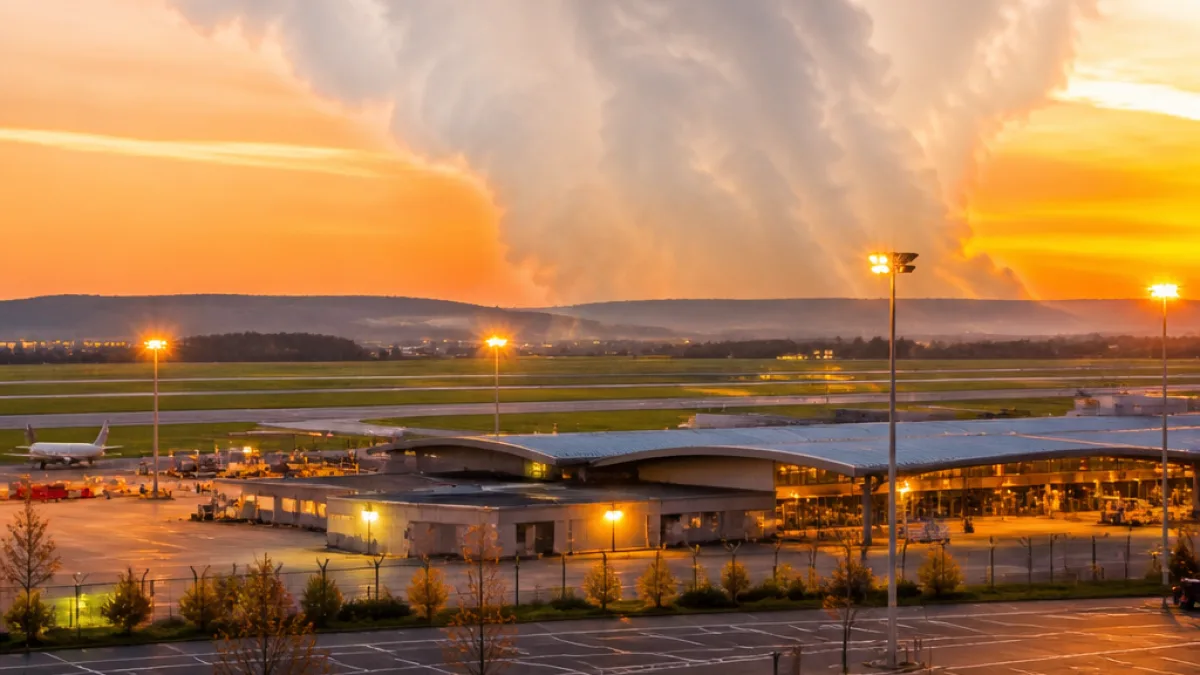
Airport reopening raises tensions between growth ambitions and carbon goals
Documents presented at a South Yorkshire Mayoral Combined Authority (SYMCA) meeting last September included a Preliminary Climate Impact Report for the proposed reopening of Doncaster Sheffield Airport (DSA). The figures in that report have focused attention on a fundamental policy challenge: whether expanding airport capacity in South Yorkshire can be squared with the region's declared climate commitments.
The climate analysis contains a high-case projection that direct aircraft emissions from flights to and from DSA could reach roughly 300 kilotonnes of CO2 in 2035, and rise thereafter. By contrast, SYMCA's own target for total emissions across the rest of South Yorkshire is around 720 kilotonnes of CO2 in 2035 — and falling. That comparison, set out in the documents, has prompted scepticism from experts and campaigners about the scale of emissions associated with reopening the airport.
Proponents of DSA have argued the site could become a centre for low-carbon aviation technology, presenting a vision of local economic growth and green innovation. But the climate report — and broader technological realities — complicate that optimism.
"Opening an airport with emissions on that scale is clearly extremely disproportionate," the analysis notes, highlighting the tension between projected aviation emissions and regional carbon budgets.
Key constraints cited in the material include the long turnover time for aircraft fleets, meaning improvements in emissions performance through new models will be gradual. While lighter aerospace materials are being developed locally, technological advances alone will not deliver rapid reductions at the scale envisaged. The documents also draw attention to the likely composition of so-called sustainable aviation fuels (SAF) available in the near term.
- The majority of current SAF production relies on feedstocks such as used cooking oil.
- Much of this feedstock is imported from Asia, raising questions about supply chains and genuine sustainability.
- More advanced SAFs are under development but remain at a pilot or early commercial stage and are unlikely to substitute for conventional jet fuel quickly enough to eliminate significant emissions growth.
The report as presented to SYMCA contained projected carbon outputs but, according to the documents, stopped short of analysing how those figures could be accommodated within a 'sustainable economy' for the region. That gap has become a focal point for debate: even if a share of emissions attributed to DSA were accepted, the high-case projection represents a sizeable slice of the remaining regional carbon budget for 2035.
| Item | Projected/Target figure (2035) |
|---|---|
| DSA high-case direct aircraft emissions | ~300 kt CO2 |
| SYMCA target for rest of South Yorkshire | ~720 kt CO2 |
For Doncaster residents the stakes are practical and political. Supporters point to jobs, connectivity and the potential for local supply-chain benefits. Critics warn that the climate implications could undermine wider regional efforts to meet declared targets after SYMCA's 2019 climate emergency declaration.
What the papers make plain is that any future decision on the airport will not be limited to immediate economic calculations. Policymakers must confront the question of how projected aviation emissions fit within a shrinking carbon envelope for the region — a task that requires clear analysis, transparent assumptions and a reckoning with technological limits.
As the debate continues, councillors, business leaders and community groups in Doncaster will watch closely for further evidence from promoters of the airport plan that addresses both the emissions projections and the pathways through which they could be reduced without compromising regional carbon targets.















