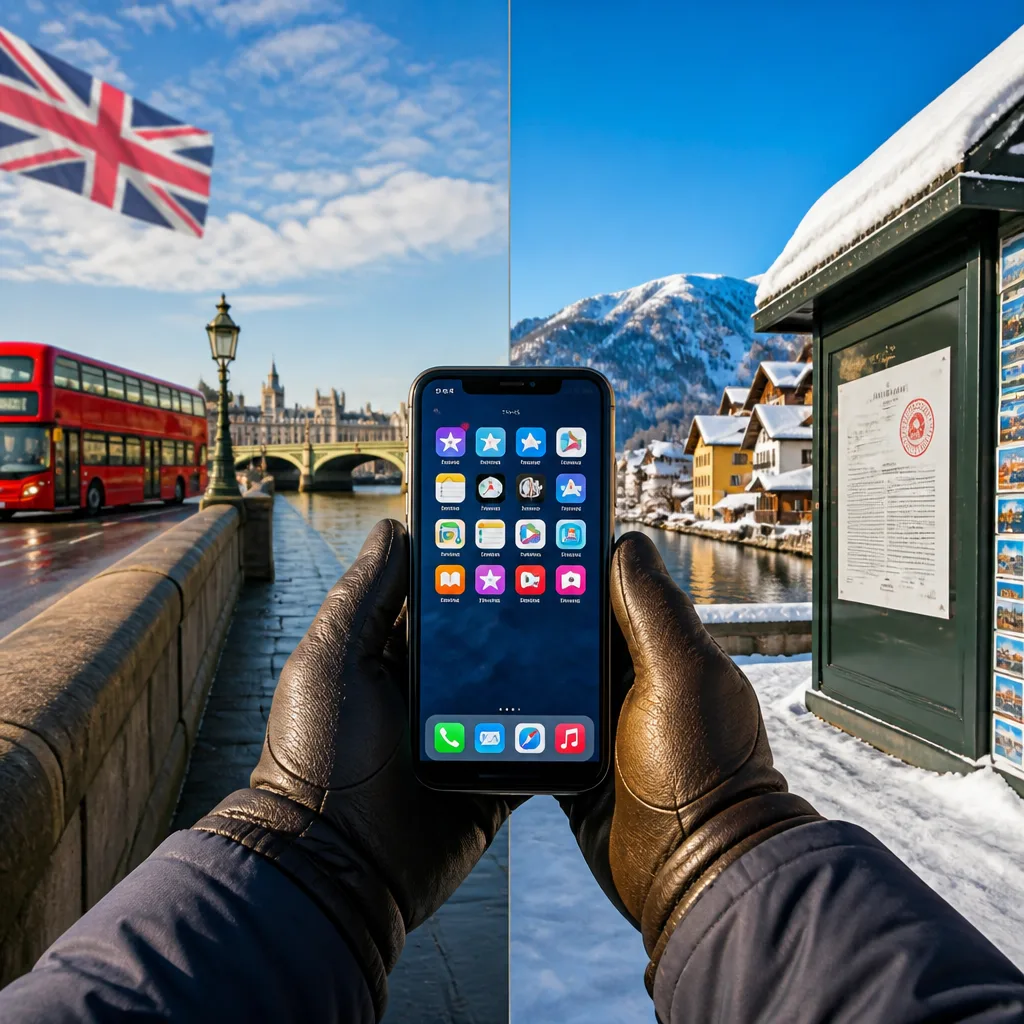
Take the same phone from London to Zurich and the screen barely changes. Your apps, accounts and subscriptions remain where you left them, but what sits behind those familiar icons can suddenly be governed by a different set of rules. A film can vanish from a streaming catalogue, a live match may belong to a different broadcaster and an online gambling service might be subject to licensing that only applies in one country.
Three different borders behind a single interface
From the user’s point of view, digital entertainment feels borderless. Behind the scenes, however, services usually operate across three distinct legal and commercial systems:
- Content rights for streaming — platforms may hold the right to distribute particular films and shows only in specific territories, so catalogues vary by country.
- Broadcasting rights for live sport — the right to show live events is often sold territory by territory, which can make a live match available to viewers in one market but not another.
- Regulatory permissions for real‑money gaming — national rules can determine which operators are authorised to provide online betting or casino services within a territory.
"The interface travels, the rights behind it do not."
The distinction matters more than it first appears. A traveller may log into an account that looks identical to the one at home, but the material that account can lawfully deliver will depend on where the underlying rights have been licensed or where an operator has regulatory approval.
Why gaming makes the borders most visible
Regulation is often clearest in the gambling sector because access depends on more than a commercial licence: in many countries, companies must hold specific national authorisation to offer real‑money services. The article uses Switzerland as an illustration: online operators there require national authorisation, so services such as the Swiss online casino Casineo operate within a domestic licensing framework rather than across a single, borderless European market.
That helps explain why a website being technically reachable from another country does not necessarily mean the service is authorised for the user’s location. Operators may block access or restrict services in jurisdictions where they lack the necessary permission, and regulators can take action against unauthorised activity.
Streaming and sport: content deals, not tech, set the limits
Streaming platforms typically face a different problem. The service itself is generally available across borders, but the catalogue is controlled by territorial distribution agreements. A series that appears on one platform in the UK may be licensed to a different provider in Switzerland, or vice versa, resulting in catalogue differences that can confuse travellers.
Live sport follows similar commercial logic: broadcast rights for a match or tournament are packaged and sold by territory. The consequence is that what looks like a single global app can behave like multiple local channels depending on the rights holders’ deals.
Consequences for consumers and policy-makers
For consumers, the upshot is practical: subscriptions and logins may not guarantee identical access overseas. This can be a nuisance for holidaymakers, professionals who travel frequently, and anyone relying on services while abroad. For regulators and the creative industries, the persistence of territorial rights raises broader questions about fairness, market competition and how to protect local consumers and creators.
Policymakers face trade-offs. Territorial licensing remains central to how film and television are financed and distributed; changing that model would affect rights holders, distributors and local production ecosystems. Meanwhile, regulators of real‑money gaming must balance consumer protection, revenue control and cross‑border enforcement in an online environment where technical access is global but legal permissions are not.
| System | Primary constraint |
|---|---|
| Streaming | Territorial content licences determine catalogues |
| Live sport | Broadcast rights sold by territory |
| Online gaming | National regulatory authorisation required |
The modern digital interface may mask these divides, but they continue to shape what we can watch and play. As consumption habits and technology evolve, conversations about harmonising rights, improving transparency for travellers and coordinating cross‑border regulation are likely to grow louder — even if the apps on our phones remain the same.