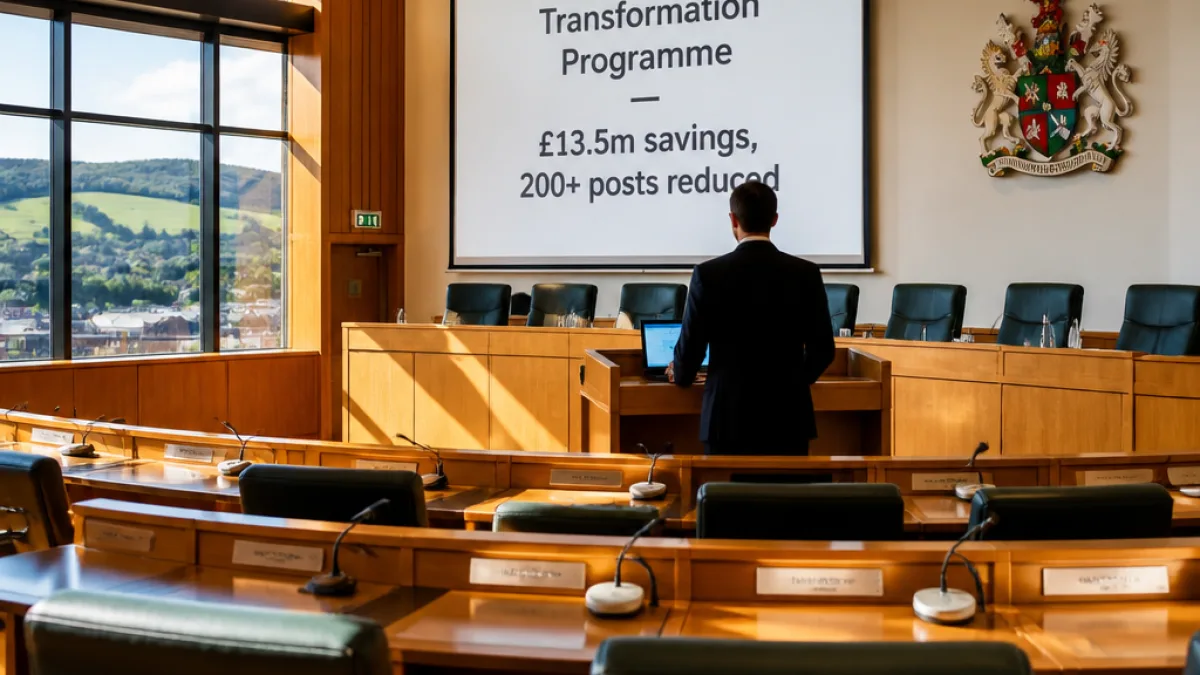
Senior officers at Caerphilly County Borough Council have told councillors that repeated references to a possible 600 post reduction should be set aside as the authority’s modernisation work begins to take effect.
Leadership urges end to speculation over 600 figure
The council’s chief executive, Richard Edmunds, said the figure was from a previous point in time and promoted unnecessary worry among staff. Officers emphasised the council is still working within constrained finances but insisted the organisation-wide transformation programme is delivering measurable results.
“That was a point in time several years ago,”
The comment was made in response to a question from Councillor Kevin Etheridge as officers sought to reassure elected members that the authority is not recommitting to a headline number that first circulated in 2024.
Transformation delivers savings and workforce change
At the heart of the discussion is a programme of service redesign and workforce management that officers say has already produced significant benefits. The council has reported:
- £13.5 million of savings delivered through the transformation programme;
- a reduction of more than 200 full‑time equivalent posts through vacancy management and flexible workforce measures;
- an approach that prioritises frontline services while using voluntary measures such as early retirement and voluntary redundancy where needed.
Those figures were set out by the council’s director of people services, Lynne Donovan, who told councillors the 600 number was “used at a point in time to demonstrate the scale of the workforce reduction required to close the budget gap.” She and the chief executive described it as an illustrative figure rather than a firm commitment to compulsory redundancies.
Choices driven by funding shortfall
Officers were frank that the council is not receiving the level of funding it would like. Mr Edmunds said the shortfall meant leaders and members must make difficult choices about services and how they are delivered.
He stressed the council’s preference is not to rely on compulsory redundancies, pointing instead to a mix of restructuring, the removal of vacant posts and workforce flexibility to achieve necessary reductions while protecting day‑to‑day services.
| Area | Reported outcome |
|---|---|
| Savings delivered | £13.5m |
| Staff reductions (FTE) | 200+ |
| Previous illustrative figure | 600 FTE (first referenced in 2024) |
Councillors were told that, where services can be made more efficient, change must happen to keep the authority sustainable. That message aligns with the leadership’s stated aim to prioritise front‑line provision where possible.
Local implications and the road ahead
For residents across Caerphilly borough, the debate is not just about numbers on a page but the future of everyday services such as social care, waste collection and community support. Officers’ emphasis on voluntary levers to reduce staffing levels aims to avoid sudden disruption, but the council accepts that ongoing financial pressure will require continued transformation.
As the authority moves forward, elected members will be watching how projected savings are achieved in practice and whether services can be maintained at current standards while the workforce is reshaped. For staff, the message from the top is that earlier headline figures should no longer be used to stoke anxiety — but the need for change remains clear.
Local people will want to see transparent plans and assurance that front‑line services will be protected as far as possible while the council tackles a funding gap that shows little sign of abating.