
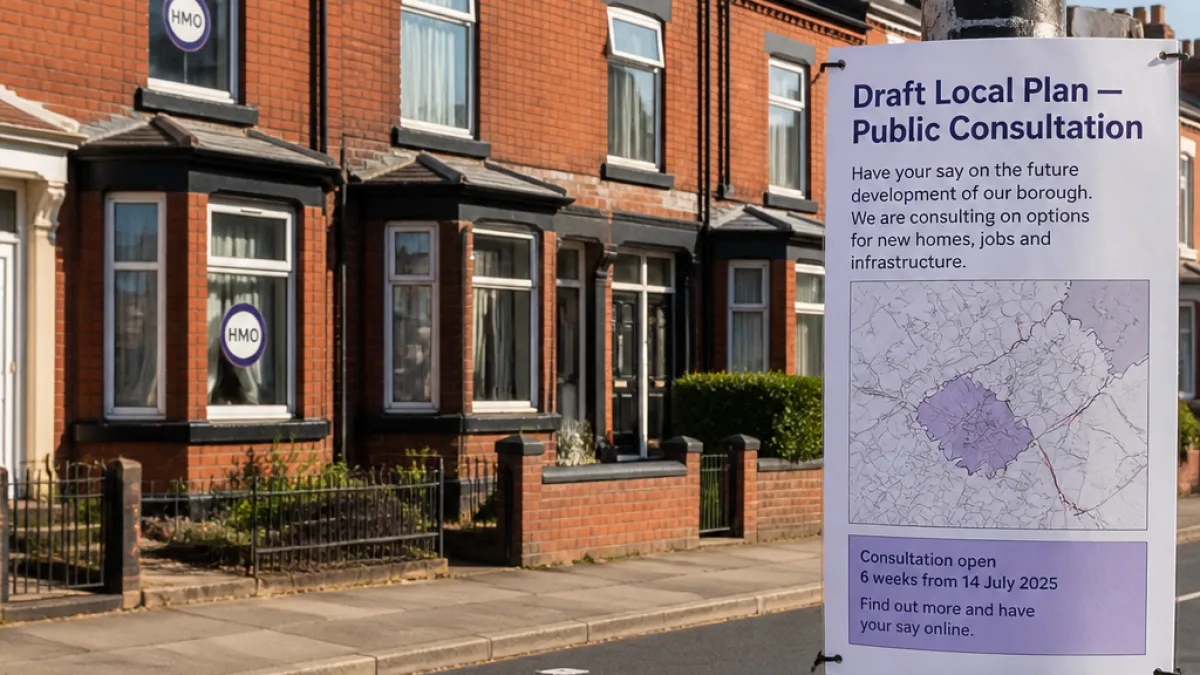
Council moves to limit HMOs in specific Bolton neighbourhoods
Bolton Council has published a draft local plan that would stop new houses in multiple occupation (HMOs) being established in parts of the borough and place tighter controls on conversions across the town. The plan is due to be discussed at a meeting of the council on Monday 28 September before being opened to public consultation.
Town Hall planners say HMOs remain part of Bolton’s housing offer but argue that an increasing concentration of shared houses can harm streets and neighbourhoods. The policy aims to strike a balance by recognising that shared accommodation can suit many households while preventing large clusters of HMOs in sensitive areas.
"Bolton’s preference is for purpose-built conventional homes providing safe and stable accommodation for all households. However, it is recognised that houses in multiple occupation are an important part of Bolton’s overall housing offer."
The draft contains several clear restrictions. Under the proposed rules an HMO:
- must not be located within The Haulgh, Farnworth Town Centre, or the area north and east of Bolton School near Queens Park;
- must not result in 10 per cent or more of residential properties within 100 metres of the site becoming HMOs;
- must not cause a house to have an HMO on either side of it.
The plan also reiterates existing standards that HMO proposals must meet, including minimum gross internal floor area requirements and providing reasonable outlooks, access to daylight and privacy for residents.
Context and recent planning decisions
The proposals follow a policy shift by the council earlier this year introducing an Article 4 direction. That measure removed the permitted development right that previously allowed family homes to be converted to HMOs without formal planning permission, meaning owners now need to apply. The new draft local plan builds on that approach by setting geographic and numerical limits.
The move comes after individual planning decisions have already reflected concerns about larger shared houses. For example, plans were recently rejected for a 10-bedroom HMO at 33 Mercia Street, the council notes, illustrating the practical consequences of tighter controls.
What the rules would mean on the ground
If adopted, the measures would restrict where landlords and developers can convert properties into HMOs and where new purpose-built shared housing could be located. The 10 per cent threshold within 100 metres creates a technical test that could prevent incremental clustering of HMOs on terraced streets and in neighbourhood pockets.
| Restriction | Detail |
|---|---|
| Geographical ban | The Haulgh; Farnworth Town Centre; north and east of Bolton School near Queens Park |
| Concentration threshold | HMO must not cause ≥10% of residential properties within 100m to be HMOs |
| Adjacency rule | Development must not cause HMOs either side of a house |
Councillors will debate the draft at the meeting on Monday before the document is placed before residents for consultation. During that public stage, landlords, residents, community groups and others will be able to submit representations on the proposed approach and suggest changes.
Planners make clear the policy does not seek to eliminate shared housing. Instead it signals a preference for purpose-built conventional homes that provide stable accommodation while ensuring HMOs remain an available option where they do not harm local amenity.
The proposals are likely to be welcomed by residents worried about concentrations of HMOs in certain streets, but they will also draw scrutiny from landlords and agents who say shared housing provides an essential, affordable option for people at different life stages and incomes. The consultation will be the forum where those competing interests are tested.
Once the draft local plan has been amended in light of consultation responses it will follow the statutory process towards adoption, with further stages and potentially an examination in public required before policies become final. For now, the draft sets out the council’s direction of travel on a contentious planning issue that affects where people can live and how neighbourhoods change in Bolton.












