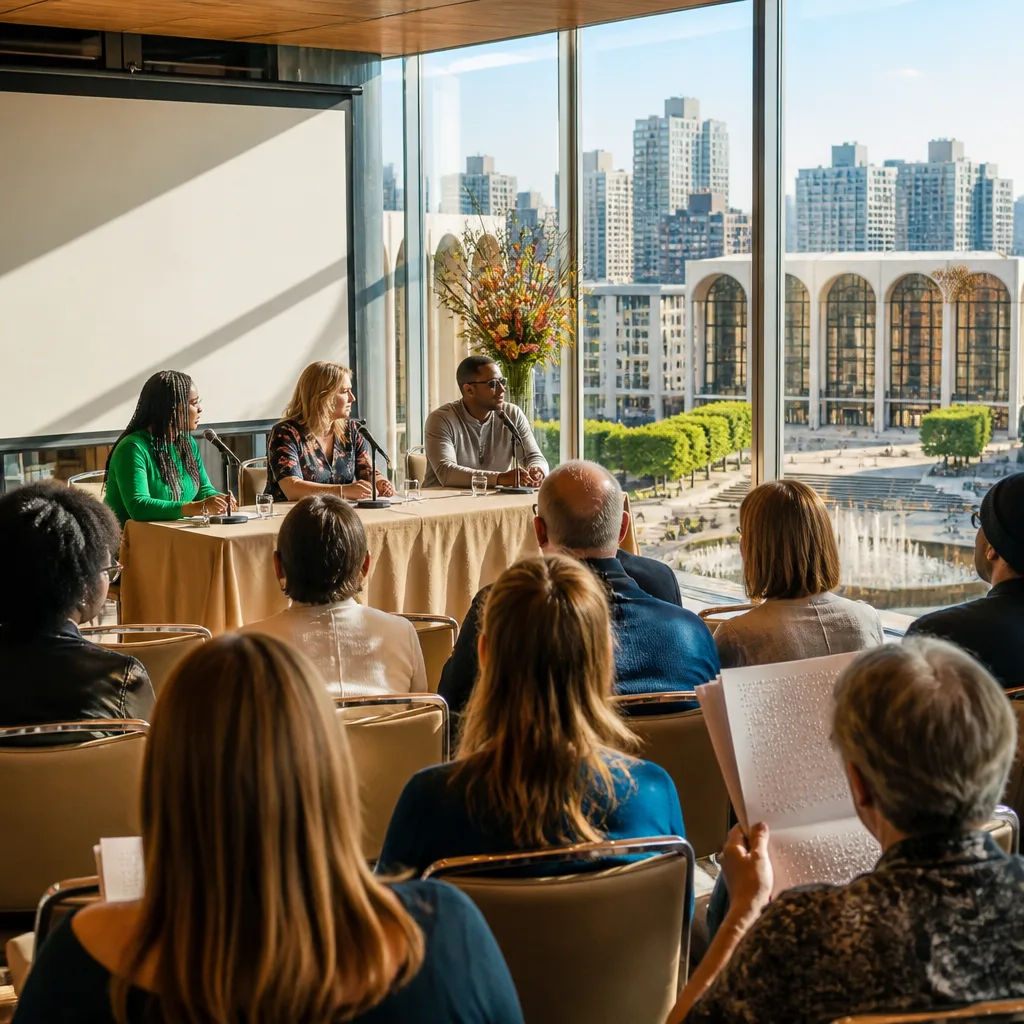
NEW YORK — Leaders and creators who are blind or have low vision convened at Lincoln Centre’s Stanley H. Kaplan Penthouse this week to make the case that accessibility must be central to the entertainment business, not merely an afterthought.
From advocacy to industry conversation
The event, staged by Lighthouse Guild in partnership with communications company Spectrum, formed the fourth annual gathering under the Access in Focus banner. It aimed to connect blind professionals and accessibility advocates with broader conversations about inclusion in film, television, theatre, music and social media.
Moderated by Kiana V. Glanton of Lighthouse Guild, the discussion featured a small but influential group of guests: recording artist and RAMPD.org founder Lachi, educator and content creator Nicole Harris, and Petr Kucheryavyy of Spectrum’s Accessibility team, who works on outreach and the Spectrum Access app.
Experts who bridge advocacy and practice
Speakers reflected professional and lived experience of navigating creative industries that often lack built-in accessibility. They argued that more inclusive storytelling and improved technology can benefit all audiences while also expanding opportunities for creators with disabilities.
| Panelist | Role / Affiliation |
|---|---|
| Lachi | Award-winning recording artist; founder and CEO of RAMPD.org |
| Nicole Harris | Content creator and founder of Love The Hope Project |
| Petr Kucheryavyy | Senior director of outreach and product owner, Spectrum Access app |
| Kiana V. Glanton | Moderator; Lighthouse Guild |
RAMPD.org, led by Lachi, is a professional network advocating for musicians and music professionals with disabilities; Love The Hope Project, founded by Harris, focuses on community-building and advocacy. Spectrum’s presence signalled a growing interest from technology and communications firms in practical accessibility solutions.
Practical change, not tokenism
Panelists emphasised that accessibility must be present at every stage of the creative process — from casting and writing to design, production and distribution — rather than retrofitted. They discussed how accessible design and inclusive storytelling improve the entertainment experience for everyone, while creating more authentic representation on screen and on stage.
“What I treasure most about nights like this are the perspectives I hear from the audience, the people in our community, who feel heard and seen. That’s what makes this event so beautiful,”
The event offered a mix of personal testimony and practical examples of how technology and production practices can be adapted. Spectrum’s contribution centred on the Spectrum Access app and the company’s accessibility work, underlining how service providers can support participation and consumption.
- Inclusion in creation: Advocates urged hiring and consulting blind professionals across the creative chain, not only for access services but as creators and decision-makers.
- Design for all: Speakers pushed for accessible formats and interfaces at conception stage to avoid exclusionary outcomes.
- Industry partnership: Technology firms and content platforms were encouraged to work with disability-led organisations to scale accessible solutions.
As the entertainment industries continue to adapt to new platforms and audiences, the discussion at Lincoln Centre framed accessibility as both a moral imperative and a creative opportunity. The voices assembled were clear: when blind and low-vision people are included as makers and advisers, storytelling becomes richer and the audience wider.
The Lighthouse Guild event underlined a familiar point for disability advocates — progress is happening, but sustainable change requires commitment across institutions, from funding bodies to broadcasters and streaming platforms.