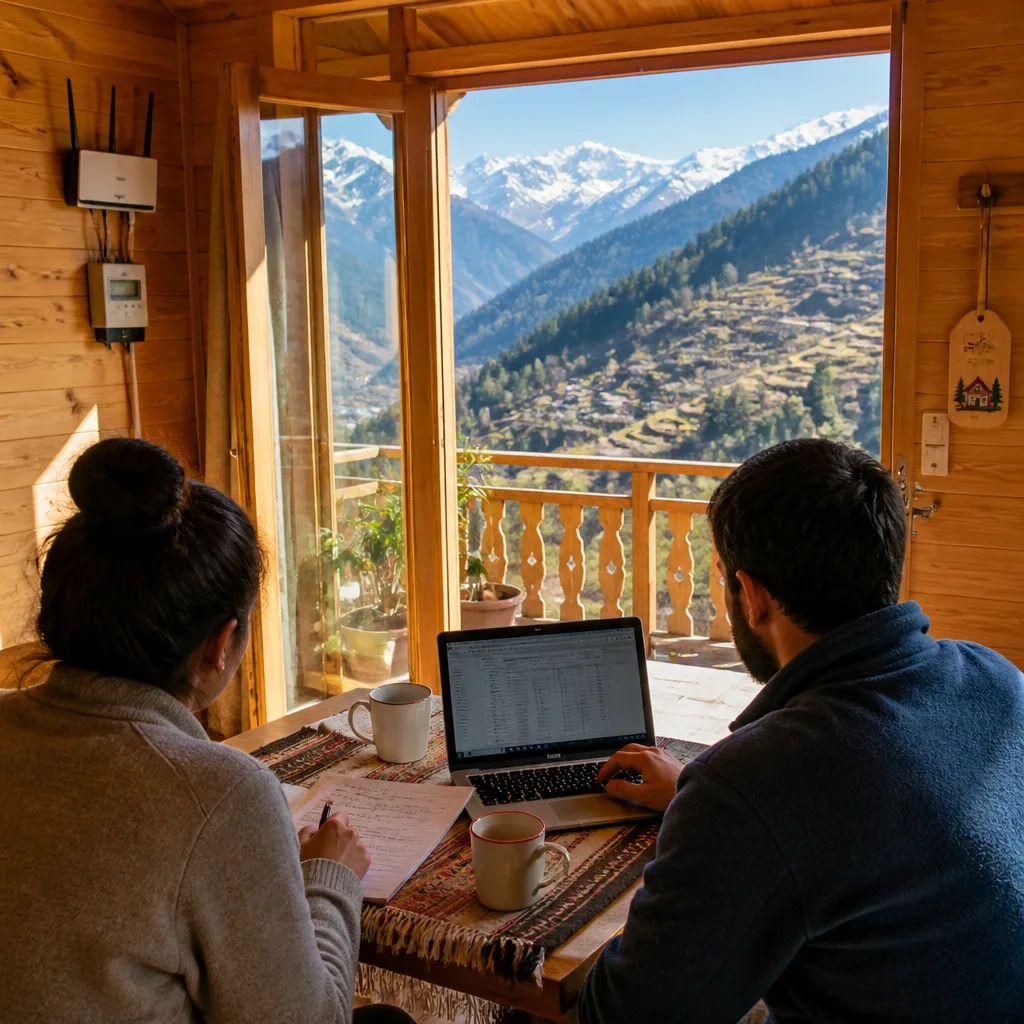
A couple who have relocated to a village near Manali say their household outgoings total roughly Rs. 50,000 a month, providing a snapshot of what day-to-day expenses look like for people working remotely from the Himalayas.
Where they live and what makes their situation atypical
The couple, identified in their social media video as Divya and her partner Saurav, live in Gazan, a settlement close to the hill station of Manali in Himachal Pradesh. They share that they occupy a 4 BHK apartment and operate a homestay from the property. That combination of accommodation and an income-earning venture means their circumstances differ from someone simply renting a small flat.
Detailed monthly spending
In the Instagram post titled "Living in the mountains, episode 1", the couple itemised their typical monthly bills. They emphasised that the totals reflect their lifestyle choices — including occasional outings and running a guest accommodation — and are not to be read as a definitive cost for all Himalayan villages.
| Category | Monthly cost (Rs.) |
|---|---|
| Groceries | 10,000 |
| Eating out | 5,000 |
| Fuel | 3,000 |
| Electricity & water | 1,000 |
| Wi‑Fi & phone | 2,500 |
| Outings / mountain adventures | 3,000 |
The couple also note that they walk for many short journeys, which helps keep their fuel bill low. They estimate the total of these items at about Rs. 50,000 per month.
How to interpret this figure
There are a few important caveats. The amount described is an account of one household’s spending pattern. Costs will vary widely depending on location within the Himalayas, household size, whether you rent or own, and how much you rely on private transport or frequent travel. For example, the couple say a 1 BHK rental in the area can be found for approximately Rs. 15,000, while a 2 BHK may be closer to Rs. 25,000, figures that would materially change a monthly budget for someone not running a homestay.
Put simply: this is a useful reference point for people contemplating a move to mountain living, but it should not be taken as a universal benchmark.
What this tells prospective movers
- Housing choice matters: Renting a smaller unit reduces the largest monthly expense considerably.
- Local travel habits reduce bills: Walking and local living cut down fuel and transport costs.
- Income sources affect affordability: Operating a homestay provides extra revenue, altering the budget calculus compared with a household relying solely on remote salaries or local employment.
"Living in the mountains, episode 1"
For readers weighing up a move, the couple’s breakdown offers practical detail on everyday costs such as groceries, utilities and connectivity. It also highlights that living in a tourist region brings both opportunities — for example, renting spare rooms to visitors — and potential higher expenses at peak seasons.
Any decision to relocate to a rural or mountainous area benefits from research tailored to personal needs. That includes checking broadband reliability for remote work, seasonally adjusted fuel and food prices, and the availability of medical and other essential services. The couple’s account gives a real-world example of one way to make mountain life financially viable while working remotely, rather than a one-size-fits-all prescription.
As more people consider exits from crowded cities, first-person budgets such as this can help form a practical sense of what everyday life in a different setting might cost — as long as they are treated as illustrative, not definitive.