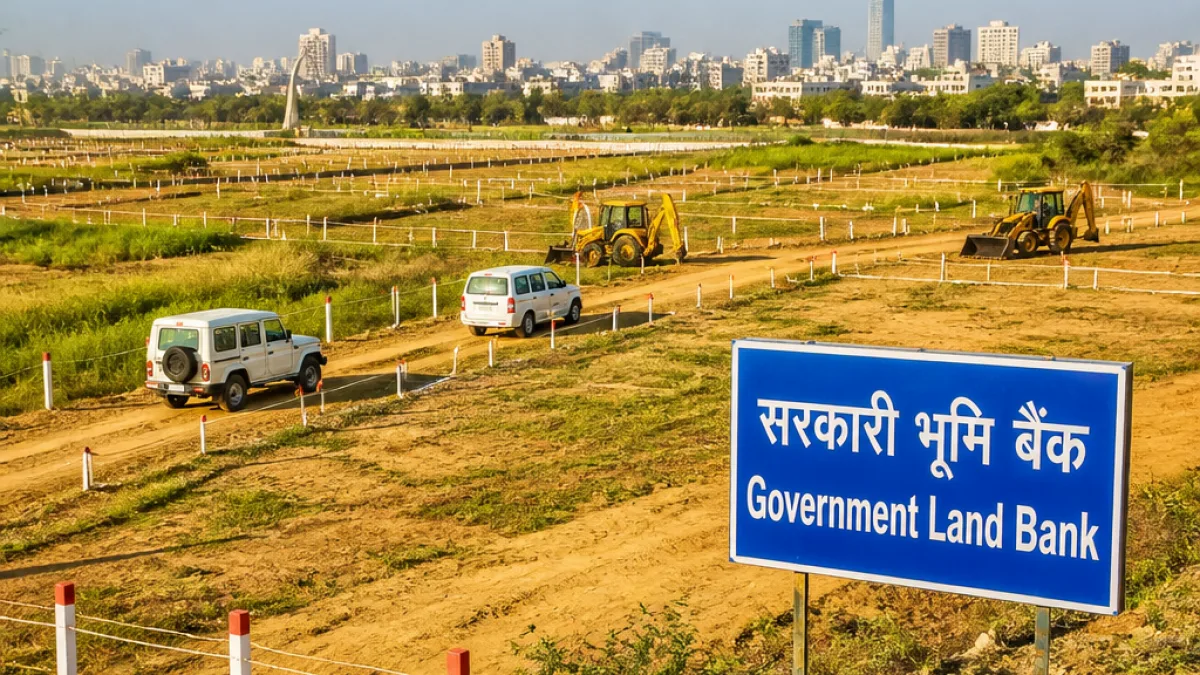
Lucknow: The Uttar Pradesh government has reclaimed more than 84,005 hectares — roughly 2.08 lakh acres — of land from illegal occupation over the past nine-and-a-half years, the state revenue department said on Wednesday. The department described the results as part of an ongoing anti‑land mafia campaign that combines administrative action, legal proceedings and criminal cases against identified encroachers.
Institutional framework and online monitoring
Officials said the campaign is backed by a four-tier Anti‑Land Mafia Task Force organised at the state, divisional, district and tehsil levels to ensure coordinated identification and eviction of illegal occupants of public property. The department also developed a dedicated online portal to register complaints and track responses.
The portal has received a total of 4,34,016 complaints related to encroachment across the state. Of these, authorities report that 4,31,697 complaints — more than 99% — have been disposed of, while 2,319 complaints remain pending, the statement said. The system, the department added, enables continuous monitoring from complaint filing through disposal.
What was recovered and why it matters
Revenue officials highlighted that freeing over 84,005 hectares has created a substantial government land bank which could be utilised for various development projects. Making such land available, they said, will accelerate infrastructure and public works across the state by reducing the need to acquire privately held parcels and by preventing future illegal occupation of public assets.
- Land freed: 84,005 hectares (≈ 2.08 lakh acres)
- Complaints received: 4,34,016
- Complaints resolved: 4,31,697
- Pending complaints: 2,319
| Metric | Number |
|---|---|
| Land recovered | 84,005 hectares (~2.08 lakh acres) |
| Complaints received on portal | 4,34,016 |
| Complaints disposed | 4,31,697 |
| Pending complaints | 2,319 |
Legal and criminal measures
The revenue department said the campaign has not only focused on physical eviction but also on pursuing effective legal action. Criminal cases have been initiated where appropriate and administrative measures have been used to restore public property. Officials described the approach as a full‑cycle mechanism: identifying encroachments, initiating notices or prosecutions, and physically freeing the land.
By institutionalising action through a multi‑tiered task force, the administration aims to reduce local delays and ensure uniformity in enforcement across divisions and districts. The online portal is intended to add transparency by allowing authorities and complainants to track progress.
Implications for development and governance
Recovered land provides the administration with parcels that could be used for public purposes such as roads, schools, healthcare facilities, urban expansion and other infrastructure projects. The statement from the revenue department emphasised the potential to speed development without lengthy land acquisition exercises.
For residents, effective action against encroachment can mean clearer property titles, reduced conflict over land, and better access to state services planned on public land. For the government, retaining control over state land may improve fiscal planning and reduce litigation related to land acquisition.
Officials acknowledged that some complaints remain pending and said continued monitoring and local enforcement will be necessary to sustain gains. The department also signalled that the task forces will continue to process complaints and take action against ongoing encroachments.
The revenue department's figures cover the period of roughly nine-and-a-half years; the statement did not specify precise year‑by‑year recoveries or a district‑wise breakdown in the release accompanying the figures.