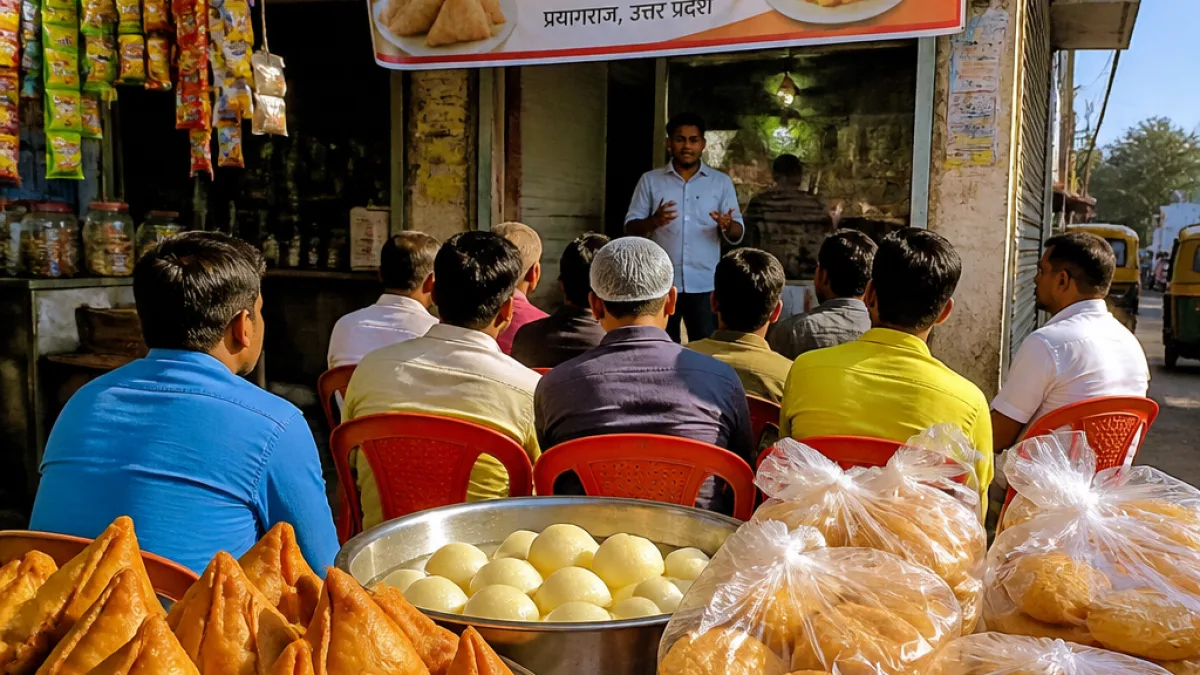
State scheme to commercialise Prayagraj specialties, officials say
The Uttar Pradesh government has moved to expand commercial opportunities for Prayagraj’s traditional foods by bringing samosas, rasgullas and puri‑kachoris under its One District, One Dish (ODOD) Financing Assistance Scheme, officials said on Monday. The initiative, implemented locally through the District Industries Promotion and Entrepreneurship Development Centre, is designed to help traders and small producers establish new units or scale up existing businesses.
Assistant commissioner (industries) Sarika Singh said a divisional expert committee, drawing on specialists familiar with the region’s culinary traditions, had initially shortlisted samosas. Following further recommendations, the committee included rasgullas and puri‑kachoris under the financing scheme. So far, 20 entrepreneurs have been selected for benefits under the programme.
- Support available for setting up new units or expanding existing ventures.
- No minimum educational qualification; applicants must be at least 18 years old.
- Benefits can be availed only once by an applicant or a member of the applicant’s family; candidates with prior benefits are ineligible.
According to official estimates shared by the industries department, the value chain for these three food items already involves around 800 manufacturers, 400 street vendors, 300 restaurants and nearly a dozen self‑help groups engaged in production, marketing and allied activities. Officials expect the initiative to generate employment for over 1,500 people in Prayagraj, and the department has also identified larger processing units operating in the city and neighbouring towns.
"The objective is to convert popular local products into stronger commercial brands by providing financial assistance and training," the assistant commissioner (industries) said.
What the scheme offers and local stakes
The ODOD Financing Assistance Scheme combines financial support with capacity building, according to the district industries body. While the state government has not published the specific subsidy or loan amounts for each beneficiary in the material provided to the district office, officials said assistance would cover a range of needs from equipment to working capital and training in production, packaging and marketing.
For Prayagraj, where religious tourism coexists with a lively street‑food culture, officials framed the move as an attempt to harness local culinary reputation for broader economic gains. By packaging and standardising production and by helping entrepreneurs access credit and training, the government aims to develop recognisable brands that could reach markets beyond the city.
| Item | Estimated number involved |
|---|---|
| Manufacturers | 800 |
| Street vendors | 400 |
| Restaurants | 300 |
| Self‑help groups | Nearly a dozen |
| Projected jobs | Over 1,500 |
Local traders and self‑help groups stand to gain if the scheme helps reduce barriers to formal credit, standardise quality and open access to larger markets. At the same time, officials noted conditions intended to prevent multiple benefits accruing to the same household — a measure designed to widen the scheme’s reach across different families and enterprises in the district.
Implementation will be overseen by the district industries office in coordination with the divisional committee that recommended the additions to the ODOD list. The inclusion of rasgullas and puri‑kachoris after initial shortlisting of samosas indicates a degree of flexibility in recognising local producers and culinary variants within the scheme’s framework.
Officials said further details, including the final list of beneficiaries and disbursal timelines, would be announced by the district industries department as selections are formalised.