Jammu — A Parliamentary Committee on Demographic Changes wrapped up a three-day visit to Jammu on Thursday after meeting senior government and police officials, community organisations and delegations to gather inputs on migration, displacement, population patterns and related concerns in Jammu and Kashmir, an official statement said.
Committee engagement and key submissions
The high-level committee, headed by Justice (Retd) Prakash Prabhakar Navlekar, completed its Jammu schedule after a series of consultations across the city and surrounding areas. Justice Navlekar paid obeisance at the Mata Vaishno Devi shrine in Reasi during the visit, while other members returned to New Delhi, the statement added.
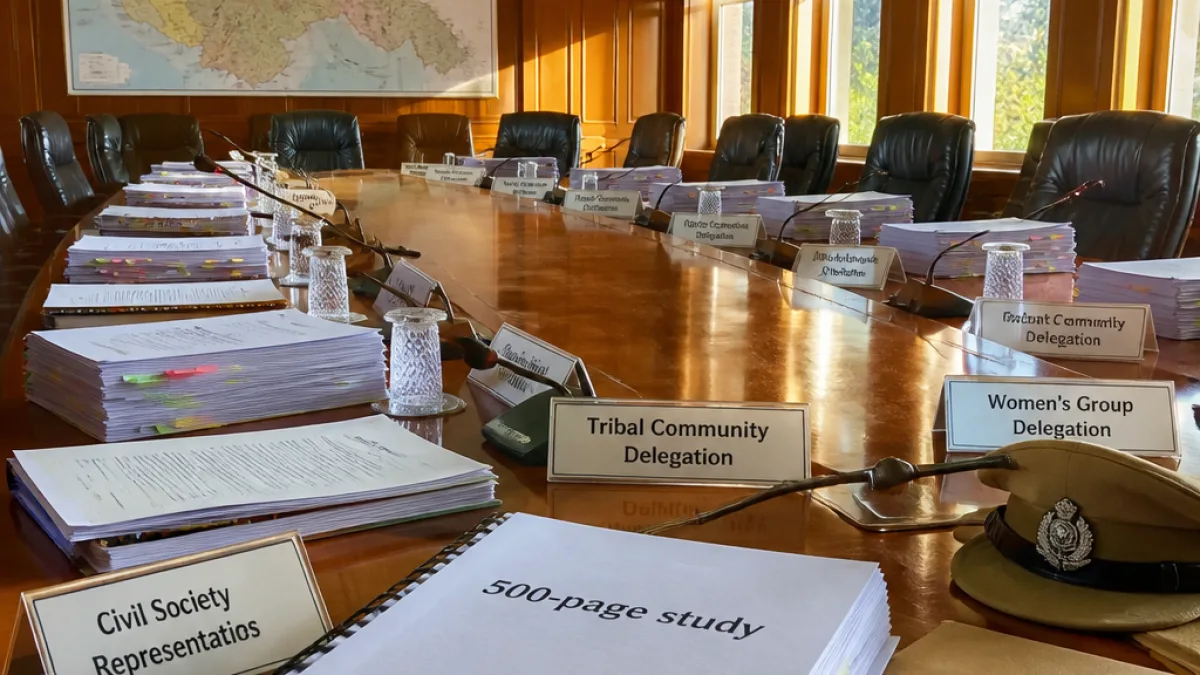
During the final phase of its programme, the committee received a detailed, reportedly 500-page study from Panun Kashmir. The delegation that presented the document included Panun Kashmir convener Agnishekhar, chairman Tito Ganju and representatives of the Jonaraja Institute of Genocide and Atrocities Studies (JIGAS). The study, according to the delegation, examines demographic developments over an extended historical period and addresses issues such as population trends, migration, displacement, settlement, political representation and property ownership.
"The Parliamentary Committee on Demographic Changes has concluded its three-day visit to Jammu," the official statement said.
The committee also engaged with the Public Opinion Forum. Representatives — including president Parveen Kumar Sharma and general secretary Dr Gopal Parthasarthi Sharma — submitted a memorandum highlighting worries about the region's changing demographic profile and urged measures concerning alleged illegal immigration from Myanmar and Bangladesh, pressing for deportation and raising possible security implications for Jammu.
- The panel held detailed consultations with government and police officials.
- Panun Kashmir presented a comprehensive 500-page study on historical demographic changes.
- The Public Opinion Forum flagged concerns over illegal immigration and security risks.
- The committee visited Jagti township, a major settlement of displaced Kashmiri Pandits.
Local context and possible implications
Jammu has long been central to debates on demographic balance and displacement in the Union Territory. The visits and submissions to the parliamentary panel underscore continuing local demand for the state and national authorities to address long-standing grievances over migration, property rights and the consequences of displacement, particularly for those displaced from the Kashmir Valley.
Officials said the committee’s field visits included Jagti township, which is one of the largest settlements for displaced Kashmiri Pandits. Engagements there and with other community groups were aimed at collecting first-hand evidence on long-term socio-economic impacts of displacement and settlement patterns, the statement said.
| Visit element | Representative(s) / Focus |
|---|---|
| Head of delegation | Justice (Retd) Prakash Prabhakar Navlekar |
| Major delegations | Panun Kashmir (Agnishekhar, Tito Ganju), Jonaraja Institute (JIGAS), Public Opinion Forum |
| Field visit | Jagti township (displaced community settlement) |
Observers in Jammu said the committee’s findings could influence future legislative or administrative measures on population management, registration and rehabilitation policies. Any recommendations by the parliamentary panel would typically be considered by the relevant ministries and could inform policymaking at the Centre.
Security and migration remain sensitive topics in Jammu and Kashmir. The memorandum submitted by the Public Opinion Forum highlighted alleged infiltration and the presence of migrants from neighbouring countries as a concern that, the Forum said, could have ramifications for local employment, resource distribution and law-and-order. The panel’s consultations with police officials were aimed at assessing such claims alongside other evidence presented by civil society groups.
The committee’s visit follows a broader national interest in demographic shifts across regions and comes at a time when several stakeholders in Jammu are pressing for official recognition of population and property-related grievances arising from conflict and displacement. The parliamentary panel’s report, expected after compilation of inputs from its field visits, will clarify whether it proposes legislative, administrative or enforcement measures to address the issues raised.
For Jammu residents, the key outcomes to watch will be the committee’s recommendations on documentation, rehabilitation, property restitution and any proposals directed at bolstering administrative capacity to monitor demographic changes and migration flows within the Union Territory.