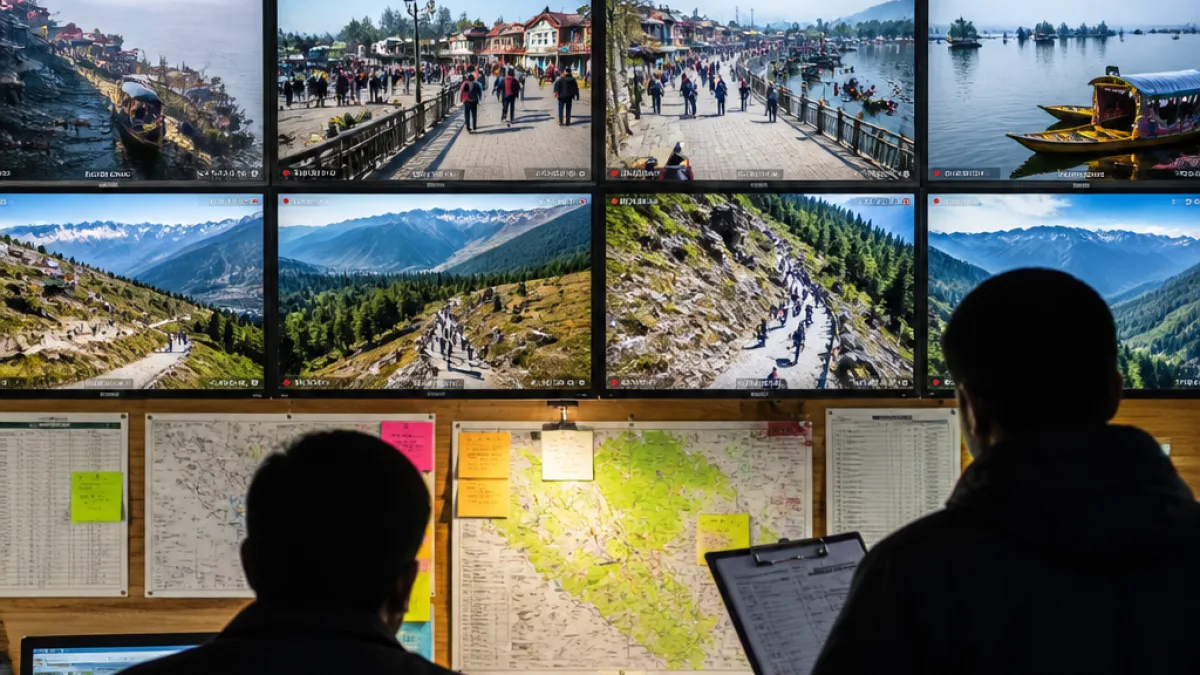
Srinagar: A Parliamentary committee has recommended an "integrated security and surveillance framework" for all major tourist destinations in Jammu and Kashmir, calling for centralised monitoring facilities, comprehensive CCTV coverage, periodic security audits and pre‑season review of inter‑agency standard operating procedures (SOPs).
Recommendations follow Pahalgam terror attack
The committee's recommendations are included in its report on Administrative Governance, Socio‑Economic Development and Border Security and Internal Security of the Union Territory of Jammu and Kashmir, and on Border Security Management and Preparedness in the UT of Ladakh. The proposals come against the backdrop of the April 22 terrorist attack in the Baisaran valley of Pahalgam in which 26 people, mostly tourists, were killed after assailants took shelter at higher locations.
The panel emphasised the need for clear institutional mechanisms and operational coordination among security agencies to ensure a swift, coordinated response to security incidents at tourism sites, particularly during peak seasons.
Key elements of the suggested framework
- Comprehensive CCTV coverage across major tourist hubs with centralised monitoring centres.
- Regular vulnerability assessments and periodic security audits to identify and address gaps.
- Clear inter‑agency SOPs to be prescribed and reviewed before every peak tourist season.
- Centralised monitoring facilities to enable coordinated, timely responses to incidents.
The committee recommended that these measures be institutionalised so that preparations are not ad hoc but follow a set regimen reviewed periodically.
On‑site study tour informed findings
The committee undertook a study visit to Jammu, Srinagar, Gulmarg, Sonmarg and Kargil from May 11 to 15, 2026. During this on‑the‑spot assessment it reviewed security arrangements at Gulmarg, discussed law and order in Sonmarg with Jammu and Kashmir Police representatives, and assessed border security and operational preparedness in Kargil through interactions with Indian Army officials.
| Visit dates | Places visited | Focus of assessment |
|---|---|---|
| May 11–15, 2026 | Jammu, Srinagar, Gulmarg, Sonmarg, Kargil | Security arrangements, law and order, border preparedness |
Noting a steady rise in tourist numbers to the Union Territory, the committee underlined that enhanced security was essential both to protect visitors and to sustain tourism, which many local economies depend upon.
"An integrated security and surveillance framework"
Practical implications and next steps
If adopted by the government, the recommendations would require coordination between multiple agencies — state and central police units, paramilitary forces, intelligence agencies and tourism authorities — to set up technical infrastructure such as CCTV networks and central monitoring rooms. The committee also called for pre‑season reviews of SOPs to ensure readiness before peak tourist influxes.
The proposals underscore the need for routine vulnerability mapping and periodic audits at popular locations. Such assessments would identify vulnerable approaches, high‑footfall zones and points requiring enhanced manned patrols or surveillance technology.
Context for stakeholders
Tour operators, local administrations and law enforcement will need to engage on implementation modalities, resource allocation and timelines for establishing centralised monitoring and audit mechanisms. The committee's report does not specify cost estimates or exact technical standards; those details would be worked out at administrative and inter‑agency levels if the recommendations are taken forward.
The committee's visit and its subsequent recommendations reflect a policy pivot towards systematising security at tourism sites in Jammu and Kashmir, balancing tourist confidence with operational practicality for security agencies.
Further action will depend on administrative decisions by the Union Territory government and central security agencies regarding funding, technical specifications and division of responsibilities for monitoring and response.