Tura, Meghalaya: The Meghalaya government on Tuesday unveiled a state-led research programme, Tracing the Roots, aimed at producing a scientific record of the indigenous heritage of the state. Chief Minister Conrad K. Sangma launched the initiative at the District Auditorium in Tura, dedicating the project to his late father, Purno Agitok (P. A.) Sangma, on what would have been the elder Sangma's 79th birth anniversary. Arts and Culture Minister Sanbor Shullai and MLA Mehtab Chandee A. Sangma attended the event.
Purpose and scope
The government described the programme as a multidisciplinary research effort to examine the origins, migrations, languages, material culture and oral traditions of Meghalaya's major tribal groups: the Garos, Khasis and Jaintias. The project will combine historical research, linguistics, archaeology, archival study and indigenous knowledge systems to build an evidence-based narrative of the peoples of the state.
According to the Chief Minister, the idea for an organised study emerged from a long-standing concern expressed by P. A. Sangma about the absence of systematic documentation on the roots and cultural history of Meghalaya's tribes. He said a note he prepared about 18 months ago served as the basis for the present initiative.
“It was one of those normal conversations between a father and son. But looking back, every conversation had a strong message. It was like a classroom for me, a roadmap for life and for the State,”
The programme has been framed to produce both scholarly outputs and materials accessible to the public, including digital archives and educational resources, the government said at the launch.
Fieldwork and international links
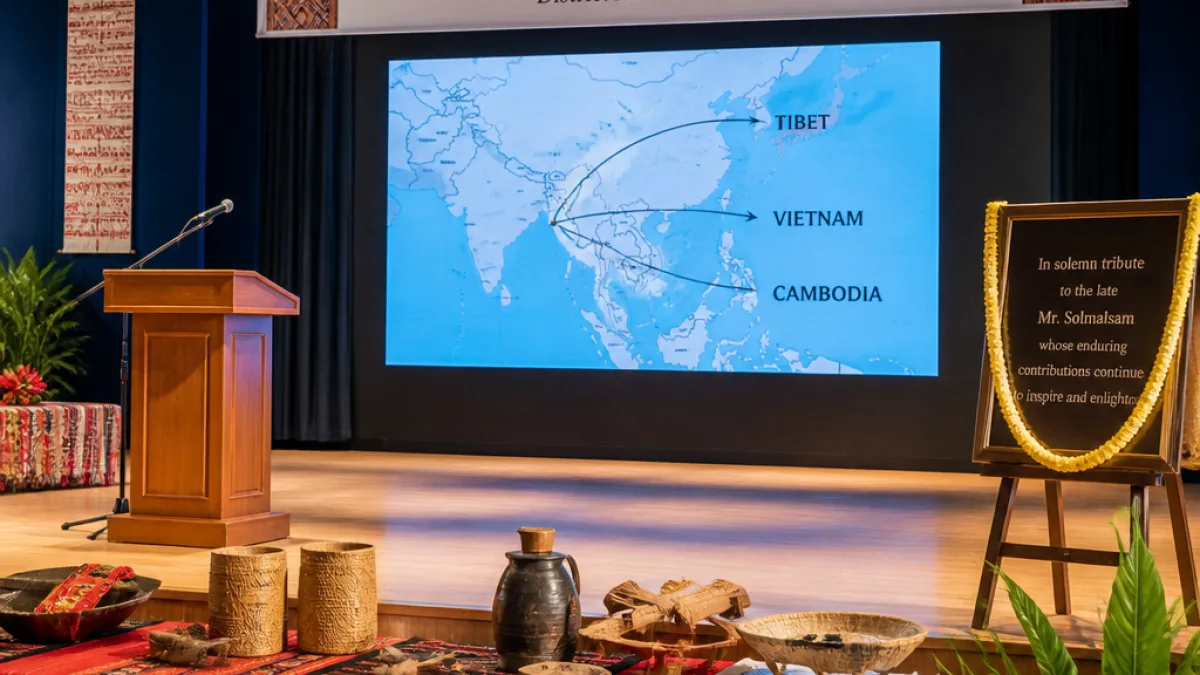
As part of the initiative, 75 scholars will undertake field visits to countries in Southeast and East Asia—specifically Vietnam, Cambodia and Tibet—to trace possible socio-cultural linkages with communities in Meghalaya. The state administration said the overseas trips are intended to explore historical affinities and migration pathways that could shed light on ethnic and cultural continuities across the region.
Project components have been given distinct study focuses. The Khasi-Jaintia research has been titled Ki Dienjat: Re-examining Khasi-Jaintia Socio-cultural Linkages with Southeast Asia, while the Garo-focused work will investigate what the government described as the Tibet and northern highlands hypothesis regarding Garo origins and movements.
| Component | Focus | Overseas destinations |
|---|---|---|
| Khasi–Jaintia | Socio-cultural linkages with Southeast Asia (Ki Dienjat) | Vietnam, Cambodia |
| Garo | Examine Tibet and northern highlands hypothesis | Tibet |
Data management and outputs
The Chief Minister also inaugurated a dedicated e-portal that will serve as a central repository for research data, digital archives, scholarly publications and educational materials related to the project. Officials said the portal is intended to make findings accessible to researchers, students and the general public and to provide a platform for long-term preservation of the collected material.
At the launch, the government emphasised the scientific nature of the work and the intention to move beyond folklore and anecdote by securing evidence through archaeology, linguistics and archival study. The multi-pronged approach is designed to ensure that conclusions rest on verifiable data rather than uncorroborated tradition alone.
Local significance and expected outcomes
Officials framed the programme as both a scholarly undertaking and a cultural safeguard. By documenting language, oral histories and material culture, the project seeks to inform curriculum development, museum curation and heritage tourism while also underpinning community claims about identity with research-based evidence.
- Research team: 75 scholars to conduct fieldwork and comparative studies.
- Disciplines involved: History, archaeology, linguistics, oral traditions, indigenous knowledge, archival research.
- Deliverables: Digital archives, scholarly publications and educational resources accessible through the e-portal.
While officials expect the work to generate academic papers and public-facing material, they also noted that rigorous research timelines and peer review processes would govern the publication of findings. No specific completion date for the overall project was announced at the launch.
The initiative represents a high-profile effort by the state government to converge administrative resources and academic expertise around the study of Meghalaya's tribal heritage. It also underscores a political and cultural priority: to place the state's historical narratives on a documented, evidentiary footing.