MLC urges conversion of corridor into local economic dividend
Meerut — A Member of the Uttar Pradesh Legislative Council (MLC), Dharmendra Kumar Bhardwaj, on Tuesday placed before the city a five-point RRTS Dividend Plan seeking to translate the rapid rail corridor that links Meerut to Delhi into measurable jobs, land-value and logistics gains for the city.
Bhardwaj framed the proposal as a delivery document that specifies what must be built around the corridor, who must build it, by when and in public view. He emphasised that the rapid rail line — the Namo Bharat regional rail — which became fully operational through Meerut in February 2026, should produce an economic return for the city rather than remain solely a transport achievement.
"Meerut stopped being Delhi's neighbour in February. It became Delhi's partner. Time to invoice the partnership,"
The MLC said:
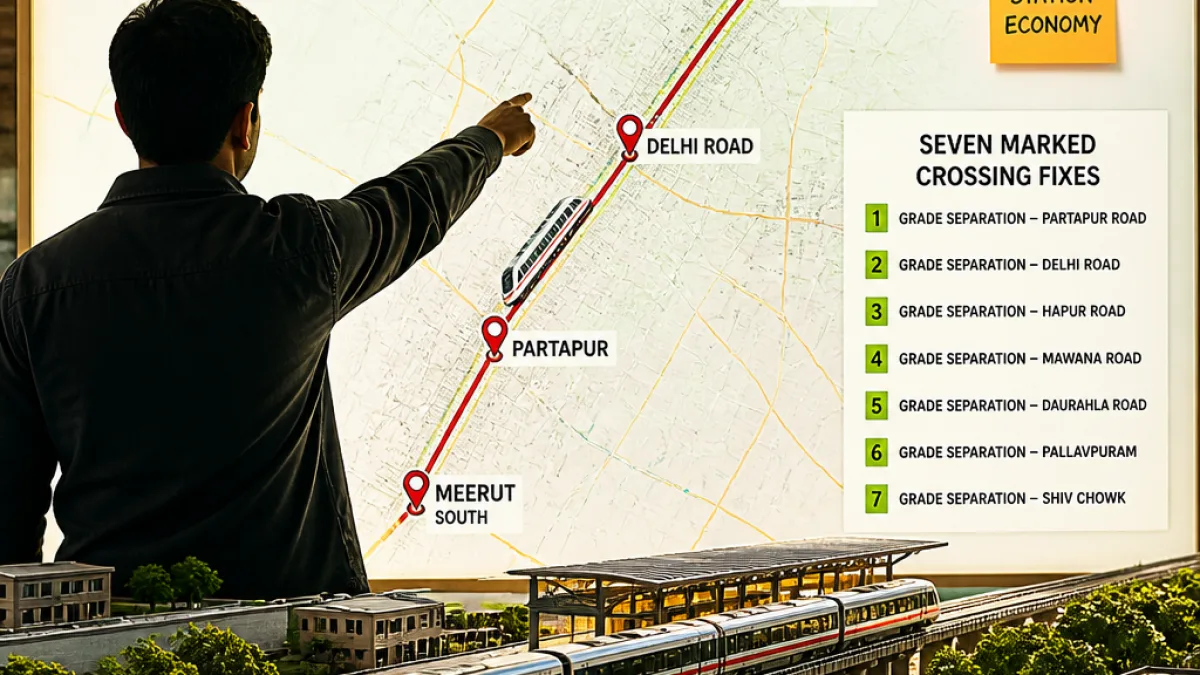
"The train arrived in February; the dividend must arrive now. A station is not a stop, it is a market."He argued that the corridor’s potential must be converted into tangible outcomes for local nodes including Partapur, Delhi Road and the Hapur bus stand.
Five points target stations, townships, freight and transparency
Bhardwaj outlined the plan around five targeted measures, described as necessary to turn the corridor into an economic spine for Meerut. The points he tabled are:
- Station economies — treat stations as markets and micro-economic hubs;
- Township ledger — a public record of planned township developments along the corridor;
- Freight linkage — integrate freight and logistics facilities with the corridor to serve local industry;
- Open dashboards — public monitoring of commitments, timelines and land-use changes;
- Seven crossing fixes — specific interventions to address level crossings and access points in Meerut.
The plan also calls for clear assignment of responsibility for each item and timelines for their delivery, with public dashboards proposed to ensure transparency and accountability.
| Item | Purpose |
|---|---|
| Station economies | Generate commercial activity and jobs at transit nodes |
| Freight linkage | Connect local manufacturers and logistics to corridor capacity |
| Open dashboards | Track progress publicly and assign responsibility |
Why the plan matters for Meerut
The MLC linked the proposal to a longer shift in the city’s geography of opportunity. Meerut’s road link to the capital was substantially shortened after the opening of the Delhi–Meerut Expressway in 2021, and the RRTS’s full operation in February 2026 has further rewritten commuting patterns. Bhardwaj noted this strategic change while pointing to Meerut’s industrial profile, including its large share in the country’s sports-goods exports.
By presenting the RRTS Dividend Plan as a delivery-focused document, the MLC sought to move debate from infrastructure celebration to economic management. The plan highlights the need for land-use decisions, logistics integration and commercial planning to follow the transport investment so that local residents and businesses capture benefits.
Local stakeholders will watch whether municipal and state agencies adopt the plan’s proposed public dashboards and whether developers and logistics operators begin formalising township and freight projects around the corridor nodes named by Bhardwaj.
If implemented, the measures aim to convert reduced travel time between Meerut and Delhi into employment, higher land values and improved freight connectivity for manufacturing centres around the city. Bhardwaj’s proposal therefore seeks to align transport infrastructure with measurable economic outcomes for Meerut’s residents and firms.
Officials and agencies responsible for corridor development did not issue an immediate response to the plan at the time it was presented.