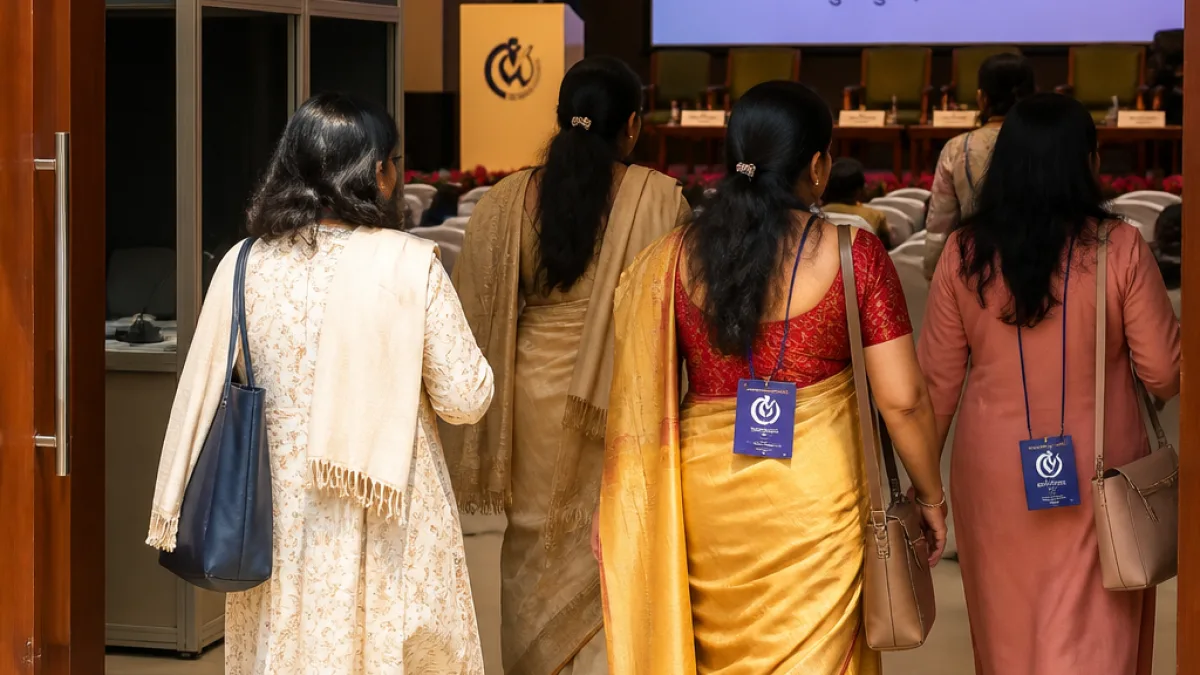
A delegation of women legislators from Kerala walked out of a National Commission for Women (NCW) capacity-building workshop in Surajkund, Faridabad, on Tuesday, alleging that most sessions were conducted in Hindi and that translation or English usage was not provided to facilitate participation by representatives from non-Hindi-speaking states.
Kerala delegation raises inclusion concerns
The Kerala group at the two-day workshop included Deputy Speaker Shanimol Osman, Ministers Bindhu Krishna and K A Thulasi, and MLAs KK Rema, Fathima Thahliya, Vidya Balakrishnan and Usha Vijayan. They said they had expected practical guidance on legislation and legislative procedures but found the sessions overwhelmingly Hindi-medium, limiting interaction and comprehension.
Minister Bindhu Krishna said the objection was not to Hindi per se but to the absence of arrangements that would allow non-Hindi speakers to follow and participate. "We are from South India. We don’t understand Hindi to that extent, so we requested that they mix it with English so we could understand. But nobody heard," she said.
"We expected more information, ideas and guidelines on legislation -- how we make laws and how we implement them," Krishna said.
Format and content of sessions criticised
The legislators complained that while printed materials and posters were in English, oral sessions proceeded largely in Hindi, with limited scope for interaction. They said a planned open-house discussion was not held and that the programme consisted mainly of lectures on procedural matters such as filing police complaints and calling ambulances, rather than detailed legislative training they had anticipated.
MLA Fathima Thahliya pointed out that the schedule chiefly featured a series of classes, leaving little room for reciprocal exchange or introductions among participants from different states. The group said they were not given an opportunity to introduce themselves or share their experiences with other women representatives.
Political context and reactions
News of the walkout drew comment from senior leaders, with Congress MP Shashi Tharoor critiquing the Centre’s handling of cooperative federalism. Tharoor said the episode illustrates a broader problem when national-level initiatives do not adequately account for linguistic diversity and the needs of representatives from non-Hindi-speaking regions.
The NCW had inaugurated the workshop on Monday, with Lok Sabha Speaker Om Birla taking part in the opening session. The programme was billed as a capacity-building exercise for women legislators from across the country.
What the delegation said and what they sought
- Main concern: Sessions conducted largely in Hindi, hindering comprehension for non-Hindi speakers.
- Requested remedy: Simultaneous English usage or translation to allow meaningful participation.
- Expectation: Practical legislative guidance and interactive sessions rather than lecture-led procedural briefings.
The Kerala legislators emphasised that their issue was procedural and about inclusivity rather than a critique of any particular language. They urged organisers of national programmes to ensure language accessibility so that representatives from states with different linguistic backgrounds can participate fully.
Broader implications for national programmes
The incident underlines recurring tensions over language and representation in pan-India events. For a statutory body like the NCW, which engages with elected representatives from diverse linguistic regions, ensuring multilingual facilitation is central to equitable participation. Without adequate arrangements for simultaneous translation or bilingual delivery, the utility of capacity-building initiatives for participants from non-Hindi-speaking states is likely to be compromised.
The Kerala delegation said they would pursue clarification from the commission on why translation or English medium sessions were not made available and seek assurances for more inclusive arrangements in future NCW programmes. The NCW has not, as yet, issued a public response to the walkout and the complaints raised.
| Delegation | Key complaint |
|---|---|
| Kerala women legislators | Sessions conducted largely in Hindi; lack of English use or translation |
| NCW workshop (Surajkund) | Billed as capacity-building; discussions reportedly focused on complaint processes rather than legislative training |
The walkout adds to ongoing debates about how national institutions and programmes can better accommodate India's linguistic plurality, particularly when engaging elected representatives whose capacity to participate fully affects governance and legislative outcomes.