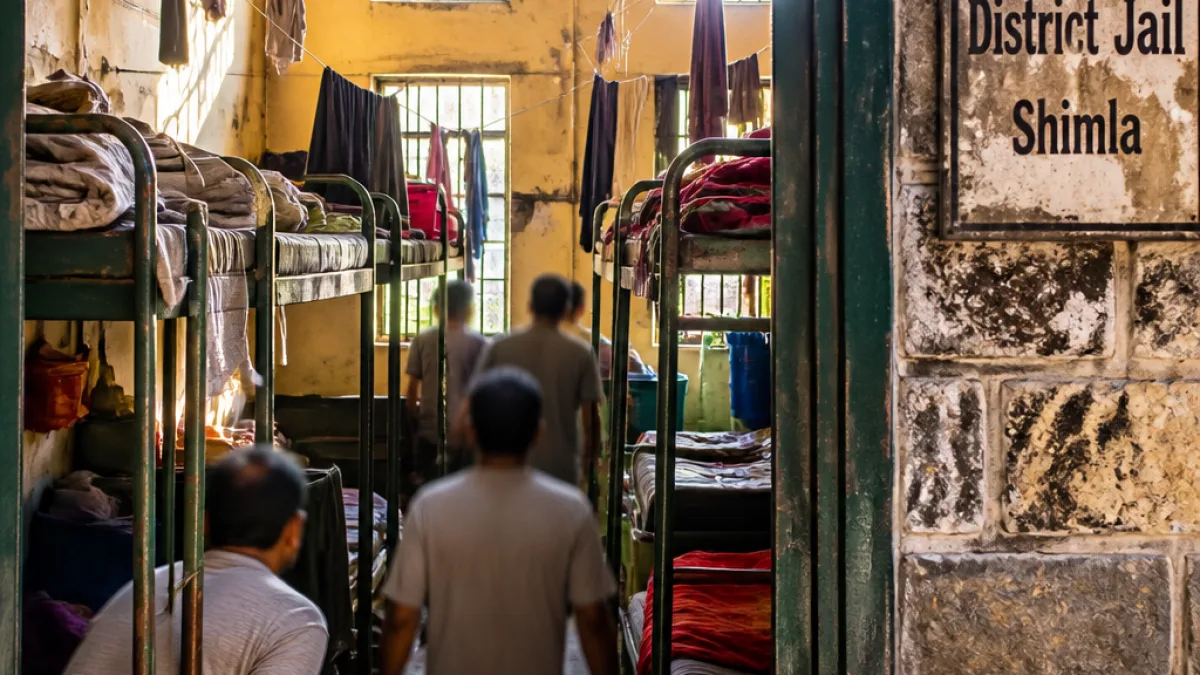
Shimla: Prisons in Himachal Pradesh are housing roughly 30 per cent more inmates than their sanctioned capacity, the state government told the Legislative Assembly on Monday. Chief Minister Sukhvinder Singh Sukhu provided the figures in a written reply to a question from Shahpur MLA Keval Singh Pathania.
"Prisons in Himachal Pradesh house about 30 per cent inmates more than their sanctioned strength," the reply stated.
Numbers and classification
The government said there are 3,355 persons lodged across the state's 14 prison facilities, compared with a sanctioned strength of 2,580. Of the total, 1,113 are convicts, 2,203 are undertrial detainees and 39 are held under civil or preventive detention.
The data indicates that undertrials constitute nearly two-thirds of the prison population, a factor that has significant implications for case backlogs, access to legal aid and the overall burden on correctional infrastructure.
Facilities operating above sanctioned strength
The Assembly reply named several institutions where the inmate count substantially exceeds authorised capacity. The most notable figures included:
- Model Central Jail, Nahan: 553 inmates against a sanctioned capacity of 471.
- Model Central Jail, Kanda (Shimla): 530 inmates against capacity of 438.
- District and Open Home, Dharamshala: 552 inmates against a sanctioned capacity of 355.
| Prison | Inmates | Sanctioned capacity |
|---|---|---|
| Model Central Jail, Nahan | 553 | 471 |
| Model Central Jail, Kanda (Shimla) | 530 | 438 |
| District & Open Home, Dharamshala | 552 | 355 |
Legal and operational constraints
Responding to a supplementary question in the House, the government said that persons convicted under the Narcotic Drugs and Psychotropic Substances (NDPS) Act cannot be transferred to open-air or open-air jail facilities under the present statutory and procedural framework. The Himachal Pradesh Prison Manual, 2021 and associated standard operating procedures were cited as the governing documents.
The reply also noted that a decision on establishing a dedicated high-security prison in the state will be taken "at an appropriate time," signalling that no final approval has been conveyed to the Assembly.
Implications and concerns
Overcrowding raises multiple concerns for prison administration and detainee welfare. High occupancy levels can strain medical services, sanitation, food supply and staff resources. For undertrials, prolonged detention before conviction also has legal and social consequences, including disrupted livelihoods and family hardship.
The Assembly information does not include details on the availability of legal aid, remand hearing frequency, prison staff-to-inmate ratios or the state of healthcare services inside the facilities — areas that human rights groups and defence counsel commonly cite when assessing prison conditions.
Other Assembly disclosures
In the same question-and-answer sequence, the government provided additional information on health and disaster relief. It said that between January 2023 and August 10, 2026, a total of 84,162 cancer patients visited government and private Ayurvedic medical colleges and hospitals in the state for treatment, with year-wise patient counts listed for 2023–25.
The Revenue Minister, Jagat Singh Negi, informed the House that the state had not yet received the ₹1,500 crore in central assistance announced by the Prime Minister last year for flood- and rain-affected people; "so far, not a single penny of this amount has been received," he said in reply to a question.
What comes next
The figures placed on the Assembly record are likely to prompt calls for administrative measures such as infrastructure expansion, increased use of non-custodial measures for minor offences, accelerated trial processes for undertrials, and enhanced prison health services. Any policy shifts or budgetary proposals would need approval by the state government and, where relevant, be coordinated with central regulations governing prisons.
Lawmakers may press for more granular disclosures on remand durations, legal-aid provision and staffing levels when the issue is taken up in committee or during further debates.