Modern training aims to secure livelihoods in Agra's footwear clusters
Agra — The Uttar Pradesh government's One District One Product (ODOP) initiative is seeking to breathe new life into Agra's footwear and leather ecosystem by combining skill development, access to machinery and linkages to finance and markets, officials and local administrators said.
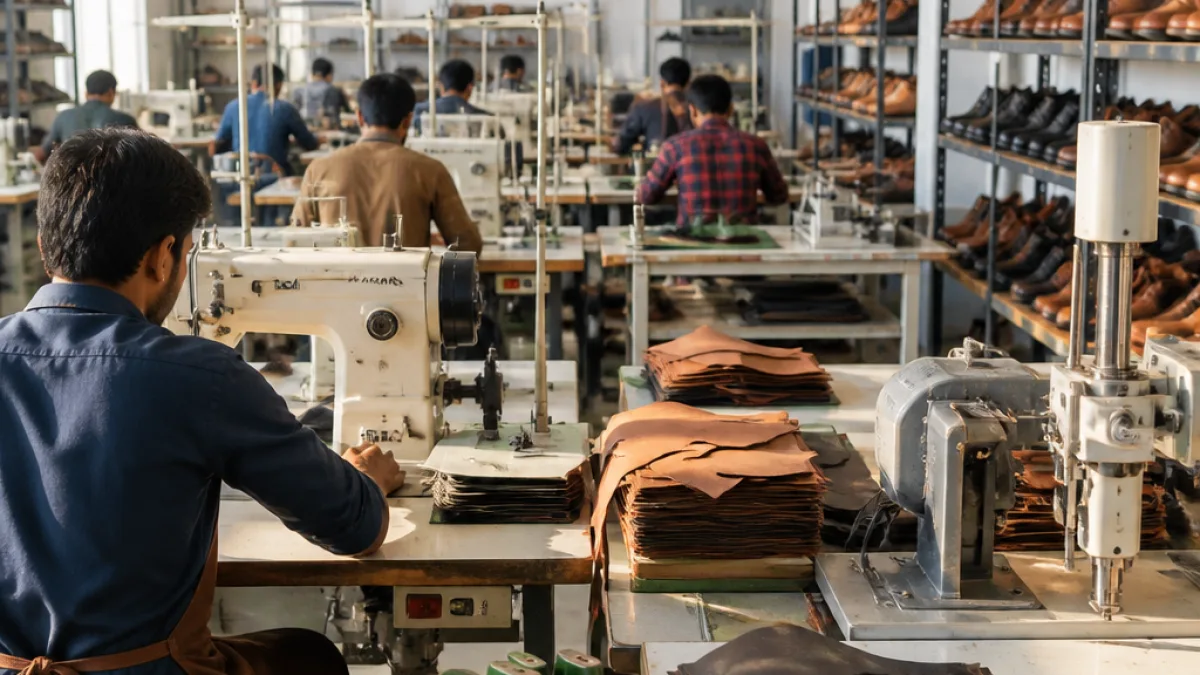
At the Common Facility Centre (CFC) in Nawada village on Shamshabad Road, trainees — including young men and women — are receiving instruction in cutting, stitching, finishing and packaging, alongside hands-on exposure to modern footwear machinery, according to district industry officials. The effort is pitched as more than short-term skill training: the programme aims to integrate inherited craft practices with institutional support to create sustainable livelihoods.
- Scale of the sector: Around ₹4,000 crore worth of leather products are exported from Agra annually, the district industry department said.
- Industry composition: The sector comprises roughly 150 export units and an estimated 4–5 lakh people dependent on leather and footwear for their livelihoods.
- ODOP approach: The initiative combines training, access to credit, machinery and market linkages rather than being a single stand‑alone scheme, Anuj Kumar Singh, Joint Commissioner of Industries, Agra Division, said.
"The ODOP initiative is not a single scheme but a combination of government interventions," Anuj Kumar Singh, Joint Commissioner of Industries, Agra Division, said.
Agra's footwear cluster includes small workshops and home-based units where skills are traditionally transmitted across generations. Officials say those informal arrangements have limited access to capital, standardised machines and formal market channels — constraints the ODOP model attempts to address by establishing shared infrastructure such as the CFC and facilitating credit and market access.
Trainers at the CFC are focusing on operational skills for modern equipment used in footwear and leather production, together with finishing and packaging techniques that meet export quality. The training also targets youth and women, whom authorities consider essential to sustaining the artisan base and enabling household incomes to diversify.
| Metric | Figure |
|---|---|
| Annual leather product exports (Agra) | ₹4,000 crore |
| Export units | 150 |
| Estimated people employed | 4–5 lakh |
Local industry officials emphasise that machinery and credit are only part of the solution. The larger challenge, they say, is ensuring younger generations acquire the skills and see viable incomes in the sector so that craft traditions do not erode. By integrating training with access to finance and market linkages, ODOP aims to move units from informal, home-based production toward more organised value chains able to meet domestic and international demand.
Stakeholders in Agra’s footwear cluster will watch whether training at the CFC translates into higher productivity, better product quality and stronger market connections that can sustain export volumes. With exports already substantial, authorities say improving productivity and product standards could preserve and potentially expand the livelihoods of the hundreds of thousands engaged in the trade.
Officials added that non-leather footwear has also been brought under Agra’s ODOP umbrella, expanding the programme’s remit beyond traditional leather products. The initiative is presented as a district-level package of interventions rather than a single scheme, with the objective of creating a more resilient ecosystem for artisans while aligning production with market requirements.
How quickly those measures affect earnings and long-term employment in Agra will depend on sustained follow-through: financing for units, uptake of modern machinery, consistent training quality at the CFC and the establishment of reliable market channels for upgraded products.