
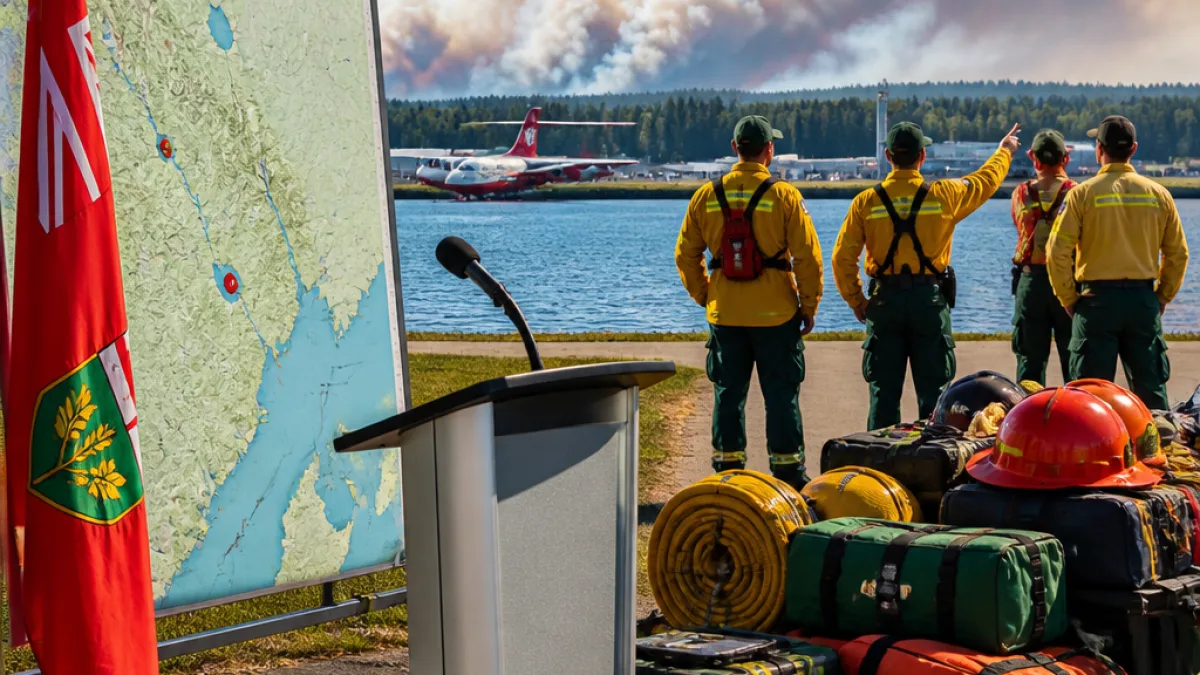
Ontario’s Natural Resources Minister has pledged to strengthen communication with northern communities after criticism that many First Nations received delayed or no warnings during a volatile wildfire season.
The announcement came Monday in Sault Ste. Marie, where the minister also unveiled a provincial commitment of $20 million to upgrade two forward wildfire attack bases in northwestern Ontario. The upgrades are split between $12.3 million for Fort Frances and $8.3 million near Sioux Lookout.
How the season unfolded
Communities across the northwest faced a brutal summer when roughly 200 fires burned in July, forcing residents from more than a dozen northern settlements to evacuate. Several First Nations suffered catastrophic losses: Namaygoosisagagun, also known as Collins First Nation, was largely destroyed and residents fled by boat, while Whitewater Lake First Nation was also badly impacted.
Smoke from the fires travelled far beyond the immediate burn areas. Southern Ontario and parts of the United States saw hazy skies for days, with large urban centres including Toronto and New York City experiencing an eerie orange glow as smoke drifted across the region.
Minister acknowledges communication failures
The minister said the government must get better at rapidly sharing essential information with communities that face sudden threats from fast-moving blazes. He indicated the province will review the season in more depth and share findings with affected communities once a formal plan is developed.
“We’ll be able to do that deep dive to look at some of the challenges that we did face,”
The statement signals a shift from an earlier comment that ministry reviews might not be released publicly; the minister said those after-season reviews will now be shared with the communities affected once the government formalizes its response strategy.
Calls for an inquiry remain unanswered
Leaders from several First Nations have called for a public inquiry into the province’s handling of the wildfire emergency. The minister did not commit to launching a formal public inquiry on Monday. Instead, he pointed to internal reviews and the forthcoming “deep dive” into operational challenges.
For communities that say evacuation notices arrived too late or not at all, that distinction may be important: a public, independent inquiry can compel testimony and produce a public record, while internal reviews remain under government control.
What the $20 million buys
Provincial officials framed the funding as a way to speed frontline responses in a region that is vast, sparsely populated and where fires can move quickly across wild terrain. Upgrading forward attack bases is intended to reduce response times and improve coordination.
| Location | Committed funding | Purpose |
|---|---|---|
| Fort Frances | $12.3 million | Upgrade forward attack base |
| Near Sioux Lookout | $8.3 million | Upgrade forward attack base |
Community concerns and practical implications
Leaders from impacted First Nations have described chaotic evacuations and a perception that the provincial emergency apparatus failed to notify residents in time. For some remote communities, the only viable escape routes were by water or aircraft, complicating evacuations when warnings are delayed.
Officials say improved bases and faster deployments will help, but community leaders and residents will be looking for clearer, rapid-warning systems that reach households and local leadership. That may include better integration of Indigenous emergency alerting protocols and more robust local communication networks.
- Upgraded bases aim to shorten response times to remote fires.
- Public release of seasonal reviews will occur after a formal plan is prepared.
- First Nations continue to press for a public inquiry; government has not agreed.
Looking ahead
Officials framed the investment as a step toward ensuring quicker firefighting responses, but rebuilding trust with northern communities will require more than infrastructure funding. It will demand consistent, timely alerts and an openly shared assessment of what went wrong this season.
As the province moves to finalise its post-season analysis, affected communities will be watching for concrete changes to communication protocols and clear timelines for when upgraded bases will be operational. For residents in isolated northern settlements, timely warning can mean the difference between staying safe and losing a home.
Coverage will continue as the government releases further details about the upgrades and the promised review.















