
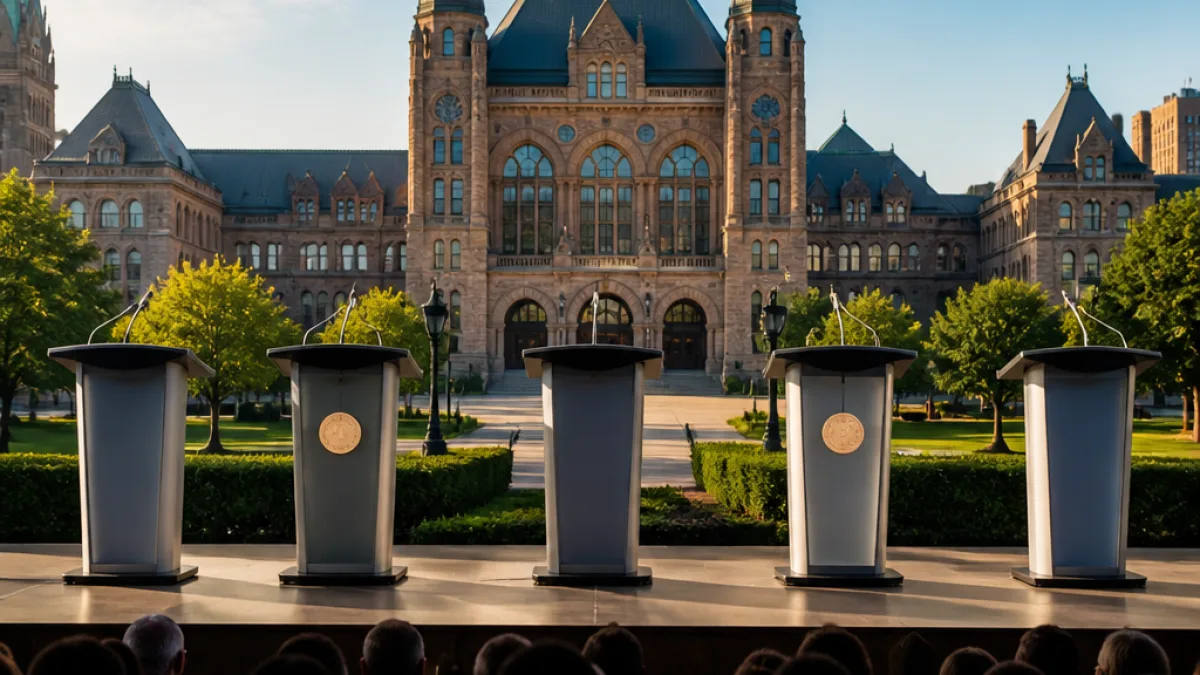
The first debate in the Ontario Liberal leadership contest on Monday night highlighted broad agreement on issues such as health care, education and affordability, but it was a single strategic question that cleaved the five candidates: should the party’s next leader have a seat in the provincial legislature?
Members will select a new leader in November, choosing the party’s fourth leader since 2018. The two most recent leaders, Steven Del Duca and Bonnie Crombie, both led the party from outside the legislature, and the Liberals finished third in the 2022 and 2025 provincial elections.
Division over presence at Queen’s Park
Among the five candidates on stage, two — Etobicoke-Lakeshore MPP Lee Fairclough and caucus colleague Stephanie Bowman — argued that having a sitting MPP as leader matters. Fairclough said she has heard persistent concerns from party members and voters that repeating the approach of choosing leaders without seats has not worked.
“We’ve tried it multiple times now, and it has not worked. And if we have a compelling candidate that has leadership experience, that has a seat in the legislature, it will make the difference.”
Two other candidates, housing advocate Eric Lombardi and former political staffer Dylan Marando, rejected the premise that the leader’s legislative status will drive voter decisions. Marando told the audience that voters will judge candidates on policy competence and results rather than parliamentary logistics.
Former federal cabinet minister Navdeep Bains sidestepped a direct answer on whether the provincial leader must hold a seat, instead invoking his cabinet and federal government experience while urging a focus on broader change.
Policy consensus, tactical disagreement
Across 90 minutes, the five candidates returned to similar ground: plans to tackle wait times and pressures in the health-care system, proposals to strengthen public education, and measures aimed at easing cost-of-living pressures for families. That commonality underlines the challenge for members choosing a leader — picking between candidates who broadly agree on priorities but differ on style and electability strategy.
Those differences are not trivial. A leader who sits in the legislature can directly hold the government to account during Question Period, participate in committee work and be more visible on the floor of Queen’s Park. A leader without a seat must rely on caucus members to be the party’s parliamentary voice until they win a seat through a by-election or general election.
- Leadership vote: Party members will decide in November.
- Key fault line: Whether the leader should already hold a seat at Queen’s Park.
- Background: Liberals have had two successive leaders from outside the legislature, and placed third in the last two elections.
What’s at stake for the party
The dispute reflects deeper questions about the party’s path back to competitiveness. Some caucus members argue that an in-legislature leader would offer immediate parliamentary leverage and credibility. Others counter that electability rests on message and competence rather than whether a leader is currently an MPP.
For voters, the disagreement may seem arcane but it has practical implications. A leader in the legislature can set the political agenda, press the government on daily issues and appear more consistently in televised legislative proceedings. Conversely, a leader from outside may focus on broader outreach, fundraising and provincial organization before contesting a seat.
| Item | Recent context |
|---|---|
| Last time Liberals in government | 2018 |
| Leaders since 2018 | Four by November selection |
| Finishing position (2022, 2025) | Third |
As the leadership race progresses toward member ballots in the fall, the debate underlines two different tactical approaches to rebuilding the party: immediate parliamentary presence versus a campaign-focused leader building provincial momentum from outside the legislature. Both camps argue their route is the most likely to end the party’s third-place finishes.
For voters and party members across Ontario — from city wards to northern ridings — the choice will determine not just who runs the party but what model of opposition they expect to see at Queen’s Park in the next election cycle.
Coverage of the leadership race will continue as candidates criss-cross the province in the coming weeks, testing which combination of policy platform and political strategy resonates with members ahead of the November vote.















