
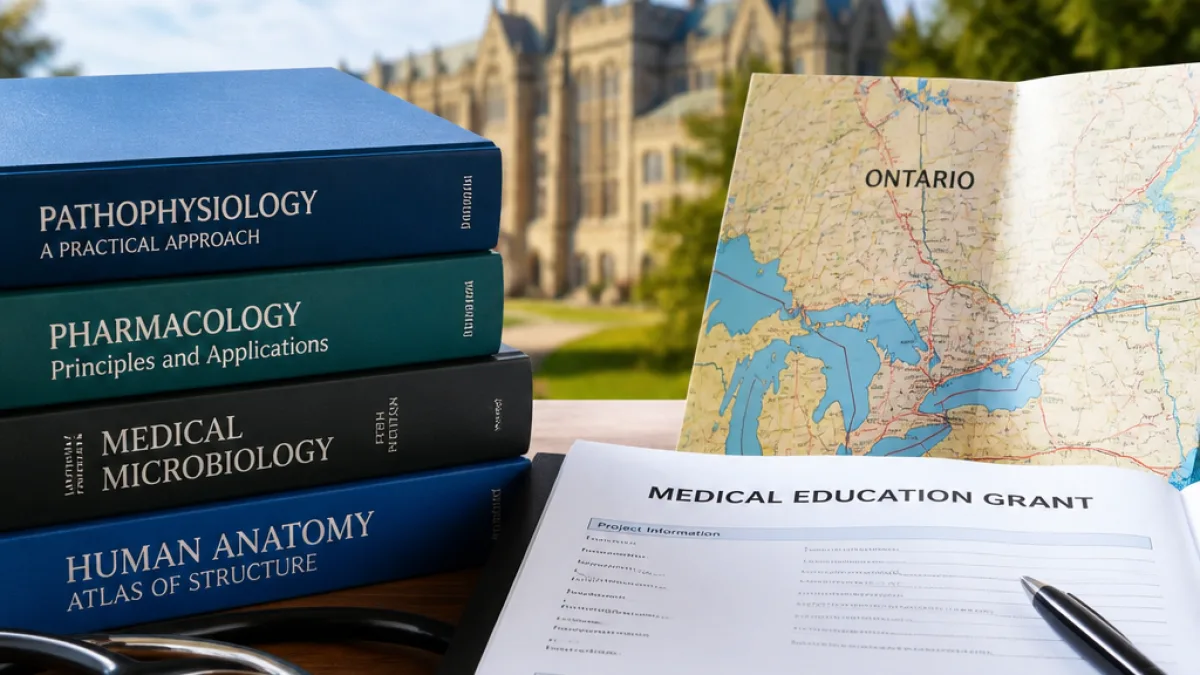
The Ontario government has opened applications for an expanded stream of the Ontario Learn and Stay Grant, launching a new Medical Education (OLSG-ME) component backed by a $220 million investment aimed at supporting more than 2,000 future family physicians who agree to practise in the province.
What the program covers
Under the new stream, postgraduate medical students who commit to working as family doctors anywhere in Ontario for a minimum of five years after graduation will have their undergraduate medical-school tuition, books and other direct education costs covered. The program is intended to reduce financial pressure on medical students and encourage them to remain in Ontario to provide primary care.
Government context and past expansions
The OLSG was first launched in spring 2023 to support students in nursing, paramedic and medical laboratory technology and science programs who pledge to work in high-need regions where they trained. In 2024, the province announced an earlier expansion that committed $88 million to help train 1,360 future family doctors under a broader OLSG stream.
Officials say the current announcement increases the program’s scale to support four cohorts of family medicine trainees, with the total number of medical students benefiting now exceeding two thousand.
“By breaking down financial barriers for our province’s next generation of family doctors, we are strengthening Ontario’s pipeline of highly skilled physicians, ensuring everyone can access the care they need, when and where they need it,” said Nolan Quinn, Minister of Colleges, Universities, Research Excellence and Security.
Deputy Premier and Minister of Health Sylvia Jones framed the expansion as part of the government’s effort to grow medical education and bolster the supply of primary-care physicians across urban and rural communities.
How it works — at a glance
- Who is eligible: Postgraduate medical students training to become family doctors.
- What is covered: Undergraduate medical tuition, books and other direct education costs.
- Service requirement: Minimum five-year commitment to practice family medicine in Ontario after graduation.
- Scale: Investment of $220 million supporting over 2,000 students across four cohorts.
Numbers and timeline
| Year | Investment | Planned trainees |
|---|---|---|
| 2023 | Program launched (initial stream) | N/A |
| 2024 | $88 million | 1,360 |
| 2026 | $220 million | Supports more than 2,000 |
Local impact and questions remaining
From Toronto neighbourhood clinics to family practices in smaller communities, the province has struggled for years with primary-care shortages. The new funding aims to expand the pipeline of family physicians by reducing the upfront cost of medical education — a factor often cited by students when considering where to train and practise.
However, details that will matter to communities and trainees remain to be clarified publicly, including how placements will be distributed geographically, what support will exist for trainees who choose to practise in underserviced rural and Indigenous communities, and how the province will track and enforce the five-year return-of-service commitment.
Health-system planners and municipal officials will also be watching how the program's expanded intake translates into actual practice capacity in underserved areas. Training more family doctors is a necessary step but not the only one: clinics, infrastructure, and provincial incentives to establish practices in lower-density regions are also critical to turning graduates into practising physicians available to patients.
Applications now open
The province says applications for the new OLSG-ME stream are open. Prospective applicants, medical schools and health-care partners will need to consult the program guidelines and deadlines issued by the Ministry of Colleges, Universities, Research Excellence and Security for details on eligibility and the application process.
The announcement marks a significant provincial investment in primary-care training. Whether the plan translates into more family doctors on the ground — in Toronto clinics and in small-town practices across northern and rural Ontario — will depend on the program’s administration and complementary policies to support new physicians once they graduate.
Reporting from London.















