
Majority of voters left unrepresented, advocates warn
Three recent Ontario by-elections — in Hamilton East—Stoney Creek, Scarborough Southwest and York—Simcoe — have renewed scrutiny of the province's first-past-the-post voting system, with critics arguing the results again demonstrate how many voters' preferences fail to translate into representation.
Across the three ridings, a sizeable proportion of ballots did not contribute to electing the successful candidate, according to analysis from electoral reform advocates. The pattern mirrors broader trends observed in the 2025 provincial election: parties' shares of the popular vote did not align with the number of seats they secured in the legislature.
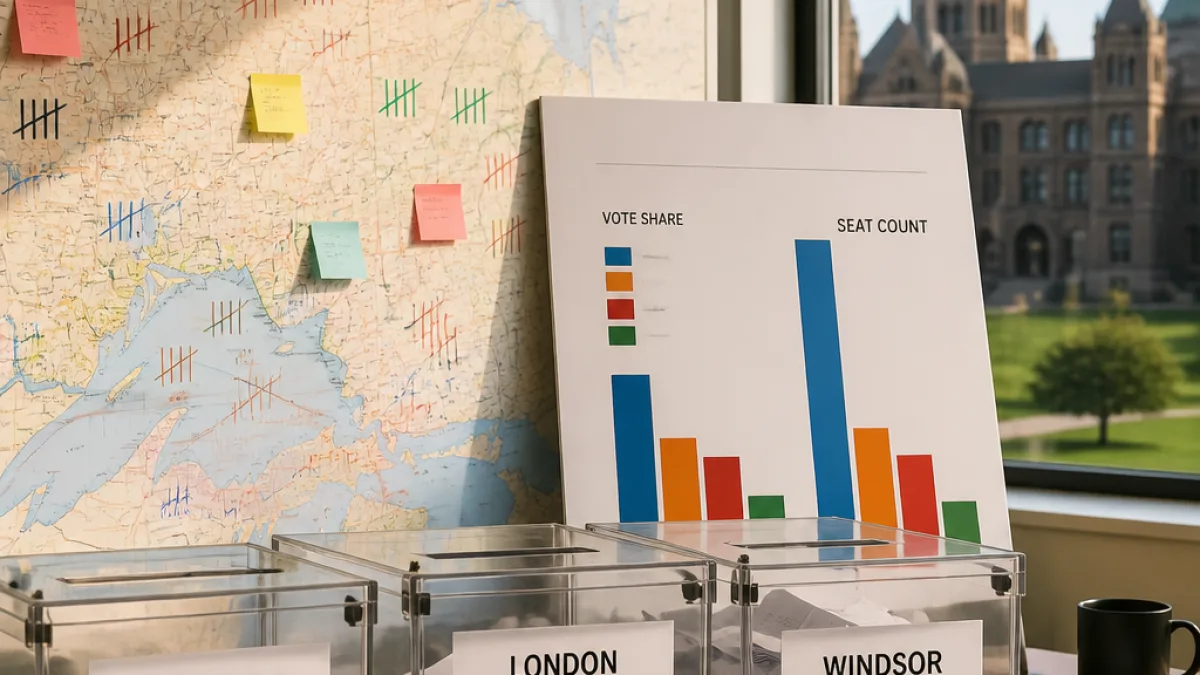
Vote totals vs. seats
Reform proponents pointed to by-election totals that were unfavourable to the Ontario Liberal Party despite its overall vote strength. In the September by-elections the Liberals received 21,950 votes across the contested ridings while the Ontario NDP totalled 18,774. Yet the distribution of seats left Liberal voters without representation from those results.
| Party | Popular vote (2025) | Seats (2025) |
|---|---|---|
| Ontario Liberal Party | 29.9% | 14 |
| Ontario NDP | 18.6% | 27 |
Those figures underline the argument that first-past-the-post can produce legislative outcomes that diverge markedly from the popular will. The Progressive Conservatives formed a third consecutive majority government in 2025 with less than half of the popular vote, a result critics say concentrates decision-making power among a minority of voters.
Local campaigns and the progressive split
In Hamilton East—Stoney Creek, observers said centre-left voters were split between parties with overlapping policy priorities, opening the door for a Progressive Conservative candidate to win despite a combined progressive plurality. Candidates and activists on the ground described a familiar dynamic: competition among ideologically similar parties that, in aggregate, attract more support than the victor but cannot translate it into a single winning candidacy.
“What are we doing here? Why are we doing this? When it comes down to it, the progressive parties can agree that we want to do better in areas that I highlighted, better public schools, better health care, better environment… What are we doing fighting this progressive primary and knocking each other over the head? We are different parties for a reason, but there is more that unites us…”
The quotation above, from Ontario Liberal candidate Heino Doessing during a July appearance on the OShow, framed what many centre-left voters and candidates alike describe as the dilemma: shared policy goals but competing candidacies under a voting system that rewards plurality winners.
Calls for proportional representation
Advocates for electoral reform have seized on the by-election outcomes to press for a shift to proportional representation, saying it would better match seat allocation with the popular vote and reduce the frequency of ‘‘wasted’’ ballots. They argue proportional systems would enable smaller parties and coalition arrangements to reflect a broader range of voters in provincial decision-making.
Some within the Ontario Liberal Party have been urged to champion such a change, particularly given the party's recurring under-representation relative to its share of the vote. Reformers say party leadership could use its platform to initiate cross-party discussions about replacing first-past-the-post with a proportional model.
Practical implications for voters and parties
For voters, the debate is about whether the system should prize geographic constituency representation over a legislature that mirrors province-wide preferences. For parties, it is a strategic calculation: under first-past-the-post, coordination or tactical campaigning can determine outcomes in closely contested ridings; under proportional systems, seat totals would track broader vote shares more closely.
- Voters: The system influences whether a ballot helps elect a local representative or effectively becomes non-contributory.
- Parties: Strategic decisions about whether to run candidates in every riding or to negotiate alliances would shift under different electoral rules.
- Policy-making: Majority governments formed with less than half the vote may govern without broad-based public support on major decisions.
As the province digests the by-election outcomes, the discussion over electoral mechanics is poised to re-emerge in policy circles and among party strategists. Whether that will translate into a concrete push for electoral reform depends on political will across party lines and public appetite for changing a system that, while familiar, produces recurrent distortions between votes cast and seats won.
For many Ontarians, the recent by-elections are more than a tally of winners and losers: they are a reminder that how votes are counted matters to who governs and whose voices are heard at Queen’s Park.















