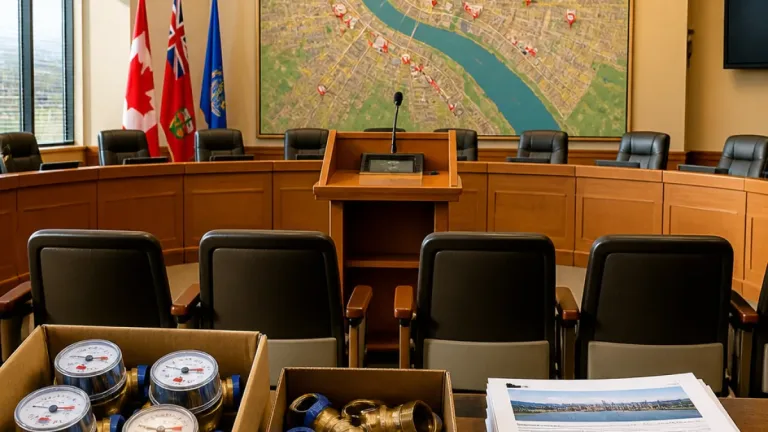
Oakville council has enacted a one-year moratorium on new data centres, becoming the first municipality in Ontario to pause such development while it studies the potential effects on municipal services, utilities and neighbourhoods.
Scope and purpose of the pause
On Tuesday, council passed an interim control bylaw that halts the construction of new data centres, enterprise computing facilities and certain high-intensity processing sites for up to one year. Under Ontario planning rules, municipalities may use such bylaws to temporarily restrict land uses while conducting a land-use planning study; the moratorium may be extended to a second year if required.
Council emphasised that the pause is not a permanent ban. Rather, the town says the interval will allow staff and elected officials to review Oakville’s Official Plan policies and zoning regulations and determine what controls or updates are needed so that future projects can function sustainably without compromising municipal goals.
What Oakville will examine
The town has outlined a program of study to assess how data centres could interact with local systems and residents. Areas under review include:
- Electricity demand and the capacity of local distribution systems;
- Water use for cooling and associated infrastructure;
- Telecommunications infrastructure needs and siting;
- Noise and vibration impacts on nearby homes and businesses;
- Emissions and environmental effects;
- Land use compatibility with surrounding neighbourhoods;
- Municipal infrastructure strain and servicing requirements;
- Environmental goals and climate commitments; and
- Public health and community impacts.
Ward 6 councillor Tom Adams told council the town wants to better understand the interaction between data centres and local utilities.
"The town hopes to see how data centres interact with electricity, water, telecommunications infrastructure," Ward 6 councillor Tom Adams said.
Why Oakville moved first
The moratorium comes as demand for large-scale computing and artificial intelligence services is driving rapid expansion of data centres across Canada. Municipal officials in Oakville signalled concern that existing planning and zoning rules may not address the specific demands and externalities posed by high-intensity processing facilities.
By pausing approvals, Oakville aims to identify whether additional zoning controls, servicing requirements, environmental safeguards or noise standards are necessary before new projects are accepted. The town’s review is intended to balance economic opportunity with protecting environmental objectives and local livability.
Local consequences and next steps
For residents, the study period should provide clarity about potential changes to land-use patterns and any measures the town may impose on future projects. For developers and utilities, the moratorium will delay approvals while the municipality completes its review, though council has stressed the measure is temporary.
| Item under review | Potential local concern |
|---|---|
| Electricity demand | Strain on distribution networks, need for upgrades |
| Water use | Cumulative consumption for cooling and treatment capacity |
| Noise & vibration | Effects on adjacent residential areas |
| Emissions & environment | Greenhouse-gas impacts, local environmental objectives |
The town has not yet published a timetable for the study’s milestones or identified specific consultation processes. If council chooses, the interim control bylaw can be extended for a second year to complete the review.
Oakville’s action may influence other municipalities in the Greater Toronto and Hamilton Area and beyond that are weighing how to manage a surge in demand for data-centre space driven, in part, by artificial intelligence and cloud services. Some municipal governments have already flagged concerns about utility capacity and neighbourhood impacts; Oakville’s decision establishes a formal pause and study model.
For now, projects currently in the approvals pipeline will be affected by the moratorium, and prospective applicants will need to await the outcome of Oakville’s land-use study before proceeding with new proposals. Council and staff will be under pressure to balance the municipality’s economic development interests with the need to protect infrastructure capacity and the town’s environmental and community goals.