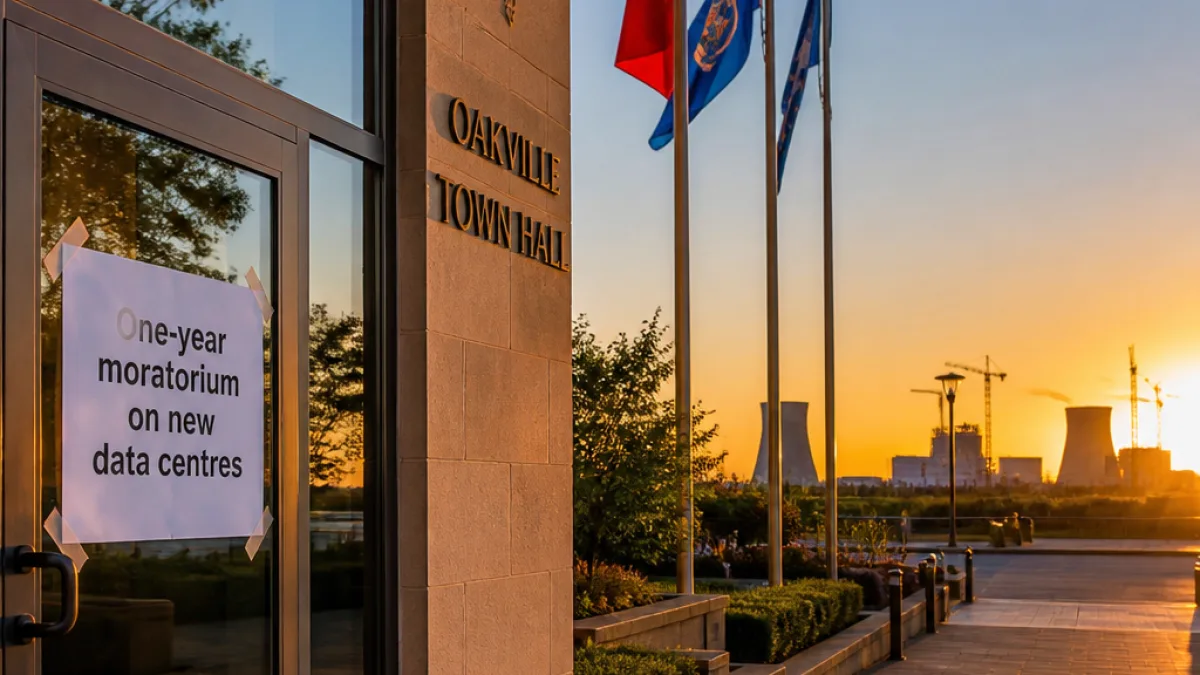
The Town of Oakville has enacted a one-year moratorium on new data centres, becoming the first municipality in Ontario to impose a pause as local leaders move to assess the planning and environmental implications of a rapid expansion in facilities that power artificial intelligence.
Council decision and scope
At a special council meeting on Tuesday, councillors voted unanimously to bar new data centre applications for one year while town staff complete a review of existing regulations. The action is intended to give municipal planners time to study potential impacts and to determine whether zoning, noise and emissions bylaws require updates.
"We're operating here not out of fear, and not in reaction to any one application. That's our job: to be alert, and to take the measures necessary,"
The statement from Mayor Rob Burton was delivered ahead of the vote. Oakville officials have said the pause is proactive; the town does not have any formal data centre applications on file at this time.
What the review will cover
Council directed staff to report back with analysis and recommendations on regulatory changes, with a focus on potential effects connected to data centre operations. Among the issues flagged for study are:
- Noise — including continuous mechanical and cooling system sounds that can affect nearby residential areas;
- Vibration — potential structural and amenity impacts on surrounding properties;
- Emissions — air quality considerations tied to equipment and backup power systems;
- Land-use — whether current zoning maps and official plan policies are adequate to direct where data centres may be sited.
Regional context and developer interest
The moratorium comes as municipalities across the Greater Toronto and Hamilton Area and wider Ontario confront a surge in interest from developers seeking sites for data centres — facilities that house servers and cooling infrastructure that can run energy-intensive artificial intelligence workloads.
Neighbouring Mississauga is scheduled to consider its own pause next month, and Toronto residents and councillors have publicly raised concerns about environmental and community impacts. Oakville's action places the town at the forefront of municipal responses in the province.
Town staff noted that while there are no formal applications at present, developer Hive Digital Technologies has been mentioned in regional discussions as part of broader data-centre activity; council emphasised that the moratorium is not a reaction to any single proposal.
Implications for Oakville residents and landowners
For residents, the immediate effect is a temporary halt on new proposals that might otherwise proceed through planning channels. For property owners and the development industry, the pause creates a period of uncertainty while Oakville refines its policy approach.
Council members framed the moratorium as a risk-management measure designed to ensure the town can set appropriate guardrails now, rather than respond retroactively to projects.
| Item | Detail |
|---|---|
| Duration | 1 year |
| Applications on file | None formal, per town officials |
| Key review topics | Noise, vibration, emissions, land-use |
How quickly council moves from moratorium to updated policy will depend on the findings of staff reports and any public consultations the town undertakes. Municipal planners typically seek technical advice on acoustics, air quality and infrastructure capacity when assessing new industrial or commercial land uses.
Broader questions remain
Oakville's pause raises wider questions about where data centres should be located within the region, how their energy demands will be met, and what buffers or setbacks might be necessary to protect residential neighbourhoods. It also highlights the tension municipalities face when balancing economic development opportunities with community and environmental concerns.
For now, Oakville residents can expect a period of study and public reporting. The town's decision will be watched closely by neighbouring municipalities considering similar measures as they evaluate the local impacts of infrastructure that increasingly underpins artificial intelligence applications.
Further details and timelines for staff reports are expected to be released by the town in the coming weeks.