
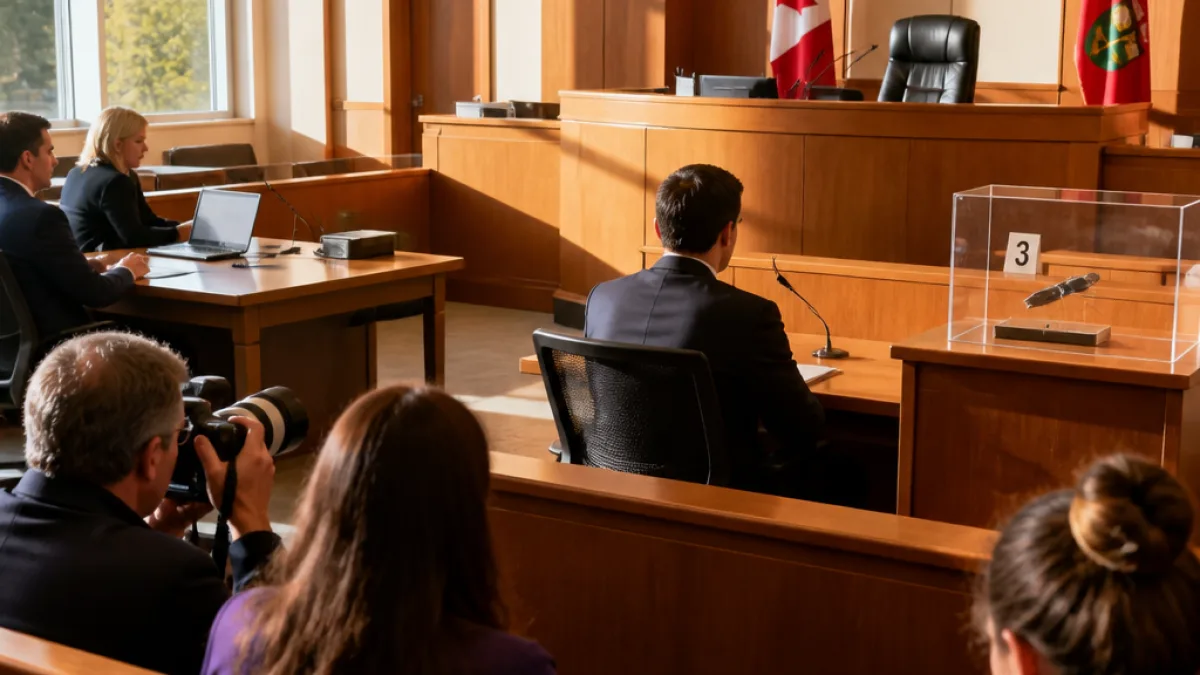
A Superior Court judge in Ontario has convicted a Toronto woman of second-degree murder for the fatal stabbing of her estranged boyfriend at his apartment on Millard Avenue in Newmarket on July 14, 2024.
Judge finds intent, rejects self-defence
In court, Justice Vanessa Christie concluded the accused, identified in court records as Mckenzie Gill, intended to cause bodily harm likely to result in death when she plunged a blade into the victim’s chest. The judge concluded Gill was reckless as to whether the victim would die, rejecting her testimony that the act was in self-defence.
“The court is fully satisfied beyond a reasonable doubt that Ms. Gill knew that by plunging a blade into Mr. Bibby’s chest in the area of his heart, she intended to cause him bodily harm that was likely to cause death and was reckless as to whether he died or not,”
The victim was identified as 36-year-old Blake Bibby. Court records show Gill admitted to stabbing Bibby once with a kitchen knife. She called 911 after the incident, but later provided misleading information about her identity and the events, then left the scene. She was arrested two days later.
History of a violent, on-and-off relationship
Both the Crown and defence agreed the couple had an on-and-off relationship since February 2022 that was volatile and marked by violence. The record includes prior mutual assaults: Bibby was charged with assaulting Gill on three occasions, and Gill faced a single assault charge after an incident in June 2023 when she punched him and threw a phone case.
Justice Christie acknowledged abundant evidence that Bibby had been the primary perpetrator of violence in the relationship and that Gill had suffered abuse. An agreed statement of facts referenced an incident in October 2022, when Gill acted in self-defence and stabbed Bibby in the shoulder after being injured.
Legal findings and credibility concerns
Despite evidence of prior violence by Bibby — which included reports of violent behaviour toward other women and family members — the judge found problems with Gill’s credibility. Gill gave several different accounts of the events to various people, and the judge concluded concerns about Bibby’s conduct arose after the stabbing rather than before.
The court’s decision turned on whether Gill’s actions could be reasonably seen as defensive or whether they demonstrated a conscious intention to inflict potentially fatal harm. On that legal threshold, Justice Christie sided with the Crown.
What the verdict means locally
The verdict reverberates beyond the courtroom: it highlights the complexities courts face when assessing self-defence claims in relationships that are themselves marked by mutual and historical violence. For Newmarket residents, the case is a reminder of the intersections between domestic disputes, court-ordered protections and criminal liability.
- Location: Millard Avenue, Newmarket
- Date of incident: July 14, 2024
- Victim: Blake Bibby, 36
- Accused: Mckenzie Gill — convicted of second-degree murder
Domestic violence supports, protection orders and reporting channels are commonly cited by local service providers as crucial tools for preventing escalation. In this case, court records note Bibby was subject to two court orders that prohibited him from contacting Gill at the time of the killing.
| Detail | Information |
|---|---|
| Charge | Second-degree murder |
| Admission | Admitted to a single chest stab with a kitchen knife |
| Post-incident actions | Called 911, gave misleading details, left scene; arrested two days later |
Sentencing has not been reported at this stage. The verdict will likely influence how future self-defence claims are presented and scrutinized in cases involving a history of domestic violence.
Local officials and advocacy groups frequently urge anyone experiencing threats or abuse to contact police or community services promptly. This case underlines the legal complexities that can follow violent relationships, especially where court orders and prior incidents are involved.
Further updates will follow as more information about sentencing and any possible appeals becomes available.















