
Improved forecast, but deficit remains substantial
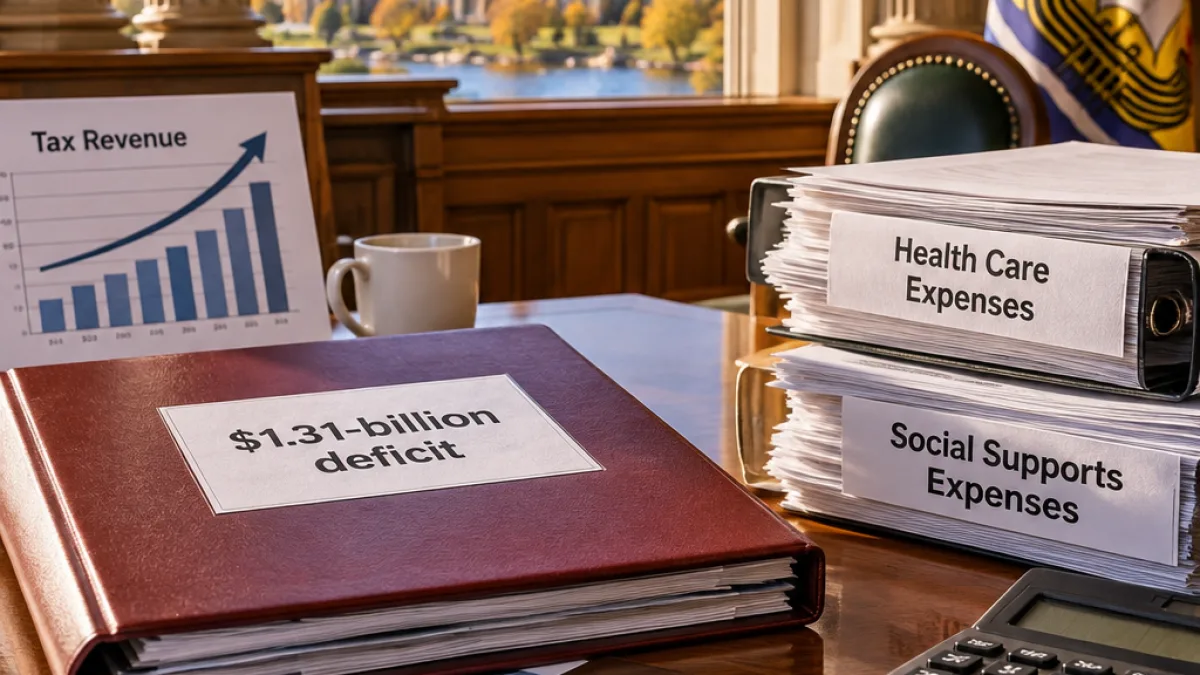
New Brunswick is forecasting a $1.31-billion deficit for the current fiscal year, offering a modest improvement in the province’s financial outlook while leaving the government with a significant shortfall to manage.
The revised projection, released Friday, is lower than the $1.39-billion deficit presented in the March budget. It is also substantially below the nearly $1.7-billion deficit anticipated in the government’s first-quarter update. The change reflects stronger-than-expected revenue, particularly from personal and corporate income taxes.
Finance Minister René Legacy said the figures point to positive movement in the economy, but cautioned that the province’s fiscal position remains far from resolved.
“The progress reflected in today’s update is encouraging, but our work is far, far from done,” Legacy said.
The minister said the province’s performance should not be judged by one reporting period alone. He framed the latest figures as part of a longer effort to improve New Brunswick’s finances during a period of uncertainty.
Population growth lifts revenue
The government expects to collect $290 million more in revenue than it anticipated when the budget was prepared. The province attributed much of that increase to population growth, which has contributed to higher personal and corporate income-tax receipts.
That additional revenue has helped narrow the projected deficit by about $80 million compared with the March forecast. Relative to the first-quarter estimate, the improvement is approximately $347 million.
| Fiscal measure | Amount |
|---|---|
| Current projected deficit | $1.31 billion |
| March budget projection | $1.39 billion |
| First-quarter projection | Nearly $1.7 billion |
| Expected revenue increase | $290 million |
| Expected expense increase | $207.9 million |
Higher spending reduces the benefit
Revenue gains have not translated into an equivalent reduction in the deficit because projected expenses have also risen. The province now expects spending to be $207.9 million higher than budgeted.
Most of that increase is linked to overruns in social supports and health-care spending. The update therefore presents a mixed picture: stronger receipts have improved the government’s forecast, but pressure on major public programs continues to push costs upward.
The figures do not represent a balanced budget or a return to the spending assumptions set out in March. Instead, they show how the deficit estimate has shifted as the government has adjusted both revenue and expenditure expectations during the fiscal year.
Opposition calls for more restraint
The latest projection also gives the government a chance to emphasize improved revenue performance after a difficult fiscal year. The deficit for 2025-2026 grew to $1.3 billion, compared with a budgeted shortfall of $549 million.
Progressive Conservative Leader Daniel Allain said he was disappointed that the update did not include additional cost-cutting measures. His response highlights the political divide over how New Brunswick should address its finances: the government is pointing to economic growth and improved revenues, while the opposition is calling for tighter control of expenditures.
The update provides no indication that the province has eliminated the underlying pressure from health-care and social-support costs. It also does not erase the difference between the latest forecast and a balanced budget. For residents, the central issue remains how the government will manage those competing demands while addressing the deficit.
What the update means next
The government’s figures will now serve as the latest benchmark for the remainder of the fiscal year. A stronger revenue position may give New Brunswick more room than officials expected earlier in the year, but the benefit is being partly absorbed by higher spending.
Legacy said the government’s work is continuing and that economic progress should be measured over more than a single quarter or year. The province’s next fiscal decisions will determine whether the improved projection represents a sustained shift or a temporary change in the outlook.
For now, New Brunswick remains on track to post a deficit exceeding $1 billion. The revised number is better than earlier forecasts, but the size of the projected shortfall keeps the province’s finances at the centre of the government’s political and policy agenda.