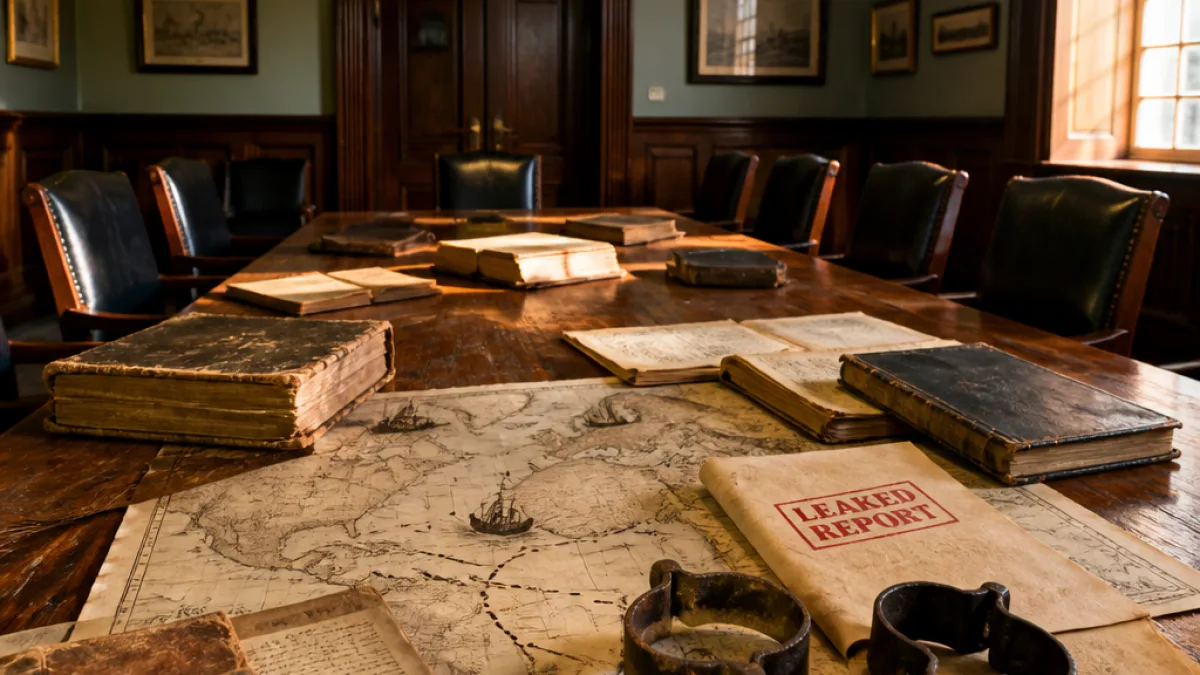
A leaked research report has identified extensive historical links between members of the governing body of London’s Square Mile and the transatlantic slave trade, naming 280 City of London Corporation members it says were involved in trafficking between 1640 and 1807.
Scope of the findings
The document, seen by the Local Democracy Reporting Service and commissioned by the Corporation in December 2024, lists 41 lord mayors — representing 23 per cent of the office-holders in that period — and 129 aldermen among those it identifies as having direct connections to the trade. The report states members linked to crossings were responsible for violently transporting at least a quarter of a million enslaved African men, women and children to plantations, and that roughly 37,000 died during the crossings.
The research was carried out by Professor William Pettigrew using the London Archives and the Register of British Slave Traders. The Register of British Slave Traders data and archival material have previously been used in other institutional reckonings, notably work published by the Bank of England and the Church of England exploring their historical links to slavery.
City response and next steps
A City of London Corporation spokesperson said it was "disappointing the report has been leaked" and that the authority would publish the report later this year. The Corporation also emphasised in its response that the authority itself had no direct link to the trade, but that some of its past members did.
"Addressing this history openly and honestly is important as we build a City where everyone feels welcome and included," the spokesperson said.
It is understood the author may add further details ahead of the report’s official publication.
Patterns and institutional connections
Among the findings the report highlights is the scale of participation in the Royal African Company — an English corporation known for its role in the trafficking of enslaved people. Of the 203 original subscribers to that company, the report says 72 (about 35 per cent) were City of London Corporation members, and 69 members were also identified as independent traffickers.
- 280 Corporation members named as traffickers (1640–1807)
- 41 lord mayors implicated — roughly 23% of office-holders in that span
- 129 aldermen named
- At least 250,000 enslaved people transported with links to those members
- Approximately 37,000 recorded deaths during the crossings
The report examines both individual profiteering and membership overlap between civic office-holders and commercial enterprises that ran the slave trade. Those intersections are central to debates under way in Britain about how to recognise and respond to historical injustice.
Local resonance and wider implications
For communities in London, Ont., the findings will be familiar in broad terms: across Canada and Britain, institutions and municipalities have been wrestling with legacies of slavery and colonialism, including how to commemorate victims, interpret public monuments and consider reparative measures. While the City of London Corporation is a British municipal authority, the methodological approach — using archival registers and commissioned historical research to map personal and institutional links — mirrors processes that Canadian cities have used when auditing difficult pasts.
Documentation naming civic figures in historic wrongs tends to prompt a range of responses: formal apologies from institutions, changes to commemorative practices, and public consultations on how best to address the legacy. The Corporation’s statement — that it intends to publish the report — signals the start of a public process that could lead to recommended actions or further study.
| Item | Figure |
|---|---|
| Members named | 280 |
| Lord mayors implicated | 41 |
| Aldermen implicated | 129 |
| Estimated transported | At least 250,000 |
| Estimated deaths during crossings | Approximately 37,000 |
How the City of London chooses to act after publication will be watched by historians, civil-society groups and civic leaders in other jurisdictions, including in Canada. The leaked report adds to a body of work prompting civic institutions to confront and contextualise links to slavery — part of a broader municipal conversation about history, memory and inclusion that continues to shape public life in both the United Kingdom and Canada.
Further detail and any supplementary analysis are expected when the City of London Corporation releases the full report later this year.