From humanitarian clinic to national midwifery leadership
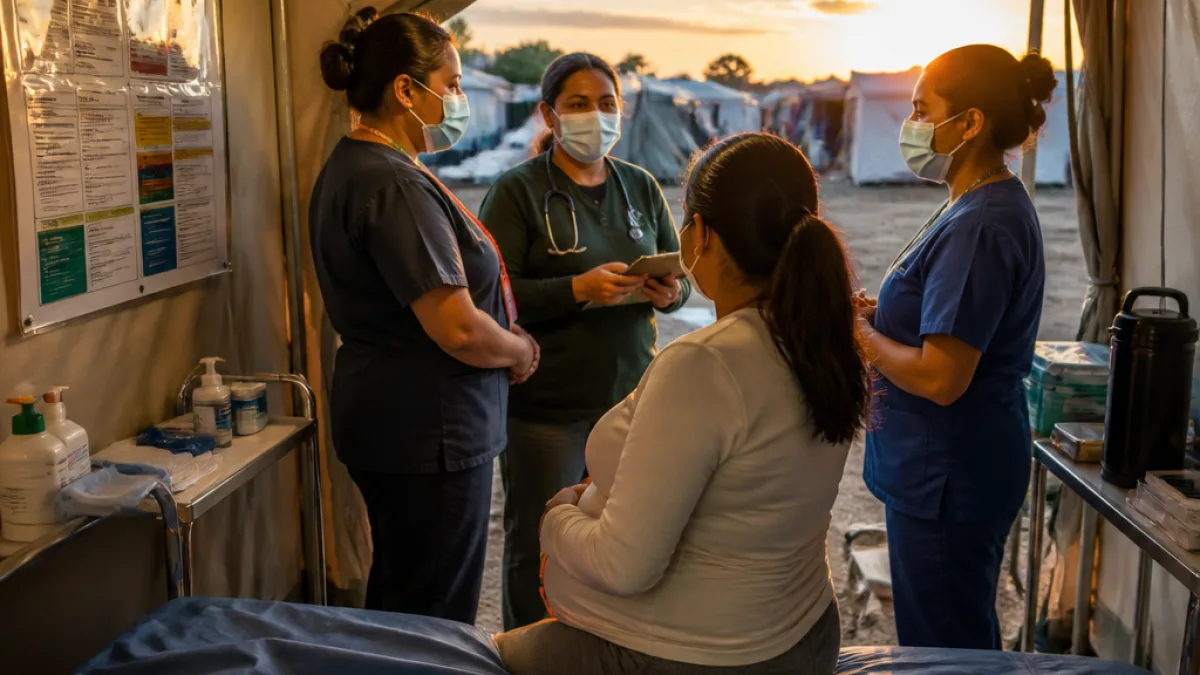
When midwife Kanata Akter began working in health services inside the Rohingya refugee camps at Cox’s Bazar, the facility where she worked attended only four to six births a month. Over subsequent years, and after she moved into a supervisory position, that monthly figure rose to between 80 and 100 births, according to an interview she gave to the International Confederation of Midwives (ICM). Her account foregrounds a claim increasingly central to contemporary maternal health: that access alone is not enough — communities must also trust the care on offer.
“This achievement is not simply about the increase in delivery numbers,” she told ICM. “It represents the trust we built within the community, our success in overcoming cultural barriers, and the collective efforts of midwives, Community Health Workers, and the wider health team.”
Akter is now Midwifery Technical Officer at the Bangladesh Midwifery Society (BMS), ICM’s member association in Bangladesh. Before taking that national role, she spent several years with the HOPE Foundation in Cox’s Bazar providing clinical care and later supervising and mentoring midwives and nurses in a setting where displacement shaped every aspect of pregnancy, birth and sexual and reproductive health.
Trust, culture and why numbers rise
The rise in facility births in that setting was not attributed to a single intervention in Akter’s account but to a combination of sustained community engagement, culturally sensitive care, and integrated teamwork between midwives, community health workers and other health staff. She listed routine services such as antenatal and postnatal care, family planning, obstetric emergency management and care for survivors of sexual violence as core components of the work that helped shift local practice.
- Community engagement — building relationships before and beyond individual clinical encounters.
- Culturally sensitive staffing — addressing preferences such as reluctance to be seen by male practitioners.
- Integrated teams — midwives working alongside community health workers to change perceptions and overcome barriers.
What this means for local health planning
For health planners and practitioners in Kanata and other Ontario communities, the account offers several concrete reminders without suggesting that local and humanitarian settings are identical. First, increased uptake of services often follows trust-building measures rather than simply increasing the number of clinics. Second, culturally appropriate staffing and outreach can be decisive when families face fear, stigma or entrenched preferences. Third, leadership and mentoring — moving skilled clinicians into supervisory and training roles — can spread good practice rapidly within a system.
| Setting | Key challenge | Approach highlighted |
|---|---|---|
| Rohingya camps (Cox’s Bazar) | Displacement, cultural barriers, low facility use | Community trust, female-staffed services, team-based care |
Urban and rural divides in maternal care
In Ontario, contrasts between urban and rural access persist: geographic proximity to services is not always the limiting factor. Kanata residents see this in the differences between suburban clinics, downtown hospitals, and peri-urban or rural services where travel, availability of female providers, and community norms can influence whether and where women seek care. The core lesson from Akter’s work — that respectful, community-rooted midwifery can shift behaviour and improve outcomes — is applicable across these contexts.
At the national level in Bangladesh, Akter’s move from direct clinical work to a technical role at the BMS signals a recognition that strengthening midwifery requires both practice and policy work: mentoring midwives, establishing standards, and integrating community perspectives into service design. These are familiar themes in Ontario health system discussions where workforce development, culturally safe care and community engagement remain priorities.
While the Rohingya camps represent an acute humanitarian context, the underlying mechanisms Akter describes — trust, cultural sensitivity, teamwork and leadership — are not unique to emergency settings. They are equally relevant to municipal and provincial efforts to ensure that pregnant people feel safe, respected and supported when they seek care.
Kanata residents and local health stakeholders may find in Akter’s experience a reminder that investments in midwifery and community health workers, together with attention to cultural preferences and outreach, can yield measurable changes in where and how people give birth. Her work underscores that numbers on their own mean little unless they reflect real improvements in access, dignity and trust.