
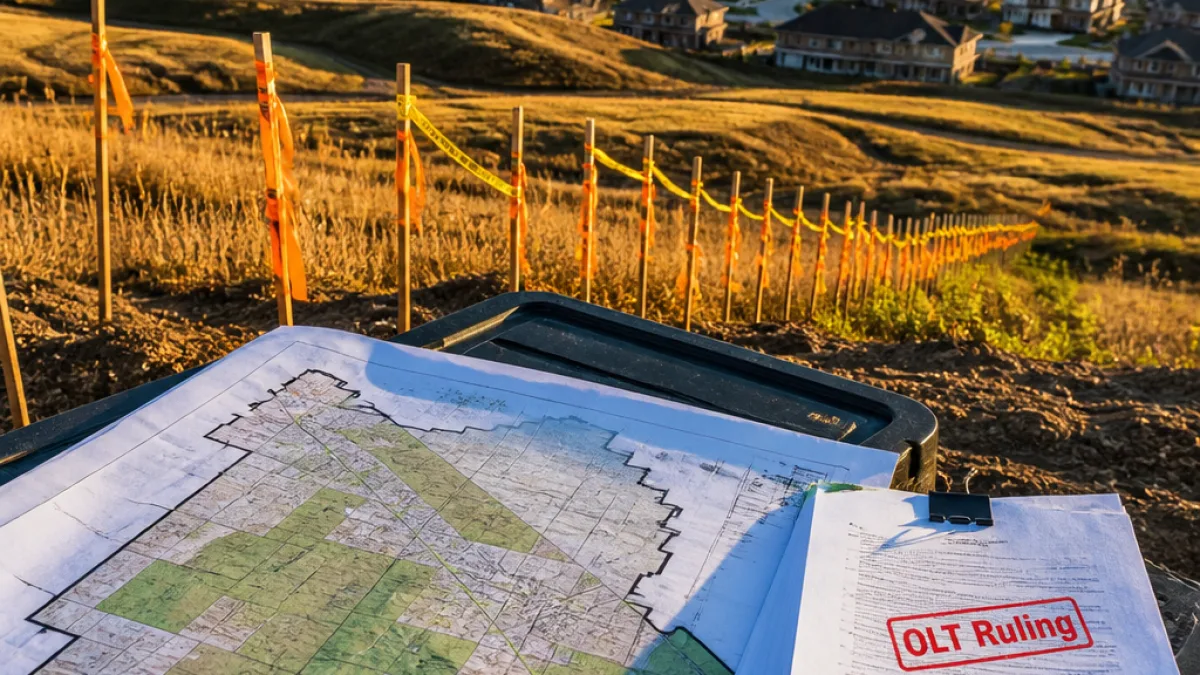
The Ontario Land Tribunal this week ordered a 1,600-hectare expansion to Hamilton’s urban boundary, reversing the city council decision of 2021 that had rejected staff recommendations for growth-area additions. The tribunal’s 45-page ruling retraces a half-decade of shifting municipal plans, consultant studies and public debate over how — and where — the city should accommodate population growth out to 2051.
From staff recommendation to council reversal to tribunal order
City staff and consultants initially identified large tracts around Elfrida and the Mount Hope area as suitable for added urban lands to meet provincially driven population forecasts. Those early plans were intended to provide room for more than 236,000 additional residents expected in Hamilton by 2051.
In 2021, Hamilton council voted 13-3 to cancel the proposed expansion. Members of council cited public pressure and advocacy groups who argued that the projected population increase could be managed through infill and densification inside the existing boundary. Staff, however, continued to advise expansion as necessary to satisfy the Provincial Growth Plan and the Provincial Land Needs Methodology.
“The Ambitious Density scenario represents an aggressive and forward-thinking approach to growth management. [It] represents an achievable, albeit challenging, growth management objective. [It] conforms to the Provincial Growth Plan and the Provincial Land Needs Methodology.”
The tribunal described the city’s plan to meet the forecast through intensification alone as “aspirational,” concluding that the level of infill relied upon by council was not sufficiently supported by evidence to forego land additions.
What the decision means in practical terms
Municipal planners and councillors must now reconcile the tribunal’s order with local priorities. The decision effectively restores — and slightly increases — the scale of new urban lands compared with staff’s later lower estimate. Staff had pared back an original estimate of 1,600 hectares to 1,340 hectares after further studies, calling the reduced figure “ambitious” in reference to the intensification targets required to make it work.
The tribunal’s figure returns the city to a larger expansion footprint. That carries practical consequences for infrastructure planning, transportation, servicing and the pace of development approvals. It also raises questions about the balance between protecting agricultural and natural lands and meeting provincially mandated growth responsibilities.
- Tribunal-ordered expansion: 1,600 hectares
- Staff-revised estimate (2021): 1,340 hectares
- Population forecast to 2051: more than 236,000 additional residents
| Item | Figure |
|---|---|
| Tribunal-ordered expansion | 1,600 hectares |
| Staff recommended (pared-down) | 1,340 hectares |
| Projected population increase (to 2051) | 236,000+ |
Politics, evidence and the limits of intensification
The ruling underscores tensions between council decisions framed as responsive to local advocates and the statutory framework municipal governments must follow. Several councillors have emphasised evidence-based decision-making in recent debates; the tribunal’s finding that the intensification plan was aspirational may prompt renewed scrutiny of where that evidence was judged sufficient or not.
Staff had warned that only a combination of substantial land additions and aggressive intensification inside the existing urban area would meet provincial requirements. The word “ambitious” used by staff to describe the pared-back expansion figure was picked up by opponents and used to imply the plans were overly expansive, even though staff meant the densification target would be difficult to achieve.
For residents, the practical implications will centre on timing and location of development applications, upgrades to roads and sewers, and how neighbourhood character may change in areas identified for growth. For farmland and conservation advocates, the tribunal’s order will be seen as a setback to efforts to limit urban sprawl.
Next steps for Hamilton
The tribunal decision sets a legal direction; it does not itself lay out the detailed servicing plans or phasing timelines. Those technical steps will fall to city staff, developers and, ultimately, future council decisions as studies and development applications come forward. The ruling makes clear that provincial methodology and evidence thresholds carry decisive weight in land-use outcomes — even when municipal politics and public sentiment push in another direction.
Residents and stakeholders can expect renewed consultation and debate as Hamilton works to align municipal plans with the tribunal’s order while attempting to preserve priorities such as densification, protection of agricultural land and the need for new infrastructure.















