Local sentencing in U.S. Georgetown highlights serious drug convictions
A man identified as a resident of Georgetown, South Carolina, was sentenced to a decade in prison after pleading guilty to second-offence possession with intent to distribute methamphetamine and fentanyl, the Fifteenth Circuit Solicitor’s Office announced on Thursday.
The defendant, 44-year-old Rayford Green, received concurrent 10-year terms for each charge, according to a statement provided by Kelli Smith, the assistant solicitor who prosecuted the case. Authorities say the offences occurred in February at a Bay View Resort property in Myrtle Beach.
Court filings and the solicitor’s release say officers became involved after resort employees alerted police to suspicious behaviour in a hallway. Surveillance video reviewed by investigators allegedly showed the defendant placing a large bag into a corridor trash can just before officers entered the floor.
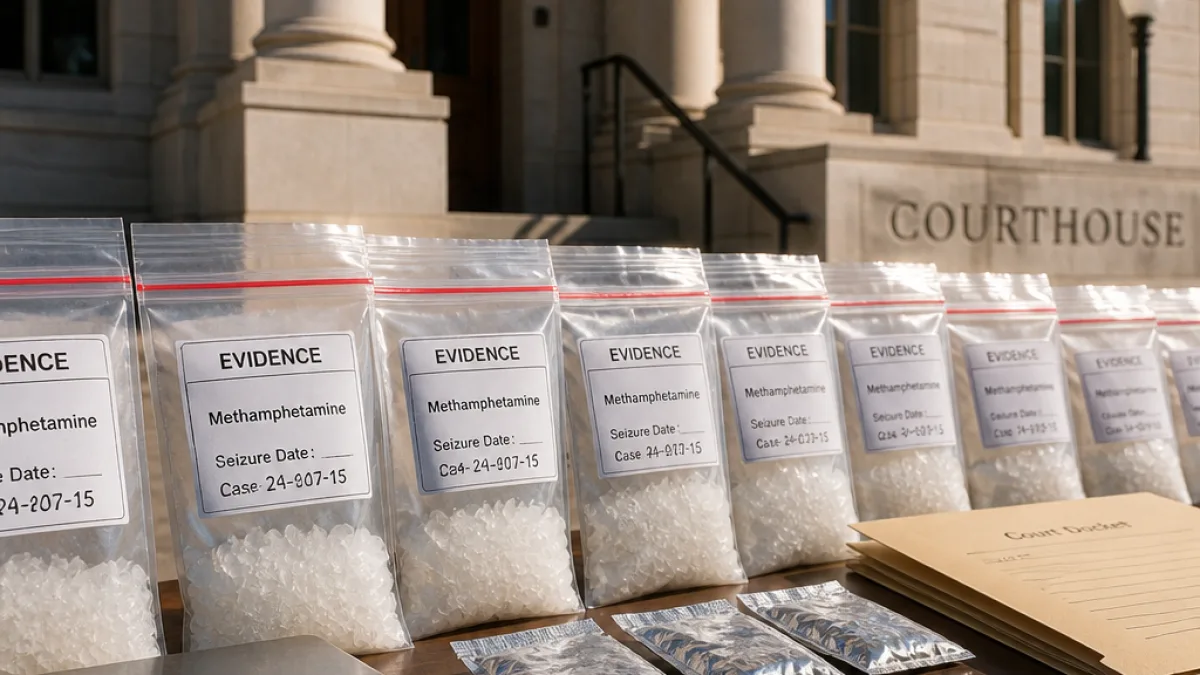
Officers retrieved the bag from the waste receptacle and reported recovering more than 300 grams of methamphetamine and 4 grams of fentanyl. Each conviction is classified as a serious offence under South Carolina law and will count as a strike under the state’s three‑strike statute. The solicitor’s office warned that another serious conviction could carry a life sentence.
“The Solicitor’s Office would like to thank officers from the Myrtle Beach Police Department for their hard work on this case and for successfully removing a large quantity of narcotics from the community,” Kelli Smith said in the release.
What the sentence means
Under the disposition announced by the Fifteenth Circuit Solicitor’s Office, the two 10‑year sentences will be served concurrently. That means Green will serve a single 10‑year term in custody for both counts, rather than 20 years consecutively.
Because both charges are designated as serious offences, they carry additional long-term legal consequences beyond imprisonment. In South Carolina, the three‑strike law increases penalties for repeat offenders; the solicitor’s office noted that the two convictions together represent strikes on Green’s record.
- Defendant: Rayford Green, 44.
- Charges: Second‑offence possession with intent to distribute methamphetamine; second‑offence possession with intent to distribute fentanyl.
- Sentence: 10 years per charge, to be served concurrently.
- Seized substances: More than 300 g methamphetamine; 4 g fentanyl (as reported).
Regional policing and community impact
The prosecutor’s acknowledgement of the Myrtle Beach Police Department’s role underscores the collaborative nature of narcotics investigations in coastal jurisdictions that handle both resident and visitor populations. Recovering hundreds of grams of methamphetamine and several grams of fentanyl from a resort setting raises questions for public-safety officials about distribution networks, transient clientele and enforcement priorities in tourist corridors.
While this case originated in Georgetown County, South Carolina, and does not involve residents of Georgetown, Ontario, it is an example of how regional drug prosecutions proceed under U.S. state statutes and how sentencing outcomes can hinge on prior convictions. For residents tracking drug‑related court outcomes, the case illustrates the severity of penalties for repeat offences and the practical effect of three‑strike laws in the American justice system.
| Item | Detail |
|---|---|
| Jurisdiction | Fifteenth Circuit, Georgetown County, South Carolina |
| Location of incident | Bay View Resort, Myrtle Beach |
| Evidence recovered | >300 g methamphetamine; 4 g fentanyl |
The solicitor’s office did not provide additional details about the defendant’s criminal history in the release beyond noting that the charges are second‑offence counts. No further comment on sentencing specifics or potential parole eligibility was included in the public statement.
Local readers should note this report describes legal proceedings in a United States jurisdiction. The case serves as a reminder of the varying legal frameworks that govern drug offences across North America and the significant penalties that follow repeat convictions.