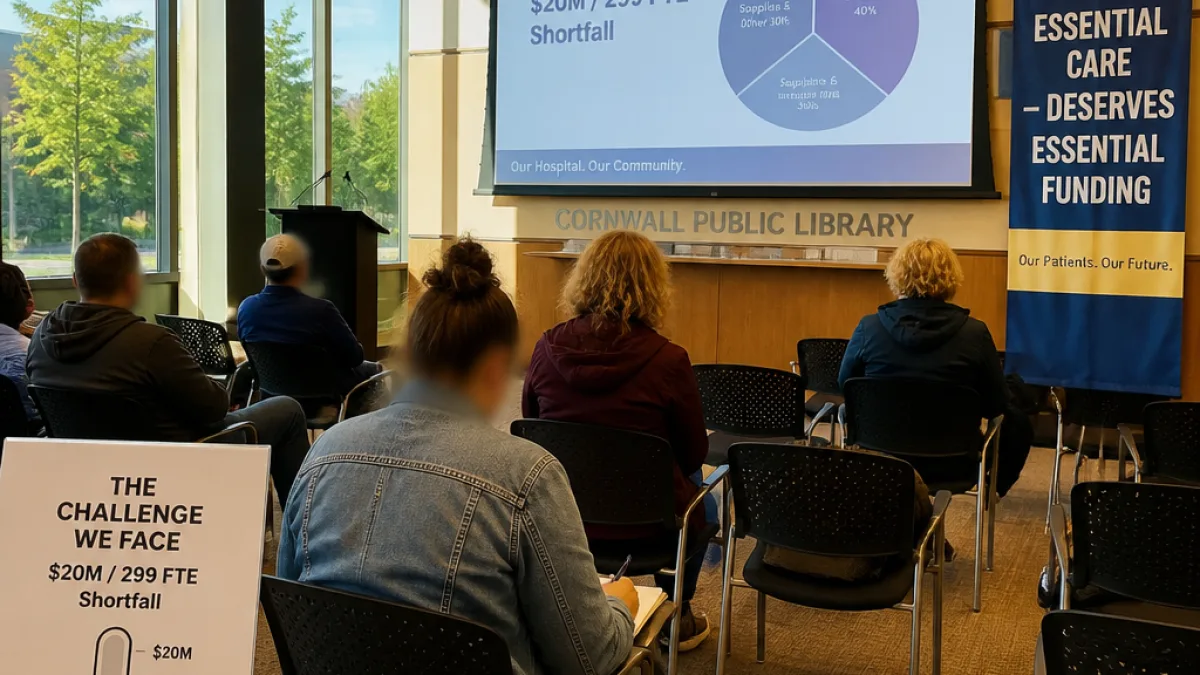
Union researchers brought a blunt message to Cornwall this week: provincial funding increases for Ontario hospitals are not keeping pace with rising costs, and the gap is straining local health-care capacity. At a public presentation of the Ontario Council of Hospital Unions (OCHU-CUPE) report, "Pushed Over the Brink: The Escalating Assault on Ontario’s Hospitals," union officials said Cornwall Community Hospital and St. Joseph’s Continuing Care Centre are among the facilities feeling the pressure.
Union outlines local shortfall
The report, presented at the Cornwall Public Library, finds that Ontario’s hospital funding plan — increases of 3.1% in 2024-25, 4.05% in 2025-26 and a projected 3.3% for 2026-27 — is running behind cost pressures the union estimates at around 6% annually. That mismatch, union officials argue, contributes to deficits, staffing cuts and reduced patient capacity.
Doug Allan, a senior researcher with CUPE National, said the difference between funding growth and cost growth translates into a decline in the level of care hospitals can provide. He told the audience:
“Funding at the rate of inflation, which is approximately what they’re doing right now, means an actual reduction in the levels of care and the ability of the hospital to provide care.”
On a local scale, the report estimates that bringing Cornwall’s hospitals up to the Canadian average for core services would require roughly an additional $20 million annually and about 299 full‑time-equivalent (FTE) staff combined for Cornwall Community Hospital and St. Joseph’s Continuing Care Centre. The union said most of that staffing increase would be allocated to Cornwall Community Hospital because it is the larger institution.
- Provincial funding plan: 3.1% (2024-25); 4.05% (2025-26); 3.3% (2026-27)
- Estimated cost pressure: ~6% annually
- Local gap: $20 million and 299 FTEs for Cornwall’s two hospitals
Broader implications and provincial picture
While the focus in Cornwall was on local impacts, the report situates the problem across Ontario. OCHU-CUPE estimates the province would need an additional $5 billion each year and about 55,000 FTE staff to bring core hospital services up to the level of other Canadian provinces.
The union also drew attention to rising demand for inpatient care. According to their figures, total inpatient days in Ontario have increased by 29% over the past decade, amounting to more than two million additional inpatient days. The report noted that working capital balances held by hospitals have deteriorated: hospitals had more than $2 billion in working capital in 2020, a figure the report says had fallen subsequently.
| Measure | Union estimate / figure |
|---|---|
| Ontario projected funding increases | 3.1% (2024-25); 4.05% (2025-26); 3.3% (2026-27) |
| Estimated annual cost pressure | ~6% |
| Cornwall hospitals additional funding needed | $20 million annually |
| Cornwall hospitals additional staff needed | 299 FTEs |
| Provincewide additional funding needed | $5 billion annually |
| Provincewide additional staff needed | 55,000 FTEs |
The briefing in Cornwall is part of a broader CUPE campaign to highlight what the union describes as a trend toward underfunding and, in some cases, privatization of hospital services. Union representatives say the combination of insufficient funding growth and rising costs forces hospital administrators into difficult decisions, including program cuts and workforce reductions.
For Cornwall residents, the union’s local estimates underscore concerns about access to care, wait times and the capacity of the local health system to absorb growing demand. Hospital administrators and provincial officials were not quoted in the union’s presentation materials. The figures and recommendations advanced by OCHU-CUPE frame a clear ask: increase funding and staffing to meet both present needs and what the union calls the standard across the rest of Canada.
As the debate over health-care funding continues provincially, Cornwall faces the practical reality of balancing services for a mixed urban-rural catchment where hospital capacity and staffing decisions have direct effects on patients and families across the region.