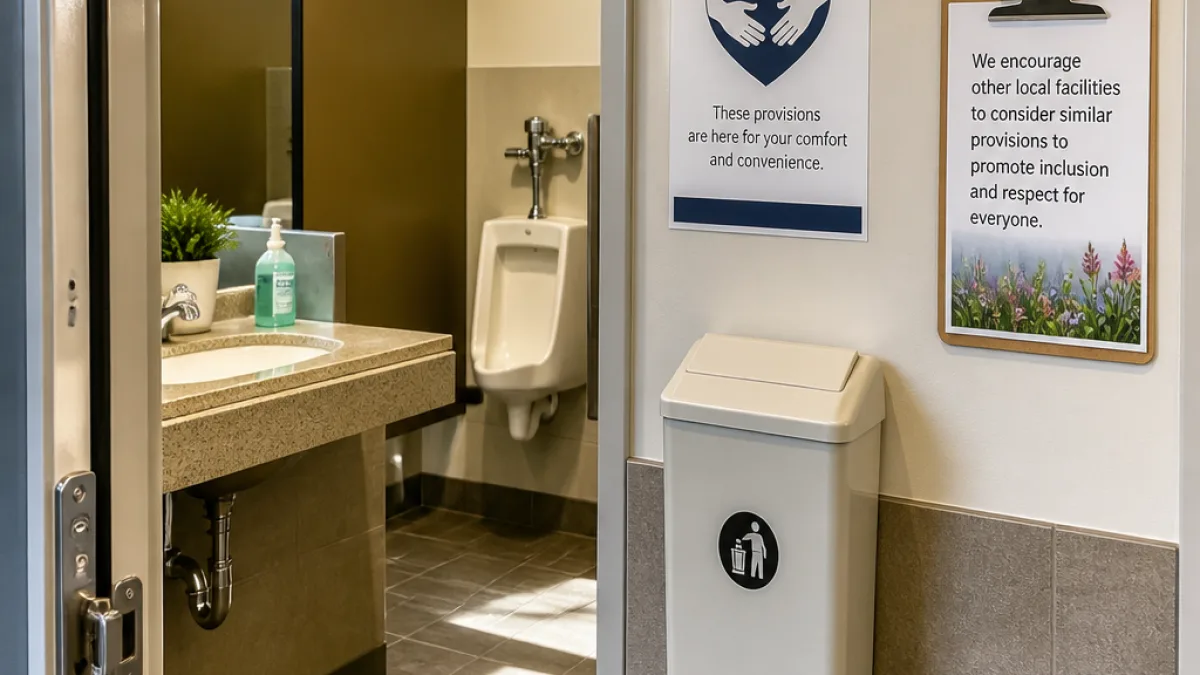
Small change, significant dignity: what one Cornwall council did
A town council in Cornwall, England, has introduced sanitary disposal bins in men's public toilets at its Public Hall to support people who experience incontinence. The move, adopted by Liskeard Town Council, is intended to provide "a discreet, hygienic way to dispose of these products" for men who may need to use absorbent pads or other aids.
The council said the installation is "a simple but important step towards improving dignity, accessibility, and inclusion" and that the trial site at the Public Hall could be expanded to other local facilities. The initiative was championed by deputy mayor Sylvia Berry, according to the council announcement.
"a simple but important step towards improving dignity, accessibility, and inclusion"
Why it matters beyond Liskeard
The measure addresses a practical problem that can prevent people from leaving home. The town council noted that conditions such as prostate or bowel cancer—cited by the NHS in explanatory material—can require frequent toileting and that a lack of suitable disposal options may make public outings difficult or embarrassing.
While the action took place in the UK, it raises questions about public washroom provision and accessibility here in Cornwall, Ontario. Communities across Ontario — urban cores and small towns alike — are balancing limited facility budgets with rising expectations for inclusive services. Simple fixtures and commodities in shared spaces can materially affect whether residents feel confident using community buildings, recreational centres and municipal halls.
Practical benefits highlighted
The council emphasised several immediate benefits of the bins. These include maintaining hygiene in washrooms, offering discretion to users, and signalling inclusion to people who manage continence issues. For facility managers, the bins are inexpensive relative to broader accessibility upgrades but can produce a measurable change in user experience.
- Improves disposal options for absorbent products and incontinence aids
- Reduces embarrassment that can keep people from using community spaces
- Simple to implement in existing washrooms and low-cost to maintain
Local consequences and next steps for Cornwall, Ontario
Municipal leaders and facility operators in Cornwall, Ontario, may find value in reviewing their own washroom provisions in light of this modest UK example. The policy discussion is not limited to gendered spaces; it extends to how public facilities accommodate the needs of seniors, people with chronic medical conditions and others who require discreet disposal options.
Choices around where to place receptacles, how to empty them, and whether to include signage or staff training involve operational decisions. Those decisions intersect with budget cycles and with broader accessibility commitments under provincial and municipal policy frameworks.
Comparative snapshot
For quick reference, here is a brief comparison of key points raised by the Liskeard measure.
| Aspect | Details from Liskeard |
|---|---|
| Location | Public Hall (trial) |
| Champion | Deputy mayor Sylvia Berry |
| Purpose | Discreet, hygienic disposal for men with incontinence |
| Potential follow-up | Roll-out to other town facilities |
Small fixtures can be gateways to more inclusive public spaces. As Cornwall, Ontario, continues to adapt services across an urban-rural mix, municipal officials and community groups may wish to consider similarly low-cost measures that help residents participate fully in civic life.