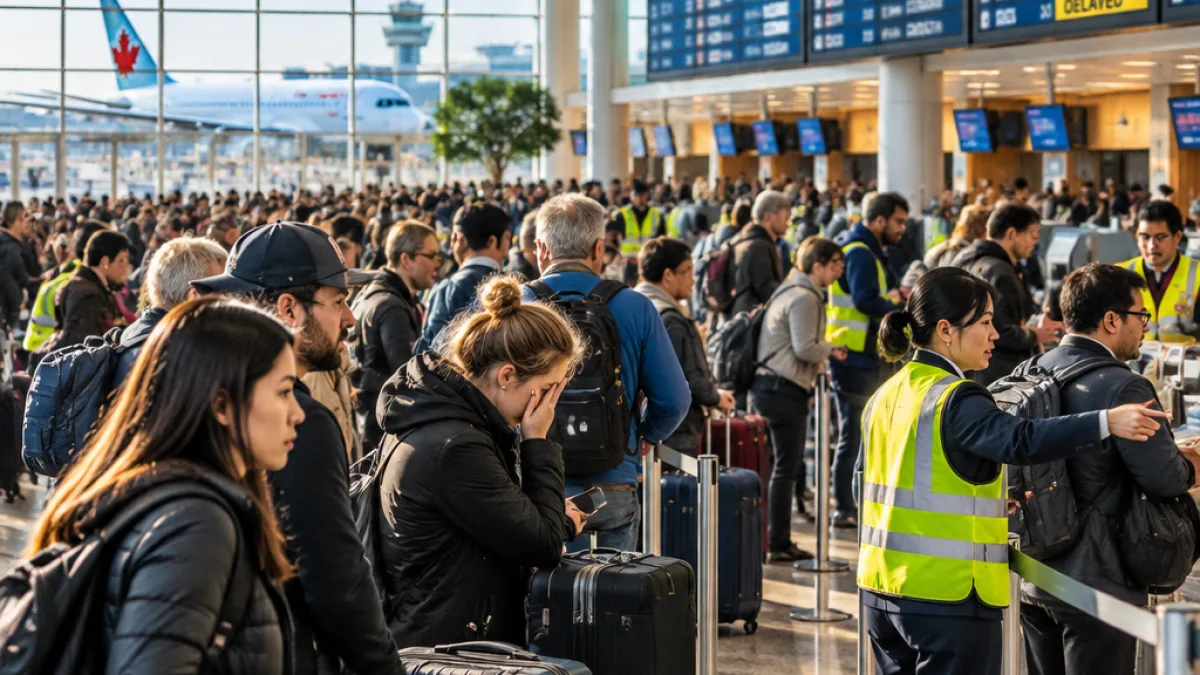
Canadian airports and airlines spent Saturday trying to restore regular service after a U.S. air-traffic shutdown left aircraft and crews out of position and created a backlog that continued to affect travellers across the country.
Toronto Pearson International Airport said it had brought in additional staff as it prepared for a busy travel day. WestJet, based in Calgary, said it was responding to a significant disruption, while Porter Airlines warned that its operations might not return to normal until the end of the weekend.
“Returning to normal operations will take some time.”
The statement came from Yasmine Mehdi, an Air Canada spokesperson, after the airline said it had cancelled approximately 250 flights following the U.S. stoppage. Air Canada said the cancellations affected about 27,000 passengers and that further disruptions were possible because planes and crews were no longer positioned where they were needed across its network.
A disruption that carried across the border
The trouble began Friday when the U.S. Federal Aviation Administration issued a ground-stop order that halted air traffic in the United States for roughly four hours. The U.S. government said new technology being added to the country’s air-traffic-control system overloaded older equipment, leading to intermittent gaps in communications and radar coverage.
Although the order was issued in the United States, its effects were felt at Canadian airports as scheduled flights, aircraft movements and crew assignments were thrown off balance. The result was a second day of operational pressure for Canadian carriers, which had to manage cancellations, rescheduling and travellers waiting for updated information.
| Carrier or airport | Saturday update |
|---|---|
| Air Canada | Cancelled approximately 250 flights and worked to add flights to its schedule. |
| Porter Airlines | Expected operations to take the weekend to return to normal; refunds available where rescheduled flights cannot be accommodated. |
| Toronto Pearson | Called in more staff for a busy travel day. |
| WestJet | Responded to a significant travel disruption. |
Travellers urged to check before leaving home
Airports in Vancouver, Edmonton, Calgary and Halifax issued notices asking passengers to confirm their flight status before heading to the airport. Calgary’s airport asked travellers for patience as schedules began to normalize, reflecting the uncertainty that can remain after a large interruption even once the initial stoppage has ended.
Air Canada said it was working to put additional flights into its schedule and help passengers reach their destinations. The airline’s explanation that aircraft and crews were out of position underscored why restoring service could not be accomplished simply by resuming the original timetable. Each cancellation and delayed movement could affect later flights elsewhere in the network.
Porter said passengers who could not accept their rescheduled flights would receive refunds. Its warning that normal operations could take the entire weekend gave travellers a longer recovery window to consider when making plans, particularly those with connections or time-sensitive journeys.
- Check the airline’s latest flight status before travelling to the airport.
- Allow for possible schedule changes while carriers reposition aircraft and crews.
- Contact the airline about refund options if a revised itinerary cannot be accommodated.
The situation illustrated how an interruption in one country’s aviation system can continue to affect transportation in another after the immediate technical problem has been addressed. For Canadian passengers, the practical impact on Saturday was a mix of extra airport staffing, travel advisories, cancellations and delayed efforts to rebuild normal schedules. Airlines and airports did not provide a single timetable for a complete recovery, with Porter pointing to the weekend and Air Canada saying the return to regular operations would take time.
Passengers were therefore left to rely on updated notices from airports and carriers as the recovery continued. The Canadian response remained focused on managing the backlog, adding flights where possible and providing information to travellers while aircraft and crews were moved back into place.