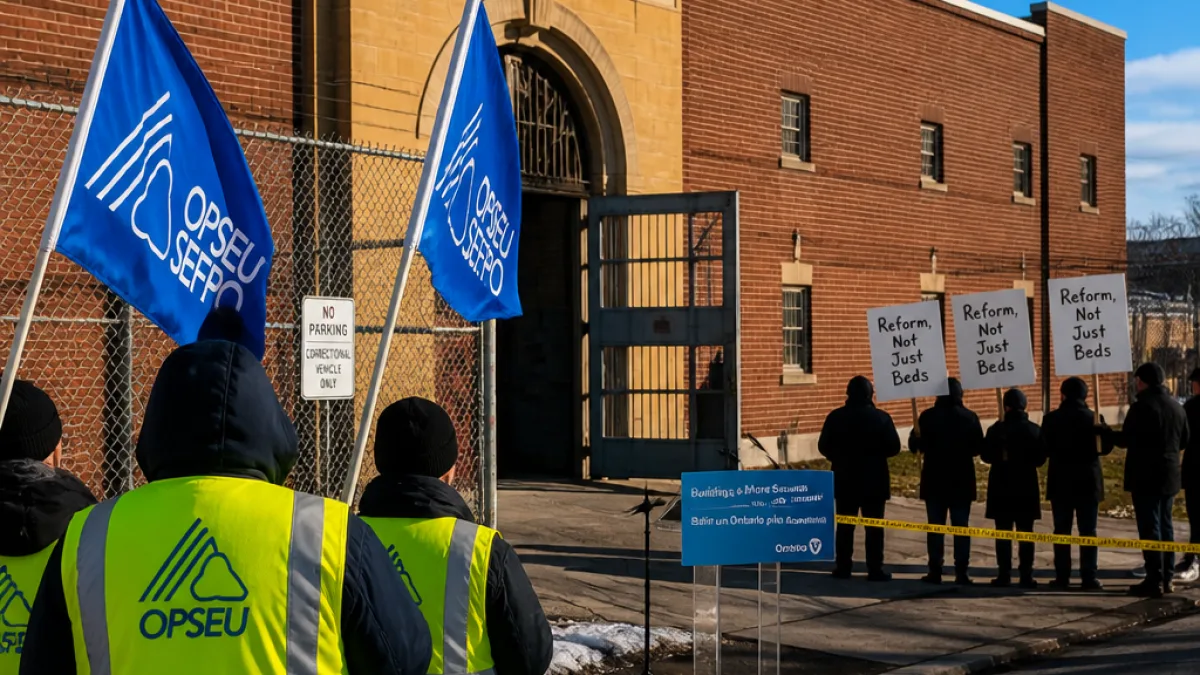
Union backs reopening; academic says plan misses the mark
The provincial government’s announcement earlier this month that it plans to add hundreds of jail beds — including reopening the Brantford Jail, closed at the end of 2017 — has drawn a mixed reaction locally, with the Ontario Public Service Employees Union (OPSEU) endorsing the move while a university criminologist warns it does not address underlying problems in the justice system.
Solicitor General Michael Kerzner made the announcement during a visit to Brantford on Aug. 6, part of a broader provincial initiative to expand capacity across Ontario’s correctional system. The proposal aims to relieve severe overcrowding in existing jails.
Chad Oldfield, corrections chair for OPSEU, argued the reopening is a necessary step to protect staff and public safety. He said many Ontario jails are operating at between 130 and 150 per cent of capacity and described cells meant for two people routinely housing three or four.
“These over capacity issues are directly linked to the increased levels of violence against our members,”
Oldfield told the Expositor that increasing the number of beds and staff would allow correctional workers to perform their duties more effectively and would enhance community safety as Ontario’s population grows.
But Justin Piche, a criminologist at the University of Ottawa, told the Expositor the provincial plan “misses the mark.” Piche questioned whether simply adding bed capacity addresses the root causes of jail overcrowding, suggesting other policy approaches are needed to reduce incarceration rates.
Local implications and practical questions
Reopening the Brantford Jail would carry operational and community consequences. Residents and municipal officials will likely want details on timelines, staffing levels, how the facility will be used (remand versus sentenced population), and what investments will accompany the physical reopening to ensure safety and rehabilitation.
- Staffing: OPSEU says more staff are required to safely operate facilities at higher capacity.
- Capacity relief: The province frames the move as short-term mitigation for overcrowding elsewhere in Ontario.
- Policy debate: Academics and advocates argue capacity increases alone do not reduce incarceration or address systemic issues.
The competing perspectives reflect a broader urban–rural and service-delivery divide across Ontario: municipal and frontline workers citing immediate operational pressures and safety concerns, while scholars and some advocates push for reforms intended to lower reliance on custodial remand and imprisonment.
| Stakeholder | Position |
|---|---|
| OPSEU (corrections chair Chad Oldfield) | Supports reopening to relieve overcrowding and improve staff safety |
| University of Ottawa criminologist Justin Piche | Questions plan; says it fails to address root causes of incarceration |
Residents concerned about public safety and neighbourhood impacts will be watching for provincial and municipal consultations. City officials have not yet released detailed local projections tied to the announcement.
As the debate continues, the central questions for Brantford will be whether the reopened facility will come with adequate staffing and programming, and whether it will be part of a longer-term strategy that reduces pressure on jails across the province rather than simply expanding bed numbers.