
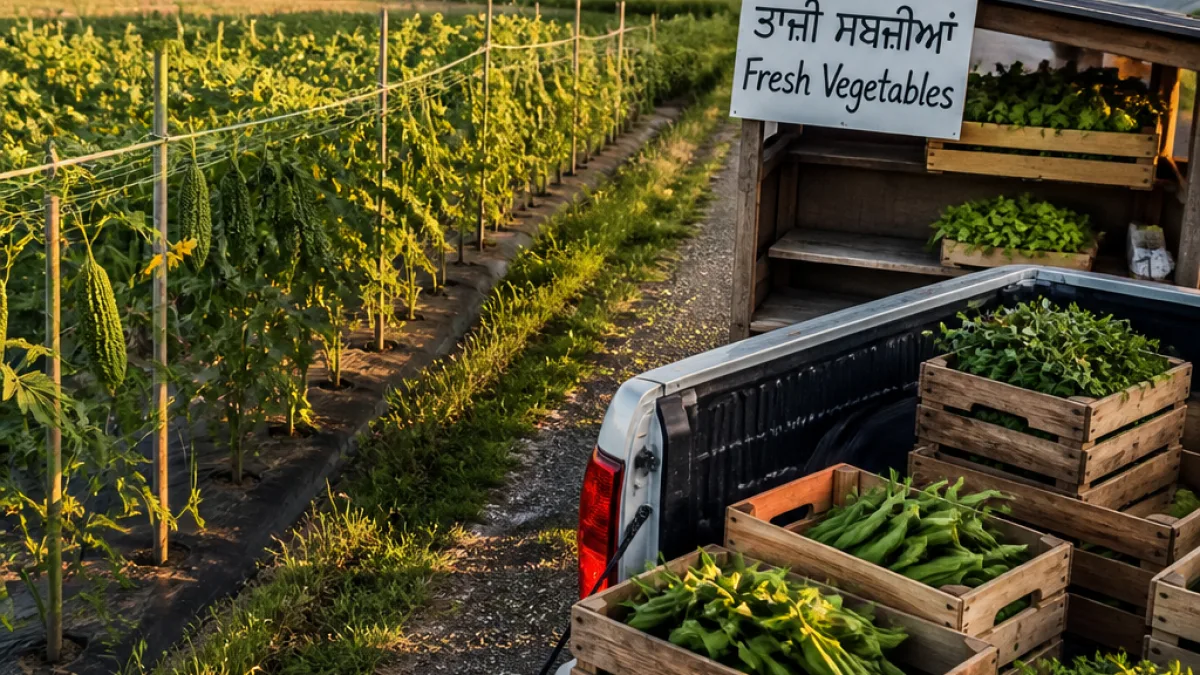
Farms near Brampton grow familiar produce, draw community back to the land
Driving through agricultural land on the edges of Brampton this summer, it is easy to see why some families — many of them Punjabi — make the trip. Rows of garlic and serrano chillies, beds of coriander and fenugreek, and patches of okra and bitter gourd offer ingredients not always available at mainstream grocery stores. The farms are doing more than selling vegetables; they are providing a tangible link to foodways and memories carried across generations.
Several small operations that cater to South Asian tastes have begun documenting their work on social media, drawing thousands of viewers and customers. Among them are King Subzi Farm northwest of the city in Caledon, Balle Balle Heritage Farm and Sarbat Farm, northeast of Brampton. Sarbat Farm’s TikTok account has just over 5,000 followers, where short videos of daily life — tractors, chickens, harvests and family customers — get regular views.
"For me, those trips meant getting a taste of a country I hadn’t grown up in."
That line, written by someone who grew up in Brampton, captures why these farms matter. For many first- and second-generation families, the produce evokes food memories from Punjab and other parts of South Asia: the particular texture of okra in sabzi, the bitterness of karela (bitter gourd) balanced in curry, the scent of fresh fenugreek leaves. The farms provide ingredients but also ritual — a spot where grandparents, parents and children can stand among rows of familiar plants.
Roots that pre-date recent immigration
South Asian involvement in Canadian agriculture is not new. Punjabi families and other South Asian migrants have farmed in Canada for generations, bringing agronomic knowledge and crop preferences with them. Local farms in the Brampton region are part of that continuity, updating traditional practices for Ontario soil and climate while meeting the demands of a diverse urban population.
Operators say social media has become an important tool. Short videos and posts show planting cycles, pest management, animal care and harvests, and they attract both customers and younger members of diasporic communities who might never have seen a farm before. For many urban residents the content acts as a digital bridge to rural life.
- Availability: Vegetables like okra, bitter gourd, fenugreek and coriander that can be scarce in mainstream stores are grown locally.
- Access: Farms serve as weekend destinations for families seeking fresh, culturally specific produce.
- Community: Social media and farm visits reinforce cultural ties and shared knowledge across generations.
Who’s growing what — at a glance
| Farm | Location relative to Brampton | Notable crops / features |
|---|---|---|
| King Subzi Farm | Northwest (Caledon) | Okra, bitter gourd, traditional vegetables |
| Balle Balle Heritage Farm | Region around Brampton | Heritage produce, family-focused |
| Sarbat Farm | Northeast of Brampton | Garlic, serrano chillies, chickens; active on TikTok (~5,000 followers) |
Local demand for these crops raises practical questions about farmland preservation and urban growth. As Brampton expands and land use changes at the city’s edge, small specialty farms may face pressure from development and rising land costs. For families who rely on these growers for culturally specific food, losing nearby producers would mean longer trips and higher prices, and an erosion of local cultural infrastructure.
There are also opportunities. Small farms that successfully reach urban customers can reinforce regional food networks and diversify local agriculture. Farmers who use social media to tell their stories and show their methods may attract new customers, volunteers and seasonal workers from within Brampton’s communities, sustaining knowledge transfer and strengthening rural-urban ties.
On weekends this summer, families continue to arrive at these farms, sometimes standing in a patch of field with a plastic bag of coriander or a bundle of chillies, comparing recipes and swapping memories. In that exchange the farms are doing what markets and grocery aisles cannot: making a piece of home visible and harvestable in the fields just beyond the city.
— Ryan Kowalski, Ontario correspondent














