
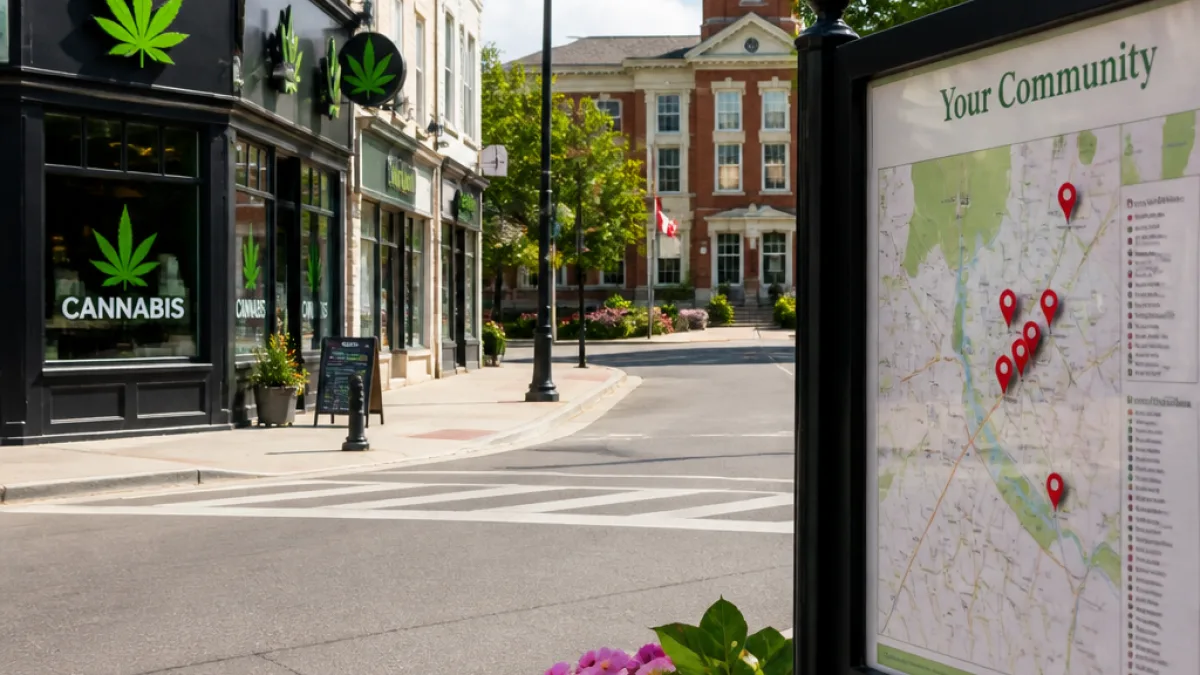
Town survey highlights local tensions over cannabis store locations
The Town of Aurora has released survey findings that show residents and business owners are worried about the concentration of legal cannabis retail stores in parts of the town, even as staff concluded there is no indication these shops are causing a broad public-safety or enforcement crisis.
The community engagement, carried out at council direction this summer, gathered 154 responses between July 14 and Aug. 9, 2026. At the time the survey was conducted the town reported 13 cannabis retail locations, largely concentrated along and near two main streets; the Alcohol and Gaming Commission of Ontario (AGCO) listed 18 stores as authorised to open in Aurora.
Council created a task force in 2025 to review the local impact of cannabis retailers after residents and some business owners raised concerns that stores were clustering in certain neighbourhood corridors. In June 2026, council directed staff to survey residents and businesses within a specific distance of legal cannabis outlets; staff later expanded the questionnaire to allow all Aurora residents to provide input.
| Metric | Value |
|---|---|
| Survey responses | 154 |
| Population (Statistics Canada) | ~68,000 |
| Cannabis stores (at time of survey) | 13 |
| Stores authorised by AGCO | 18 |
Community concerns and mixed sentiment
The results show a community divided on how cannabis retail fits into Aurora’s commercial landscape. Approximately 64% of respondents rated the overall impact of cannabis stores on the town as somewhat or very negative. Some 23% rated the impact positive, while just under 12% described it as neutral.
Notably, the survey found that a majority of respondents were not owners of businesses within 200 metres of a cannabis store — about 68% said they did not own a nearby business — and roughly 70% reported owning a business in Aurora for more than 10 years. Around 58% of survey participants said they had personally visited a cannabis retail outlet.
“Legitimate localized impacts can occur and that the current provincial framework leaves municipalities with limited tools to address one of the community’s principal concerns: where cannabis stores locate and how closely they may be concentrated.”
The quoted finding comes from the staff report summarising the engagement results, which suggests the provincial regulatory framework constrains municipal options over siting and concentration of retail outlets.
Implications for council and local planning
Those limitations matter because, as the staff report and task force work indicate, the issue confronting Aurora is less about town‑wide safety and enforcement and more about neighbourhood composition and business compatibility. Many respondents described cannabis stores as incompatible with surrounding businesses or as having negative effects in particular locations, even if they did not perceive broad public-safety issues.
Municipalities in Ontario have only a narrow set of tools for controlling where cannabis stores open. The AGCO issues authorizations under provincial rules; municipalities can deploy planning policies and licensing bylaws to a degree, but cannot outright ban retail sales that comply with provincial licensing.
- Local pressure: Clustering along two main corridors has driven resident and business concerns.
- Regulatory limits: Staff say the provincial framework restricts municipal control over location and concentration.
- Next steps: The task force and council will consider the survey results as part of ongoing work to advise municipal policy.
With relatively few formal responses compared with Aurora’s population of roughly 68,000, the survey provides a snapshot rather than a definitive measure of townwide attitudes. Nonetheless, the task force and council can use the input to shape discussions about planning measures, business licensing and community compatibility as more stores move from authorization to opening.
The findings underscore a familiar tension in suburban Ontario: local communities balancing economic activity and consumer choice against neighbourhood character and small‑scale impacts. How Aurora’s council responds could set a tone for other similarly sized towns grappling with the same provincial regulatory constraints and local concerns.















