Public art links St. Thomas’ railway roots to industrial future
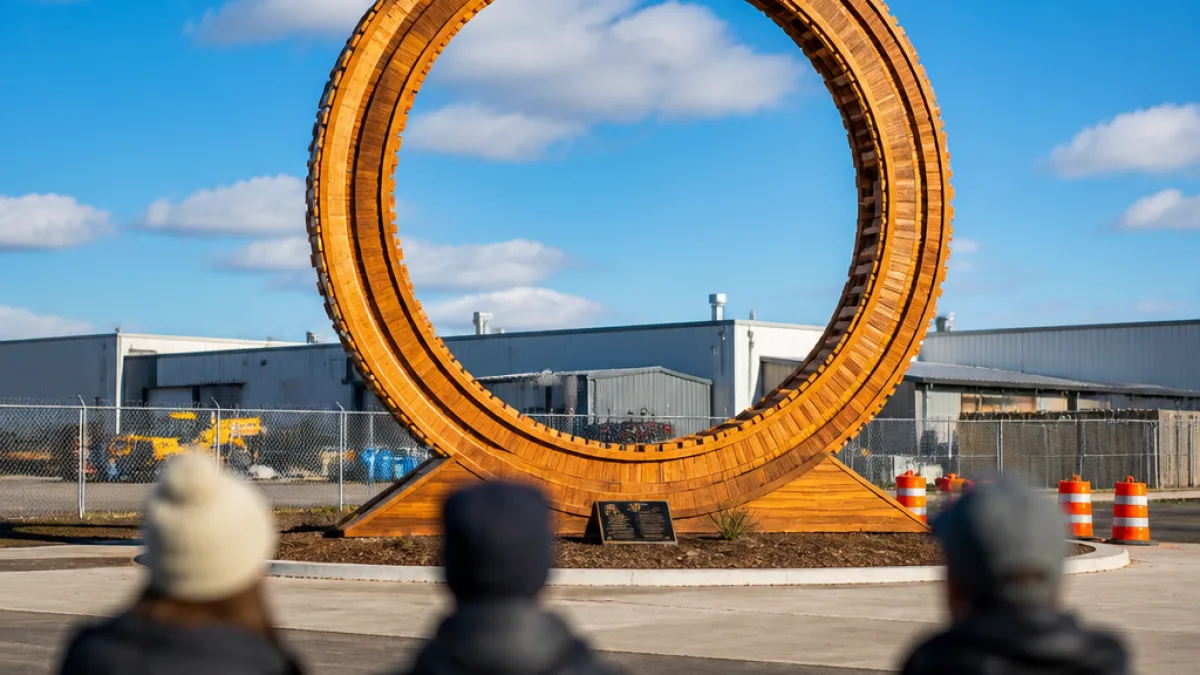
A towering, circular sculpture of a wooden toy train was unveiled this week at the entrance to the city’s industrial area, offering a playful reminder of St. Thomas’ rail history while signalling the ongoing transformation of the site into a modern industrial hub.
The piece, titled Imagination Station, stands roughly 25 feet high and was assembled at the intersection of Dennis Road and Highbury Avenue, where it will greet traffic entering Yarmouth Yards. The work is the first permanent public art commission for Woodstock-born artist Briony Douglas.
At a ribbon-cutting ceremony held Thursday afternoon, city and economic development representatives joined the artist to mark the installation. Organizers described the sculpture as both a nod to the city’s railway heritage and a creative link to the industrial development taking shape at Yarmouth Yards.
“The wooden train exists almost universally in our collective memory. By enlarging it to an architectural scale, it becomes something entirely different, not simply an object of nostalgia, but a place for reflection, gathering and shared experience,” Douglas said.
Douglas has produced installations across North America for cultural institutions and commercial brands and was chosen for the project after city officials saw her recent work with the Professional Women’s Hockey League, organisers said. Her commercial credits include projects for Cadillac, Adidas, American Express, Shake Shack and the Hockey Hall of Fame.
At the ceremony, Sean Dyke, CEO of the St. Thomas Economic Development Corp., highlighted the significance of placing the work at the gateway to Yarmouth Yards and framed the installation as part of a broader revitalization effort for the area.
“We’re standing right now in what is likely the best industrial development in southern Ontari”
(The final word of Dyke’s remark was not available in the media file.)
What the sculpture means for the city
Local leaders and the artist said the sculpture is intended to do more than decorate a roundabout. By scaling up a familiar childhood object, the work aims to provoke memory, conversation and community gathering. The choice of a toy train intentionally references the long-standing role of rail in the city’s past, while occupying a visible position at a site earmarked for industrial growth.
- Public identity: The sculpture provides a visual landmark at a major industrial gateway, reinforcing a sense of place.
- Cultural value: It represents the city’s investment in public art as part of urban and industrial renewal.
- Community engagement: The piece is conceived as a space for reflection and shared experience, not just an object.
Douglas discussed the practical side of the commission, noting that "some assembly was required" to put the piece in place — a reminder of the logistical work behind large-scale public art. The installation process, and the unveiling ceremony itself, underline a growing practice among mid-sized Ontario cities to integrate art into redevelopment projects.
| Feature | Detail |
|---|---|
| Title | Imagination Station |
| Artist | Briony Douglas |
| Height | 25 feet |
| Material | Wood (toy train motif) |
| Location | Dennis Road and Highbury Avenue (gateway to Yarmouth Yards) |
For residents, the new sculpture is likely to become a reference point — for directions, for social media photographs, and for civic conversation about how St. Thomas honours its past while making space for new industrial investment. The placement at a busy intersection ensures high visibility, while the artist’s stated aim that the piece invite people to “pause, reconnect with their own stories” points to ambitions beyond mere decoration.
As Yarmouth Yards continues to develop, municipal and economic development officials have signalled an interest in combining functional industrial growth with cultural elements that contribute to a broader sense of community identity. The long-term impact of that blend — on local pride, on visitor perceptions and on future public art commissions — remains to be seen.
The installation of Imagination Station is the latest example in St. Thomas of civic partnerships bringing art and economic development into conversation, a dynamic that reflects both the city’s industrial lineage and its present-day ambitions.