
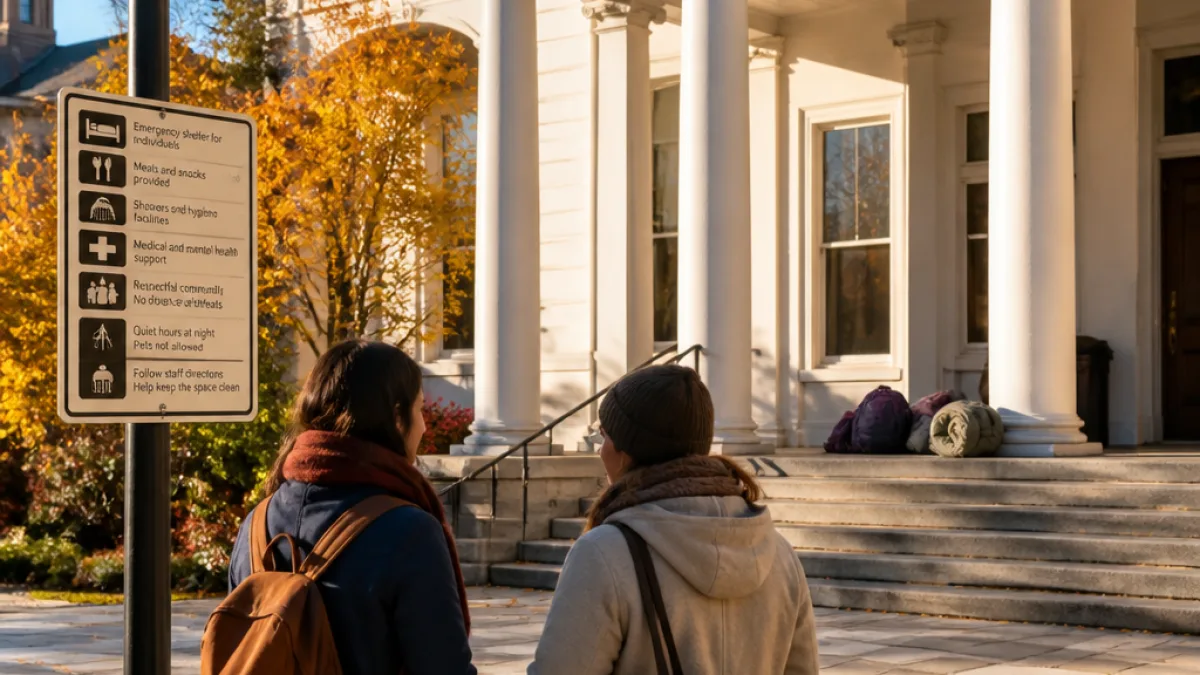
The Vermont Department of Buildings and General Services this summer installed noise deterrent devices that emit loud bird calls at the Pavilion Building in downtown Montpelier, a move the agency says is intended to reduce overnight occupancy on the property that houses several state offices.
State response to repeated incidents
Deputy Commissioner Emily Kisicki said in a late-June email that staff hoped the devices "could reduce the nighttime occupancy of these spaces." The Pavilion Building, identifiable by its white columns, is home to the governor’s offices, the treasurer, the attorney general and the Vermont Supreme Court.
State grounds crews and safety and security officers had encountered human waste and other debris on the property, prompting the agency earlier this year to place a portable toilet on site. Security officers reported encountering people sleeping outside the Pavilion complex multiple times between June 2025 and this year.
Local advocates say deterrents push people with nowhere to go
Advocates and local officials expressed concern that the state’s deterrence measures merely shift the problem rather than address underlying needs. Zach Hughes, chair of Montpelier’s homelessness committee, said the approach was troubling.
“As a homelessness advocate, this is just disturbing to me,” Hughes said. “Part of the problem is, there’s nowhere for people to go.”
Hughes noted that outreach workers recently counted 61 people living outdoors in Montpelier. The city’s sole year-round shelter has space for 18 people and was roughly three-quarters full at the time of that count, indicating a shortfall between need and available shelter capacity.
Responding to encampments has become a recurring challenge for municipal leaders across Vermont, particularly during warmer months when outdoor populations rise and public complaints increase. In recent summers, Montpelier officials have ordered removal of tents from public areas.
What the state says and what remains unclear
The Department of Buildings and General Services documented repeated incidents of people sleeping on the Pavilion’s porches and cited sanitation problems as a reason for intervening. Officials have not announced a plan to provide alternative shelter or services tied to the deterrent installation.
Local outreach teams and municipal officials continue to track outdoor homelessness in the Capital City and coordinate limited resources, but advocates say those efforts fall short of meeting demand.
Numbers that matter
| Item | Figure |
|---|---|
| People counted living outdoors in Montpelier | 61 |
| Year-round shelter capacity | 18 |
| Reported shelter occupancy at time of count | ~75% full |
How communities are responding
Municipalities across Vermont have adopted a mix of enforcement, outreach and limited services to manage encampments and assist unhoused residents. In Montpelier, city leaders and outreach workers make counts and attempt to connect people to available housing and support, but capacity constraints and statewide shortages complicate those efforts.
Advocates argue that deterrence tactics such as noise devices and physical barriers can increase risks for unhoused people by forcing them into less visible, potentially more dangerous locations. Local officials say they are balancing public health and safety concerns for both the building and its occupants with the needs of people living outdoors.
What to watch next
- Whether the state couples deterrent measures with expanded outreach or shelter options near the Capitol.
- How Montpelier’s homelessness committee and outreach providers adjust counts and services as the city heads into cooler months.
- Any policy discussions at the Legislature about statewide approaches to encampments and shelter capacity.
The use of sound devices at a prominent state building raises questions about how government balances property stewardship and public safety against the needs of Vermonters experiencing homelessness. Officials have cited sanitation and repeated overnight occupancy as reasons for action; advocates say displacement without alternatives worsens the crisis.
Coverage will continue as state and city officials, outreach workers and advocates respond to the latest round of deterrence measures and their effects on Montpelier’s unhoused population.

















