
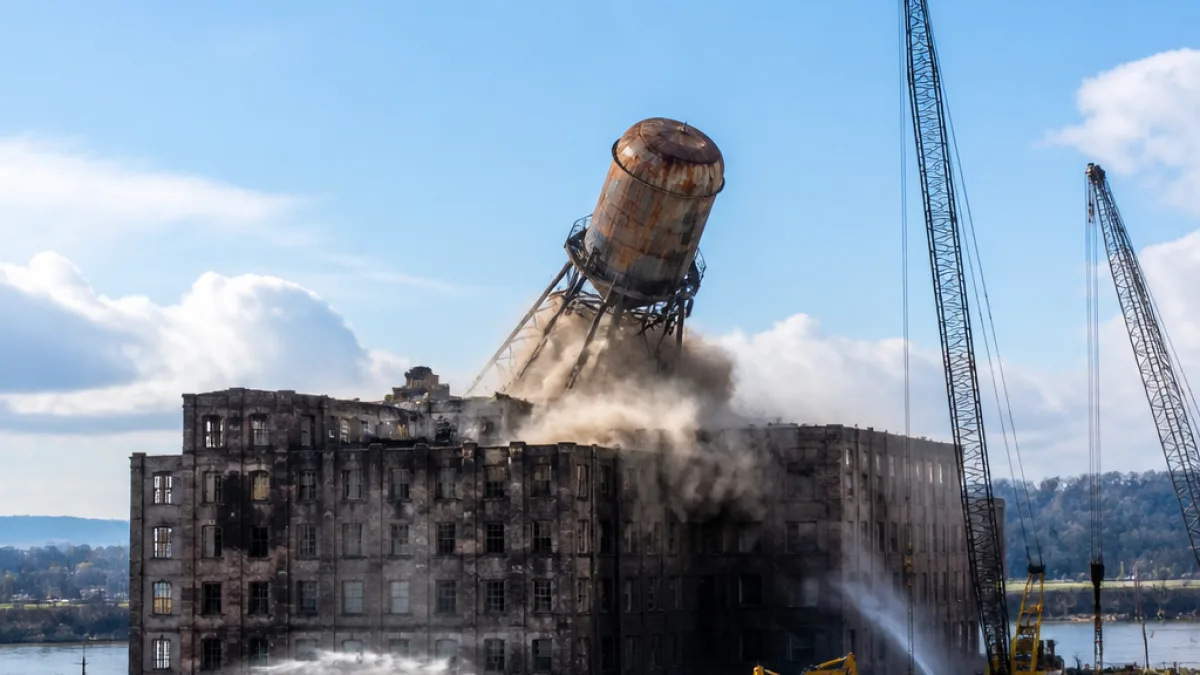
Portland officials announced Friday that demolition of the fire-damaged Centennial Mills warehouse will begin next week, with crews first wetting down the site to control dust before using explosives to bring down the building’s water tower.
Public safety and asbestos concerns drive demolition plan
The decision follows a massive blaze that gutted the downtown waterfront complex on Aug. 2, 2026. Testing of ash from the site confirmed the presence of asbestos, prompting crews to start dampening operations to reduce airborne contamination.
The City of Portland said Eugene-based Staton Companies was contracted by the property owner to carry out the demolition. Officials emphasized the unusual hazards posed by the damaged structure and the limited pool of contractors with the specialized equipment and expertise needed to do the work safely.
"This is not a typical demolition. Because the building is at imminent risk of collapse, the work requires specialized engineering, equipment, and demolition expertise to protect workers, adjacent infrastructure, the railroad, and the surrounding community."
Controlled detonation to remove water tower
City officials said crews plan a controlled detonation, using explosives, to topple the water tower that remains atop the warehouse. The timing of the remainder of the demolition will depend on how the structure behaves after that initial action.
- Demolition contractor: Staton Companies (Eugene)
- Initial action: site dampening for dust control
- Planned use: controlled detonation of the water tower
- Key risk: ash tested positive for asbestos
Traffic, timelines and neighborhood impacts
Officials said the building could be reduced to roughly half its height in about two weeks, at which point they expect to reopen the nearby section of Naito Parkway. How long full demolition and site clearance will take remains uncertain and will be dictated by the condition of the structure as work progresses.
The city has instructed Staton Companies to adhere to strict safety and security measures intended to protect workers, adjacent infrastructure — including the railroad — and the surrounding community. The urgency stems from officials’ assessment that the remaining walls and structure are at risk of imminent collapse.
| Event | Detail |
|---|---|
| Fire | Aug. 2, 2026 — four-alarm fire gutted Centennial Mills |
| Ash testing | Confirmed asbestos present |
| Site prep | Dampening for dust control beginning prior to demolition |
| Demolition start | Planned for Monday following the Friday announcement |
| Initial milestone | Building potentially half-height in ~two weeks; Naito Parkway reopening expected then |
Why the delay and what to expect
City officials acknowledged a short delay from an earlier deadline to begin demolition. They said the building’s precarious condition and the technical demands of this project limit the number of contractors qualified to perform the work. That constraint, combined with the need for specialized engineering and equipment, led to the revised timeline.
Residents and workers in the area should expect ongoing activity along the waterfront, including heavy equipment, temporary road closures and continued dust-control measures. The city reiterated its commitment to moving the work as quickly as safety allows.
Officials did not provide a firm completion date for the full dismantling or site remediation. As demolition proceeds, the city said it will monitor conditions and update the public about traffic changes, safety zones and any air-quality guidance tied to asbestos-contaminated ash.
For Portlanders who use Naito Parkway, commuters and downtown businesses, the next two weeks will be a period of disruption but also the beginning of a visible effort to remove a damaged structure that city engineers warned could collapse at any time.
















