
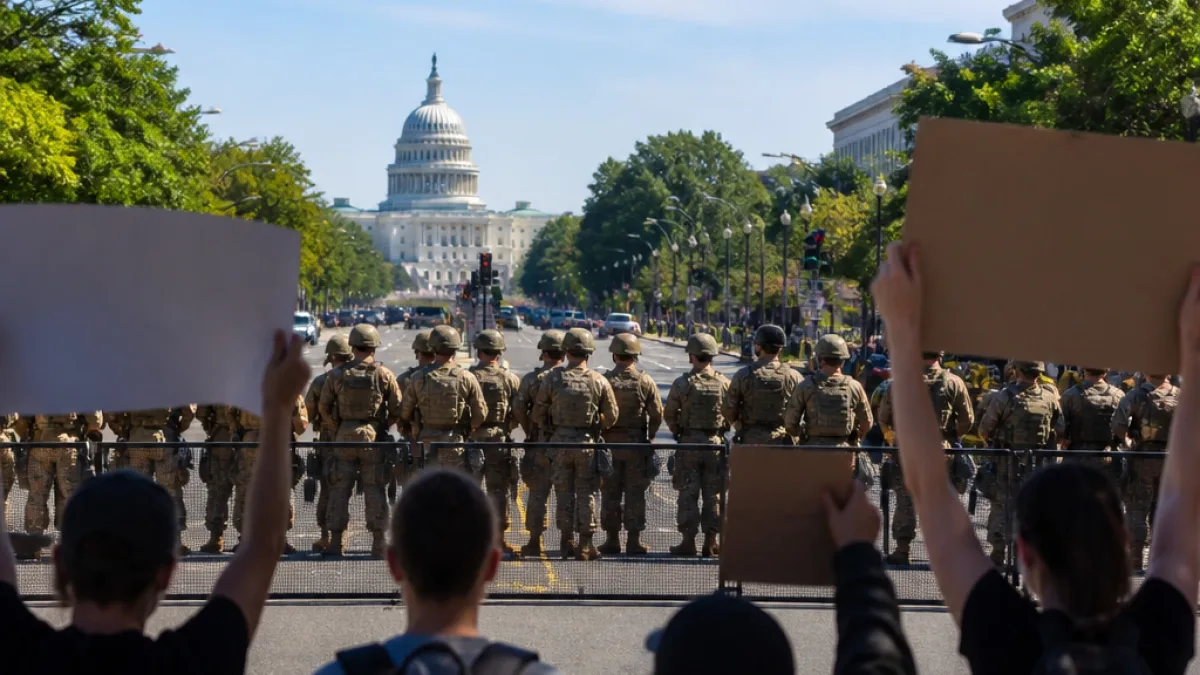
WASHINGTON — The federal deployment of National Guard troops to the nation’s capital, initiated last year as part of a federal crime-emergency response, has been extended through January 2029, prolonging a presence that many local residents and officials say feels unnecessary and intrusive.
Background and scale of the deployment
President Donald Trump announced the surge of federal law enforcement to Washington on Aug. 11, 2025, describing it as a needed measure to address crime. As of Aug. 4, more than 4,600 military personnel from the District of Columbia and 24 states and territories remained on patrol alongside additional federal law enforcement officers whose numbers were not disclosed.
| Event | Date | Noted figures |
|---|---|---|
| Federal law-enforcement surge announced | Aug. 11, 2025 | — |
| Troop count reported | Aug. 4, 2026 | More than 4,600 from D.C. and 24 states/territories |
| Deployment extension end date | Jan. 2029 | — |
Neighborhood impact and public reaction
Residents report seeing small groups of armed guard members in tourist corridors and residential neighborhoods alike. The troops have supported arrest operations, but they also have been visible at public events and along promenades where violent crime has been uncommon.
For many residents, the guardsmen’s presence has become normalization rather than a short-term emergency measure. Civil liberties advocates and local leaders have criticized the continued deployment as an overreach that infringes on the city’s self-governance.
“There’s a deep irony that here we are in the capital of the free world, and our president is treating it like a police state,”
said Scott Michelman, legal director of the American Civil Liberties Union of the District of Columbia.
Limits of local authority
Local officials and community groups who oppose the deployment face institutional constraints. Because the ordering authority for the surge is federal, elected city leaders have limited tools to compel an immediate withdrawal. The extended timeline will be an early test for newly elected officials expected after the fall midterms, who may push for diplomatic, legislative or legal remedies but lack unilateral control over the federal decision.
How the deployment has been used
Officials say the National Guard units have assisted with specific enforcement actions, including arrests. They also have kept a visible presence in high-traffic public areas, such as the Tidal Basin during the Cherry Blossom Festival and neighborhoods like Georgetown.
Those routine patrols have raised questions about proportionality and necessity. Critics point to the absence of a clearly defined emergency that would justify a multi-year military deployment on municipal streets.
What residents can expect and practical implications
- Small groups of National Guard personnel will likely remain visible in public spaces, tourist areas and neighborhoods for the foreseeable future.
- Some federal law-enforcement activity may continue to be carried out jointly with local agencies; the precise mix of forces and missions has not been fully disclosed.
- Residents with concerns about civil liberties or public-safety priorities can monitor statements from the District government and advocacy groups for updates and potential legal actions.
Because the deployment stems from a federal directive, residents seeking reassurances or changes will likely turn to their congressional delegation and the incoming local leadership to exert political pressure. The extended presence will also shape debates about public safety, civil liberties and the relationship between federal authority and local autonomy in the capital.
Looking ahead
The extension through January 2029 ensures the National Guard’s role in the city will outlast the next two years of local political cycles and may shape campaign issues and governance priorities. As the deployment continues, legal and policy challenges are expected from local advocacy organizations and officials who say the measure exceeds what is appropriate for municipal public-safety needs.
For now, Washington residents continue to navigate daily life with a heightened federal security footprint — and ongoing questions about when and how control of public order will return fully to local authorities.
Grace Yun is a state correspondent for WE NEWS.
















