Penn State pulls away from Minnesota
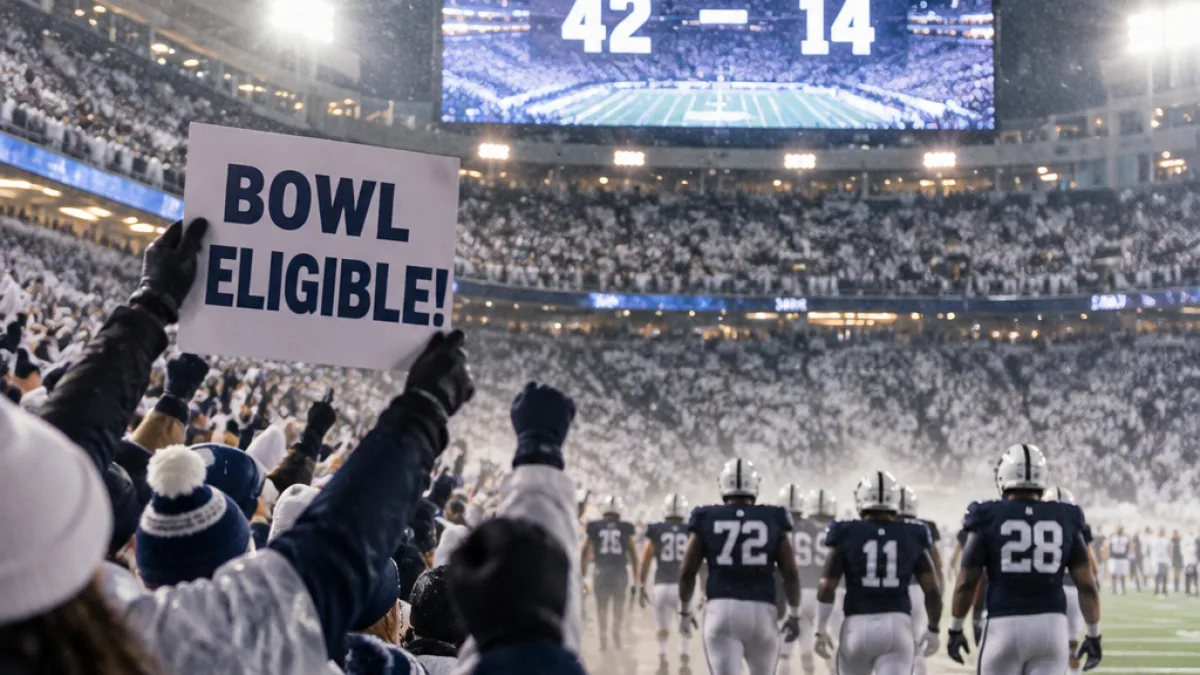
Minnesota’s football team absorbed a decisive 42-14 loss to Penn State on Saturday night at Beaver Stadium, as the Nittany Lions combined an efficient passing game, a productive rushing attack and an aggressive defensive performance to control the matchup.
The outcome was settled during a game played in difficult conditions, with rain, cold temperatures, mist and flurries affecting the atmosphere in State College. Penn State handled the setting better, building a substantial advantage before Minnesota could mount a sustained response.
For Penn State, the victory carried a clear postseason consequence. The Nittany Lions became bowl eligible with the win, adding significance to a performance that was already one-sided for much of the night. Minnesota, meanwhile, was unable to keep pace after Penn State established control early.
Becht directs a balanced attack
Quarterback Rocco Becht did not need to throw frequently to make an impact. He finished with three touchdown passes and added a rushing touchdown, giving Penn State multiple ways to finish drives without exposing the offense to major mistakes.
Becht’s performance was graded favorably in the postgame evaluations, particularly because he avoided the kind of costly errors that can give an opponent a chance to recover. Penn State also turned to Alex Manske, who threw the first touchdown of his college career.
The passing production was supported by a ground game that consistently moved the offense forward. Carson Hansen and Cam Wallace combined for 208 rushing yards on 27 carries, and Hansen added a touchdown. Hansen alone accounted for 126 yards, giving Penn State a dependable source of offense when the weather made throwing more difficult.
| Penn State performance | Result |
|---|---|
| Final score | Penn State 42, Minnesota 14 |
| Rocco Becht | Three passing touchdowns and one rushing touchdown |
| Carson Hansen | 126 rushing yards and one touchdown |
| Hansen and Cam Wallace | 208 combined rushing yards on 27 carries |
| Ben Brahmer | Two touchdown receptions |
Receivers capitalize on opportunities
Ben Brahmer was a central part of Penn State’s scoring output, catching two touchdown passes. His production gave Becht a reliable target in the red zone and helped the Nittany Lions convert their control of the game into points.
Penn State’s offense did not have to rely on one position group. The quarterback contributed through the air and on the ground, the running backs produced more than 200 yards, and the receivers turned scoring chances into touchdowns. That distribution made it difficult for Minnesota to slow the attack by focusing on a single threat.
Defense sets the tone early
The Nittany Lions’ defense was especially effective at the start of the game. The unit was described as suffocating Minnesota early, helping Penn State build its lead while the swirling weather added another challenge for the offense.
That early defensive pressure shaped the rest of the night. Once Penn State had created separation, Minnesota faced the task of trying to generate offense against a defense that had already established control. The Nittany Lions briefly allowed the game to loosen during the latter part of the third quarter and into the fourth, but the lapse did not threaten the final result.
A night with few positives for Minnesota
From Minnesota’s perspective, the 28-point margin reflected a game in which Penn State dictated the pace and field position for long stretches. The Gophers’ inability to match the Nittany Lions’ early execution left them playing from behind in wet and cold conditions.
The available postgame assessment focused primarily on Penn State’s performance rather than providing Minnesota’s individual statistics or a detailed account of its scoring drives. What is clear from the final score is that Minnesota managed two touchdowns, while Penn State reached the end zone six times.
- Penn State scored 42 points and Minnesota scored 14.
- The Nittany Lions produced a major rushing advantage through Hansen and Wallace.
- Becht accounted for four Penn State touchdowns.
- Penn State’s defense established control during the opening portion of the game.
- The win made Penn State eligible for a bowl appearance.
The result gives Penn State a postseason milestone while leaving Minnesota to assess a performance in which the opponent’s rushing attack and early defensive execution proved decisive. The Nittany Lions’ combination of production and discipline was enough to preserve the victory even after the game became less orderly late.
For Minnesota, the loss was a reminder of the margin separating the teams on this night. Penn State’s offense sustained pressure through multiple contributors, and its defense prevented the Gophers from turning the game into a competitive fourth-quarter contest. The final score reflected that imbalance: Penn State 42, Minnesota 14.