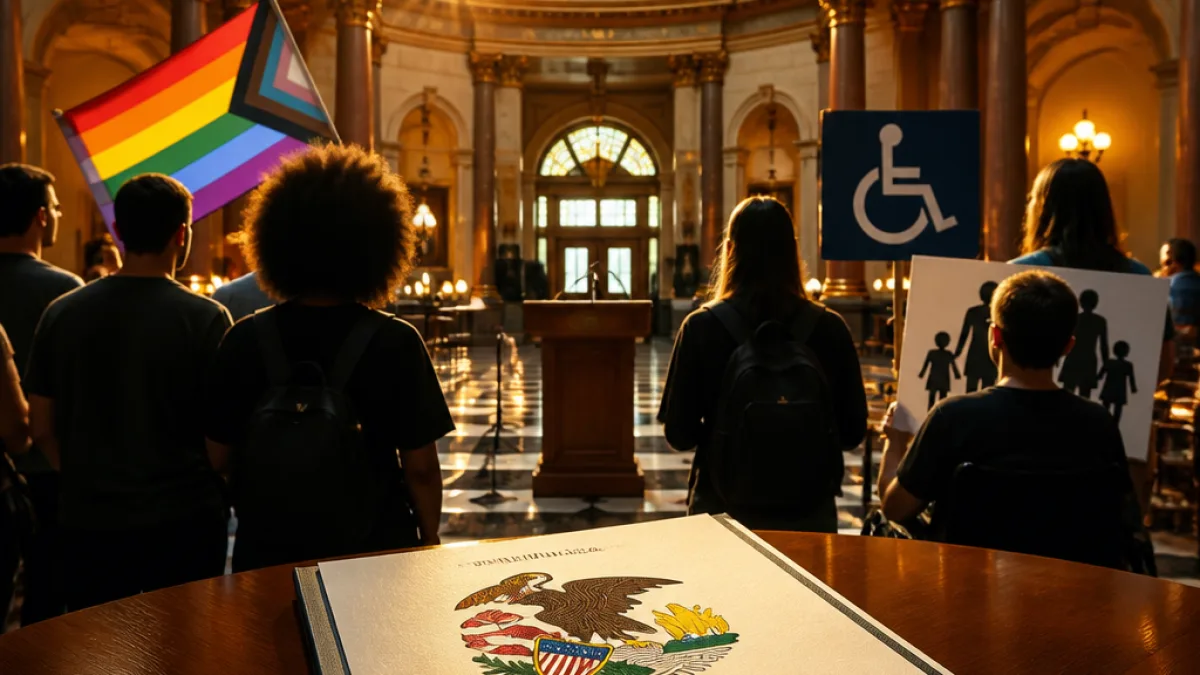
Gov. J.B. Pritzker on July 31 signed into law a bipartisan measure that expands Illinois’ ability to enforce civil-rights protections at the state level, ensuring those protections remain intact even if federal enforcement shifts.
What the new law does
The Civil Rights Safeguard Act (Senate Bill 3777) codifies disparate-impact protections under the Illinois Human Rights Act, according to a statement from the Illinois Department of Human Rights. The statute makes clear that policies and practices that are neutral on their face but result in discriminatory outcomes can be challenged under state law.
Law sponsors include state Sen. Adriane Johnson and state Rep. Justin Slaughter. The law does not create a new private right or an entirely new cause of action; rather, it broadens the scope of disparate-impact scrutiny beyond a narrower housing-focused change enacted in Public Act 103-859.
Who stands to be protected
The Illinois Department of Human Rights and advocacy groups say the expanded protections reach people affected by a wide range of practices across employment, lending, health care and education. The department called out several groups likely to benefit from the clarified standard.
- Survivors of domestic and sexual violence, who are disproportionately female.
- Black and Brown homeowners and consumers facing credit and housing barriers linked to redlining.
- Immigrants and naturalized citizens who encounter obstacles to language access.
- Disabled veterans who may experience discrimination tied to housing vouchers.
- LGBTQ+ individuals confronting sex-based discrimination.
- Students with disabilities who may face inequitable school policies.
The law is scheduled to take effect Jan. 1, 2027.
Advocates and concerns
At a press conference on Aug. 12, Cherita Ellens, president and CEO of Women Employed, described the law as a critical safeguard at a time of shifting federal priorities.
"It is a critically important measure in this moment when the federal administration is unraveling our civil rights protections every single day … and has shown they will weaponize the very agencies meant to protect us."
Ellens emphasized that discrimination often occurs subtly, through policies that appear neutral but have harmful effects. She and other advocates said the disparate-impact standard has been an important tool for addressing structural sexism and racism that can be embedded in seemingly routine practices, such as blanket requirements or screening steps that disproportionately exclude certain groups.
How this differs from previous state action
Public Act 103-859, enacted earlier, focused primarily on disparate-impact claims in housing under Article 3 of the Illinois Human Rights Act. SB 3777 extends the principle more broadly across other areas covered by the state law, enabling challenges in employment, lending, health care and education when policies produce discriminatory effects.
The Department of Human Rights framed the change as a way to preserve and strengthen state-level enforcement in the face of potential federal retrenchment. The law’s backers argue it gives state residents continued recourse when federal agencies change enforcement priorities or issue new interpretive guidance.
Practical implications and next steps
With the law set to take effect in early 2027, state agencies, employers, lenders, school districts and health-care providers will need to review policies and practices for potential disparate-impact vulnerabilities. Legal advocates and civil-rights attorneys may also begin preparing to bring claims under the clarified standard.
| Area | Example groups highlighted by IDHR |
|---|---|
| Employment | Survivors of domestic and sexual violence; persons affected by sex-based requirements |
| Housing and lending | Black and Brown homeowners and consumers; disabled veterans |
| Education | Students with disabilities |
| Health care | Individuals facing language-access barriers |
State agencies charged with enforcing the Illinois Human Rights Act are expected to issue guidance and training as the effective date approaches. Advocates say those materials will be important for educating both regulated entities and the public about how disparate-impact claims can be raised and evaluated under state law.
The measure drew bipartisan sponsorship in the General Assembly and was presented by state officials as a way to preserve civil-rights remedies at the state level even as federal enforcement priorities evolve.
More information, including the full text of the law and guidance from the Illinois Department of Human Rights, will become available as state agencies prepare for implementation ahead of Jan. 1, 2027.