Growing from a dusty downtown to a hub of agriculture and community
Photographs and records preserved by the Glendale Arizona Historical Society offer a window into the city’s early decades, showing how a small desert town transformed into a regional center for commerce and education by the early 20th century.
One of the most striking images captures downtown Glendale in 1910, when streets were unpaved and horses still had the right of way. The two-story Gillett Building, completed in 1909, stands at the southeast corner of what are now 58th Drive and Glendale Avenue. The building endured through the years and remains a local landmark.
Community life, hazards and childhood summers
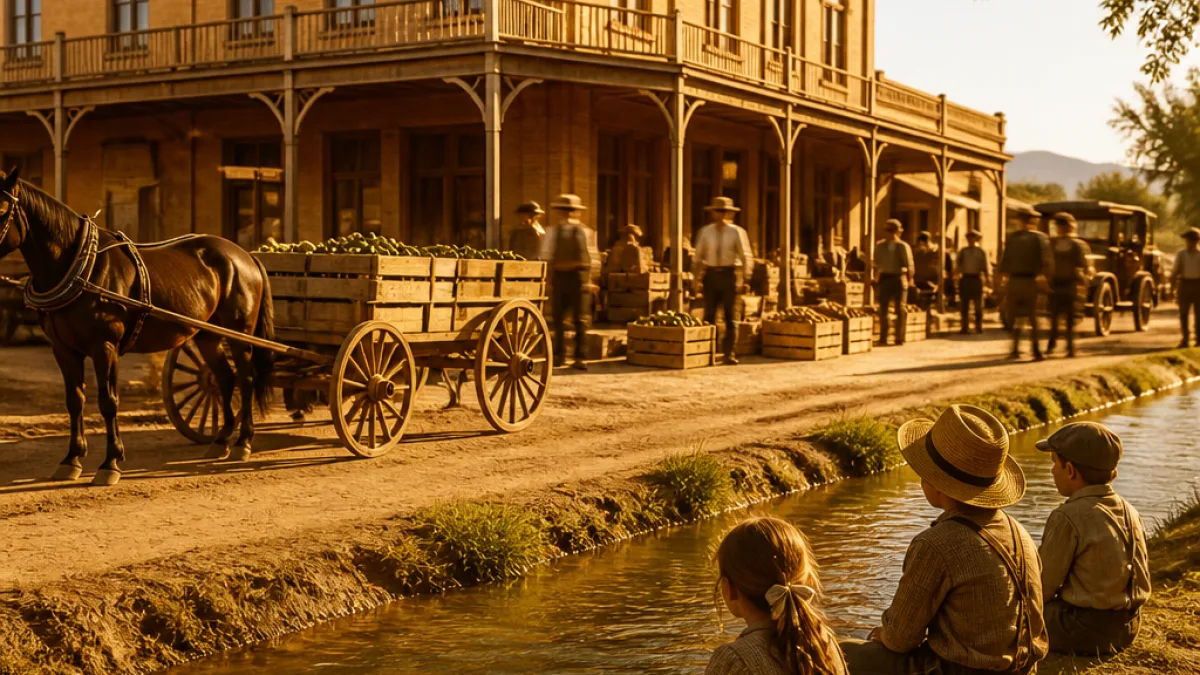
Photographs from the mid-1910s show residents cooling off in irrigation canals and ditches — common summertime recreation despite the inherent danger. One image features the Whitney boys, Forrest and Marion, splashing in Lateral 19 near their home, accompanied by three cousins from Michigan. Those images underscore how the irrigation infrastructure that supported farming also shaped daily life.
School overcrowding spurred a distinctive solution
Education became a civic priority in the early 1910s. Students paraded along Grand Avenue in 1912 under the slogan “Not room for one more,” urging voters to approve funding for additional classroom space. Voters passed a bond issue in 1913, and between 1913 and 1920 the district built an unusual complex of 36 one-room classrooms to address overcrowding. Today, one of those classrooms survives behind the Glendale Elementary School District administration building at 7301 N. 58th Ave.
“Not room for one more” — the students’ rallying cry in 1912 that helped win passage of a 1913 school bond.
From local farms to statewide shipping leader by 1920
By 1920, Glendale had developed into an important shipping point for Arizona produce. Farmers loaded fruits and vegetables into crates at a palm-frond covered shed beside the Santa Fe railroad tracks. One photograph shows crates full of cantaloupes ready for shipment. The opening of the Glendale Ice Company plant in 1912 also contributed to the city’s agricultural economy: hundreds of icebox rail cars were shipped out of Glendale annually, helping preserve perishable goods for longer transport.
- 1909 — Foundation and completion of the Gillett Building.
- 1912 — Glendale Ice Company plant begins operations.
- 1913 — Voters approve a school bond to relieve overcrowding.
- 1913–1920 — Construction of 36 one-room school classrooms.
- 1920 — Glendale ships more produce than any other Arizona city.
| Year | Event |
|---|---|
| 1909 | Gillett Building foundation and basement work; building completed later that year |
| 1912 | Glendale Ice Company plant opens |
| 1913 | School bond passed to expand classroom capacity |
| 1920 | City leads Arizona in produce shipments |
Legacy visible in today’s cityscape
These early developments — commercial buildings, community responses to overcrowded schools, irrigation-driven recreation and a thriving agricultural shipping economy — helped shape Glendale into the city residents recognize today. Historic structures such as the Gillett Building and surviving one-room classrooms link contemporary neighborhoods to the city’s formative years.
For residents, the photographs and archival notes kept by the historical society are more than nostalgia; they document civic choices and infrastructure that influenced Glendale’s growth pattern. The images also remind the community of the risks and ingenuity of earlier generations, from children swimming in canals to farmers sending cantaloupes by rail to market across the region.
The Glendale Arizona Historical Society continues to preserve and share these materials so residents and visitors can better understand the city’s early character and the developments that propelled it from a small downtown with horses on unpaved streets to a recognized agricultural and community center by 1920.