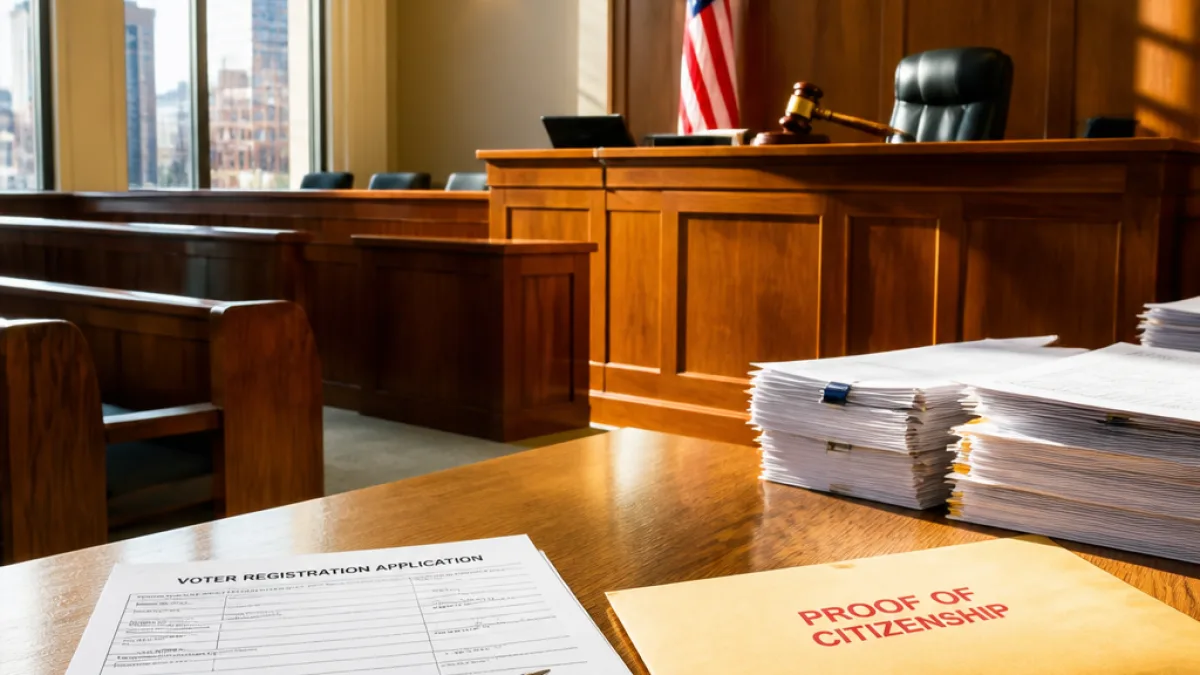
CLEVELAND — A federal judge has temporarily blocked an Ohio law that would force residents who register to vote at the Bureau of Motor Vehicles to provide documentary proof of U.S. citizenship, ruling the requirement likely violates the federal National Voter Registration Act.
Preliminary injunction halts new requirement
U.S. District Judge Solomon Oliver Jr. granted a preliminary injunction after pro-voting groups argued the provision, enacted in March 2025, imposes more than the minimum information necessary to evaluate a voter’s eligibility. The plaintiffs, including Red Wine & Blue and the Ohio Alliance for Retired Americans, sued in August 2025 seeking to block the rule.
"(A)s the rest of Ohio’s voter registration scheme demonstrates, and Defendants’ statements at the Hearing shows, election officials do not need documentary proof of citizenship to assess a voter registration applicant’s citizenship because signed attestation of citizenship is enough," Judge Oliver wrote in his decision.
The judge concluded that, without the injunction, there would be a "substantial risk of irreparable harm." The ruling prevents Ohio from implementing the documentary requirement while the litigation proceeds.
Why the case matters to Ohio voters
Nearly one-third of Ohioans register to vote through the BMV, making the agency a key access point for voter registration. Plaintiffs argued that adding documentary proof of citizenship at the BMV would create an unnecessary hurdle and likely disenfranchise people who rely on that site to register.
- Law passed: March 2025 as part of a transportation appropriations bill.
- Litigation started: Plaintiffs sued in August 2025.
- Preliminary injunction: Granted by Judge Solomon Oliver Jr.; blocks enforcement while the case continues.
The ruling turns on a provision of the NVRA that allows states to request only the minimum information needed "to enable state election officials to assess the eligibility of the applicant." Judge Oliver found the documentary requirement likely exceeds that minimum.
Background and legal posture
Ohio's Republican-controlled legislature inserted the citizenship documentation language into its biannual transportation appropriations bill in March 2025. Opponents said lawmakers had effectively added new voting restrictions by attaching the requirement to a larger budget measure.
In June, Judge Oliver rejected an attempt by the U.S. Department of Justice under the Trump administration to file a brief defending the Ohio law. The judge described the proposed filing as redundant, misaligned with the claims in the case and too late to be helpful ahead of a hearing.
What the injunction does — and doesn’t — do
The preliminary injunction is a temporary court order that prevents the state from enforcing the disputed provision while the litigation moves forward. It is not a final ruling on the merits. The plaintiffs will still need to convince the court at trial or on summary judgment that the law violates the NVRA.
| Item | Detail |
|---|---|
| Where registration affected | Bureau of Motor Vehicles |
| Portion of registrants who use BMV | Nearly one-third of Ohio registrants |
| Court action | Preliminary injunction granted |
For Ohio voters, the injunction means that BMV-based registrations will continue under the existing process, which relies on a signed attestation of citizenship rather than documentary proof.
Next steps in the case
The litigation will continue in federal court as plaintiffs pursue permanent relief. The state may choose to appeal the preliminary injunction or to defend the law in the district court through dispositive motions and, if necessary, trial. Any further appeals would move the dispute through the federal appellate system and could ultimately reach the U.S. Supreme Court depending on the outcome and legal issues at stake.
Meanwhile, election officials and voting advocates will be watching how the case proceeds because it touches on how easily Ohio residents can register to vote. The judge’s decision underscores a broader legal question being litigated nationwide: how far states may go in imposing documentary requirements on voter registration, particularly where federal statutes set minimum standards.
WE NEWS will continue to follow developments in the case and report on any changes that could affect voter registration procedures at Ohio BMVs and elsewhere.