Columbus — A new bill circulating in the Ohio Senate seeks to extend the reach of the 2025 higher education law known as S.B. 1, by embedding into statute not just course requirements but who at public colleges may decide which primary texts students must read. Legal scholars and university faculty say the change, if enacted, would push state authority deeper into classroom decision-making and could provoke fresh court challenges over academic freedom.
What the law says and what the new bill would add
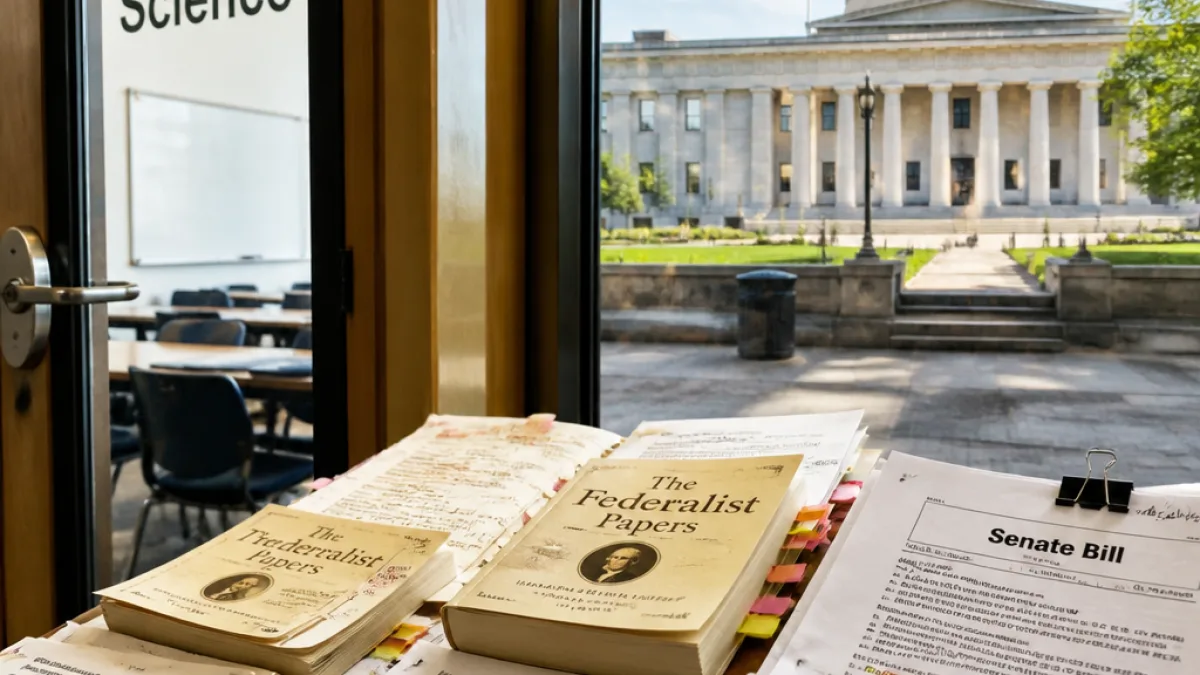
The 42-page S.B. 1, enacted in the spring of 2025, already established new statewide requirements for curricula in public institutions. Among its provisions was a mandate that newly created civics courses include at least five essays read in their entirety from the Federalist Papers. That requirement would appear to comply with a line of precedent allowing states to set curricular programs while not dictating specific viewpoints professors must adopt.
"liberties in the areas of academic freedom and political expression" were "areas in which government should be extremely reticent to tread."
The language quoted above comes from the 1957 U.S. Supreme Court decision in Sweezy v. New Hampshire, a case frequently cited by free speech and academic freedom advocates. Supporters of the new Senate bill, however, would go further than S.B. 1 by explicitly granting government-affiliated administrators the power to select which Federalist essays are assigned.
Where the friction lies
Under the current statute, S.B. 1 states the mandated essays "shall be selected by the department chair." Critics say that phrasing is consequential because chairs and deans of public universities are government functionaries answerable to state-appointed boards and ultimately to the state itself. Those critics argue placing the selection power in statute, rather than preserving professor-level discretion, blurs the traditional separation between the state's role in setting educational goals and faculty authority over how course material is taught.
Defenders of the bill argue that a department chair selecting readings is a reasonable way to ensure consistency across a statewide civics requirement. They point to recent federal appellate rulings, such as Pernell v. Florida, in which the U.S. Court of Appeals for the 11th Circuit reaffirmed that governments may prescribe programs and curricula though they may not force particular viewpoints.
Potential legal and classroom implications
Legal scholars say the question is whether specifying who at an institution chooses assigned readings amounts to viewpoint regulation in practice. Because different Federalist Papers emphasize distinct political arguments and priorities, which five essays are chosen can shape the ideological framing of the course.
Faculty governance advocates also warn of a broader precedent: codifying administrative decision-making about classroom content could encourage further legislative detail about syllabi, texts and teaching approaches in other subjects.
- Faculty autonomy: Professors typically determine course content and classroom emphasis within program requirements.
- State oversight: Legislatures can lawfully define program requirements, such as mandatory course topics.
- Legal tension: Courts have struggled to draw a line between permissible program mandates and impermissible viewpoint control.
| Provision | Detail |
|---|---|
| Number of required Federalist essays | 5 |
| Total Federalist Papers in circulation | 85 |
| Where selection authority resides under S.B. 1 | Department chair |
University administrators confronted with the law must balance compliance with protecting faculty academic freedom. Some department chairs, faculty members and the administrations that employ them could face pressure from trustees or state officials over which essays are highlighted. That pressure, civil liberties advocates say, risks transforming academic judgment into a matter of political oversight.
What's next
The proposed Senate measure has not yet completed committee action. If it advances, it would likely draw testimony from university leaders, faculty senates, constitutional law scholars and civil rights groups. Any final enactment could prompt litigation testing whether detailed statutory limits on who selects assigned readings cross constitutional lines.
For Ohio colleges and the students who attend them, the debate is immediately practical: who decides what text shapes a classroom discussion can influence what arguments students encounter and how they learn to assess competing ideas. That is precisely why observers say the stakes extend beyond academic administration to the broader civic mission of higher education.
Reporting from Columbus, Damon Carver.